


Today’s B2B buyers are decisive and impatient. When shopping on a B2B marketplace they want B2C like experiences that are fast, intuitive, and friction-free.
They expect clean navigation, familiar flows, and experiences that just make sense, especially when dealing with bulk orders, repeat purchases, and negotiated pricing. When the interface gets in the way be it a whole website or their B2B marketplace app, trust erodes fast.
This is where design starts doing real work. Not flashy visuals, but smarter structure. Clear information hierarchy. Interfaces that adapt to buyer intent. AI is quietly improving discovery, search, and product presentation so buyers reach decisions faster without feeling guided or sold to.
So what separates B2B marketplaces that scale from those that stall?
Design upgrades that remove hesitation at every step. Multilingual experiences that feel native. Checkout flows that feel like real-world buying. Search that understands intent, not just keywords. Product pages that answer questions before buyers ask them.
Let’s break down the design upgrades that will define high-performing B2B marketplaces in 2026.
Table of Contents
B2B Marketplace: Essential Design Upgrades in 2026
The future of B2B ecommerce lies in smarter, user-centric design upgrades. In 2026, brands can no longer rely on functional interfaces alone, they must reimagine their B2B marketplace apps to support self-serve buying, personalised journeys, and intelligent experiences. Thoughtful design upgrades now play a critical role in improving efficiency, simplifying complex buying workflows, and building long-term client relationships.
Here are a few B2B buying habits to take note of:
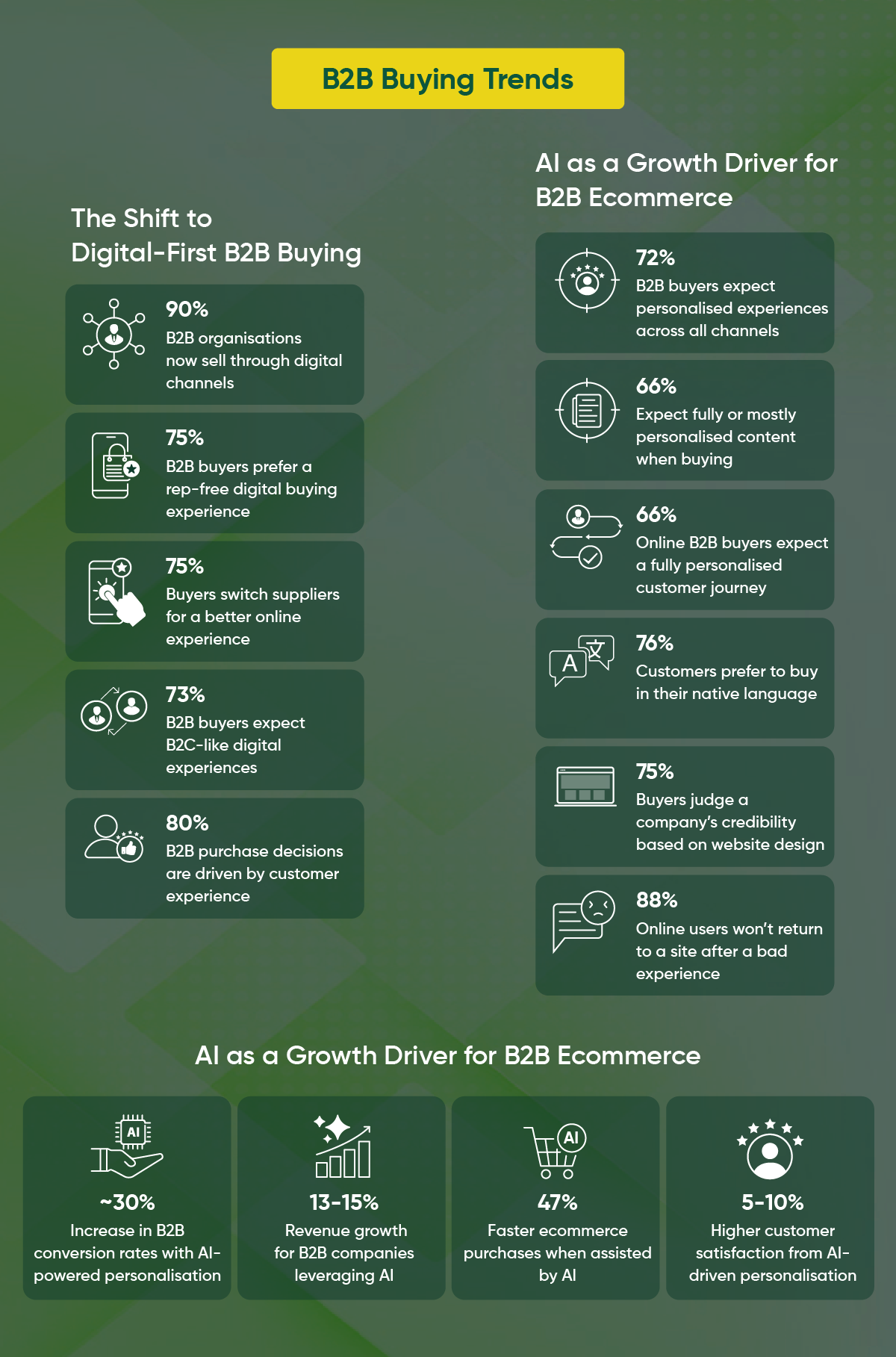
The Shift to Digital-First B2B Buying
- 90%+ of B2B organisations now sell through digital channels (McKinsey)
- 75% of B2B buyers prefer a rep-free digital buying experience (Gartner)
- 75% of buyers switch suppliers for a better online experience ( Procurement Magazine)
- 73% of B2B buyers expect B2C-like digital experiences (Hushly)
- 80% of B2B purchase decisions are driven by customer experience (Gartner)
Rising Expectations for Personalised Experiences
- 72% of B2B buyers expect personalised experiences across all channels (McKinsey)
- 66% expect fully or mostly personalised content when buying (Marketing Charts)
- 66% of online B2B buyers expect a fully personalised customer journey (Marketing Charts)
- 76% of customers prefer to buy in their native language (CSA Research)
- 75% of buyers judge a company’s credibility based on website design ( Made for Web)
- 88% of online users won’t return to a site after a bad experience ( Forbes)
AI as a Growth Driver for B2B Ecommerce
- ~30% increase in B2B conversion rates with AI-powered personalisation (McKinsey)
- 13-15% revenue growth for B2B companies leveraging AI ( Persana AI)
- 47% faster ecommerce purchases when assisted by AI (Hello Rep)
- 5-10% higher customer satisfaction from AI-driven personalisation (Bloom Reach)
The evolution of B2B marketplace design reflects a broader shift toward experience-led, intelligent, and buyer-driven enterprise commerce. As buying journeys become more digital, personalised, and automation-led, marketplace design must adapt to reduce friction and support faster, more confident decision-making.
By aligning design upgrades with modern B2B buying behaviours, brands can strengthen credibility, improve operational efficiency, and create marketplaces that drive sustained growth in an increasingly competitive B2B ecommerce landscape.
These shifts in buyer behaviour make one thing clear: B2B marketplace design can no longer be static or generic. To meet modern expectations and remove friction across complex buying journeys, marketplaces must evolve with design upgrades that are practical, scalable, and intelligence-driven.
This brings us to the five essential design upgrades that will define high-performing B2B marketplaces in 2026.
5 Essential Design Upgrades for B2B Marketplace in 2026
B2B marketplaces are evolving rapidly to meet the demands of modern enterprises. In 2026, the focus will shift towards designs that simplify complex B2B buying processes while fostering seamless interactions between buyers and sellers. A forward-thinking approach will be crucial to addressing diverse client needs and staying ahead in a competitive landscape.
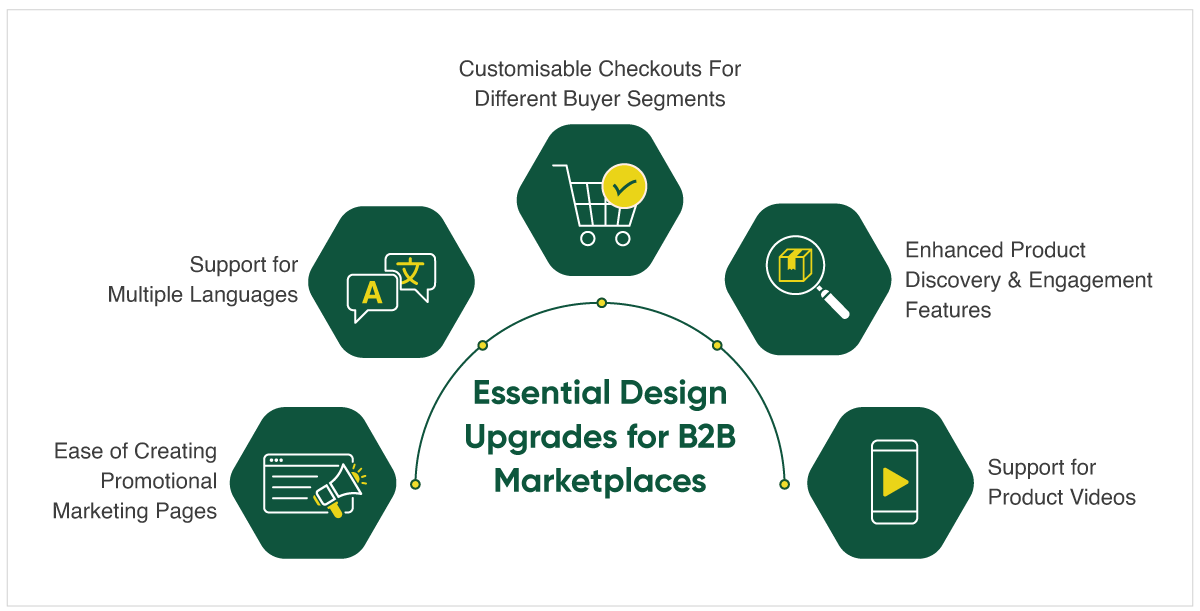
Here are 5 essential design upgrades you need to adopt in 2026:
1. Support for Multiple Languages in Websites and Apps
A B2B marketplace planning to offer a personalised shopping experience while catering to diverse audiences should transcend language barriers for seamless communication. Offering multi-language support on your website and app can significantly improve user engagement and foster trust among clients from different regions. Adding these features empowers your buyers and sellers to interact in their preferred languages, making navigation, catalogue browsing, and transactions more intuitive. Support for multiple languages is vital for businesses aiming to expand globally, enabling you to interact with your audience in their native language.
StoreHippo ecommerce solutions come with a gamut of global features that help you create a seamless shopping experience for your customers and engage with them in their native language. StoreHippo B2B ecommerce solutions offer 100+ languages (including right-to-left languages like Arabic and Hebrew) to help local and global customers shop in their native language. You can also offer multilingual support in B2B apps, helping your customers shop on the go. With StoreHippo’s hassle-free automatic translation control, you can create multilingual websites and apps in just a few clicks. You can choose between automatic and manual modes of translation or selectively override automatic translations. You can also show different languages based on the user’s geography or their device.
Additionally, StoreHippo enables enterprises to create custom agentic AI chat interfaces that support multilingual buyer interactions. From product discovery to order placement and post-purchase queries, these AI-driven conversational interfaces assist buyers throughout the journey, allowing your B2B marketplace to engage customers in their preferred language while delivering consistent, scalable support without increasing operational effort.
2. Ease of Creating Promotional Marketing Pages
Creating promotional marketing pages plays a critical role in driving engagement and boosting sales in a B2B marketplace. These pages are often required for time-sensitive campaigns, new product launches, or region-specific offers. With ease of customization, you can respond swiftly to market demands and trends, giving them a competitive edge. Well-designed marketing pages not only capture attention but also enhance the overall shopping experience, keeping your platform visually appealing and functional. When you create customizable templates and unique design options, you can tailor your messages and resonate better with different audience segments.
StoreHippo’s decoupled headless architecture helps build a successful business-to-business marketplace by giving enterprises the flexibility to create, customise, and deploy promotional marketing pages quickly, without impacting core operations or development cycles. StoreHippo is a SaaS-based fully hosted and managed platform, built on MACH architecture that gives inherent flexibility and control to build tailor-made solutions for the unique needs of your B2B marketplace. You can easily create dynamic marketing pages for your clients that pull information from your database as and when required. With StoreHippo, you can create pages within minutes and promote products specific to a geography, user segment, time, or device.
StoreHippo’s AI-powered cataloguing helps automatically generate product titles, descriptions, and categories for newly launched products across buyer segments and regions, ensuring marketing pages stay relevant, consistent, and conversion-focused.
StoreHippo offers a built-in discount engine to help you offer multi level discounts on your B2B marketplace like product-based, brand-based, order column-based, etc. StoreHippo ecommerce solutions come with a host of B2B-specific features like RFQ, multi pricing, tiered pricing, MOQ, etc.
3. Customizable Customisable checkouts For Different Buyer Segments
A personalized checkout experience is crucial for meeting the diverse needs of B2B buyers. Customizable checkout processes as a part of your B2B marketplace design allow you to offer region-specific payment methods, integrate credit wallet features, and streamline order workflows for different client groups. For example, localisedlocalized payment options can simplify transactions for international buyers, while credit wallets facilitate faster repeat purchases for regular clients. This adaptability ensures that the checkout process is both efficient and convenient, reducing cart abandonment and fostering long-term client relationships.
StoreHippo helps you customisecustomize your checkout process for different customers with its 60+ pre-integrated domestic and international payment gateways. You can integrate with more than one payment gateway to create a frictionless and flexible payment process on your B2B marketplace app and websites. Your customers can choose to pay from their preferred payment process like COD, net banking, card payments, B2B store wallets, etc. With StoreHippo you can create a marketplace website that supports payments in multiple currencies and helps grow your brand in global markets as well. You can also choose between automatic location-based and automatic store-based currency switches, so your customers are not burdened with additional exchange rate charges. For example, an IP address exploring your sub-store in Australia will see your rates in AUD or your customers can manually choose the designated store with their preferred currency. StoreHippo’s enables B2B enterprises to create custom AI interfaces where the complete buyer journey including checkout can be completed from a single chat interface.
4. Enhanced Product Discovery and Engagement Features
Efficient product discovery is vital when you plan to create an engaging B2B marketplace design, where buyers often deal with large and complex cataloguescatalogs. Advanced search and filtering options enable users to quickly find the products they need, while features like wishlists, ratings and reviews make the process more engaging. Buyers can save their preferences for future purchases, and ratings and reviews help build confidence in product quality. These features not only improve navigation but also encourage buyers to spend more time on the platform. Enhanced discovery tools combined with an engaging interface create a seamless experience, setting your marketplace apart from competitors.
You can build a successful B2B marketplace with StoreHippo ecommerce solutions that come with built-in faceted search and advanced filter options. You can use product bundling, upselling, cross-selling, and various other built-in features to boost orders and make buying easy on B2B online marketplaces. StoreHippo also comes with a well-designed site navigation, a multi-level product hierarchical category, and a wishlist feature to help its B2B customers enjoy a seamless shopping experience. Built on API-based integrations, StoreHippo also helps you engage better with your B2B customers by sending real-time notifications and nudging buyers toward exploring more products.
And on top of all these, StoreHippo enhances product discovery with AI-powered intent-based search and behaviour-driven recommendations that go beyond basic keyword matching, enabling buyers to find the most relevant products quickly, even across large and complex B2B catalogues. By understanding buyer context, past interactions, and purchasing patterns, AI helps reduce search friction, improve navigation, and create a more intuitive discovery experience that supports faster decision-making and repeat purchases.
5. Support for Product Videos
Providing product videos is an effective way to improve decision-making in a B2B marketplace app and website. Videos offer detailed insights into product features, specifications, and applications, helping buyers understand the value of their purchase. Alongside high-quality images, videos provide a comprehensive view of the product, reducing uncertainty and return rates. When paired with tiered pricing options and RFQ tools, multimedia content ensures a transparent and informed buying process. This combination builds trust and loyalty, creating a marketplace where buyers feel confident and valued, ultimately driving long-term business growth.
StoreHippo ecommerce solutions help you build comprehensive product pages with its advanced product management system. When you plan to create an engaging B2B marketplace design, StoreHippo helps you create an advanced look and feel for your product pages by adding multiple product images and videos to engage better with your customers.
Additionally, StoreHippo offers an advanced AI image enhancement tool, Magic Edit, that transforms raw product images into market-ready visuals within seconds. By automatically improving image quality and consistency, Magic Edit enhances catalogue presentation and buyer confidence, without requiring additional design resources.
Conclusion
As we step into 2026, the success of a B2B marketplace will be defined by how seamlessly design and intelligence work together. Modern, user-centric design upgrades are no longer optional, they are essential to reducing buying friction, improving engagement, and building long-term trust with B2B buyers.
What truly elevates these design upgrades is the integration of AI across the buying journey. From multilingual agentic AI chat interfaces and AI-powered cataloguing to intent-based search, smarter checkout flows, and automated image enhancement, AI transforms marketplace design from static interfaces into adaptive, conversion-focused experiences.
With StoreHippo’s AI-powered B2B ecommerce solutions, B2B brands can future-proof their marketplaces through 300+ enterprise-grade features, inherent flexibility, headless architecture, and native AI capabilities built directly into core operations. This allows enterprises to design smarter, sell faster, and grow sustainably in an increasingly competitive B2B ecommerce landscape.
Ready to upgrade your B2B marketplace design with AI-driven intelligence?
Explore StoreHippo by booking your free demo now.
FAQs: B2B Marketplace Design in 2026
1. Why do B2B marketplaces need design upgrades more frequently than before?
Because buyer behaviour is changing faster than enterprise systems. B2B buyers now compare your marketplace experience not just with competitors, but with B2C apps they use daily. Regular design upgrades help B2B marketplaces adapt to new buying patterns, devices, and interaction models without disrupting core operations.
StoreHippo’s no-code Theme Designer lets B2B marketplaces update layouts, components, and visuals quickly, keeping the experience aligned with evolving buyer expectations without developer dependency. Brands can refresh layouts, colours, components and visuals in minutes and can leverage composable design blocks, AI-editor Magic Edit and easy theme switching to keep their buyers engaged with consistently modern, high-performance experiences without operational disruption.
2. How does B2B marketplace design impact long sales cycles and repeat purchases?
Thoughtful B2B marketplace design reduces cognitive load during complex buying journeys. Clear layouts, saved preferences, quick reordering, and contextual information make repeat buying easier, helping enterprises shorten decision cycles and retain long-term buyers without relying heavily on sales teams.
StoreHippo’s Theme Designer helps enterprises optimise long B2B buying journeys by enabling quick design tweaks, prominent CTAs, dynamic forms, and multilingual layouts, making self-service smoother, repeat purchases easier, and sales cycles shorter without heavy sales intervention.
3. What role does mobile-first design play in B2B marketplace apps?
Mobile-first design is critical in B2B marketplace apps as buyers increasingly research, reorder, and approve purchases on the go. It ensures consistent experiences across devices and removes friction from high-frequency, repeat purchasing.
StoreHippo’s Theme Designer ensures mobile-optimised layouts, touch-friendly components, and consistent experiences across devices, enabling faster decisions and higher repeat engagement.
4. Can design improvements reduce operational dependency on sales representatives?
Yes. A well-designed B2B marketplace reduces reliance on sales teams by enabling buyers to self-discove. When buyers can easily discover products, compare options, understand pricing structures, and complete purchases independently, sales teams can focus on high-value relationships instead of routine order processing.
StoreHippo’s Theme Designer makes it easy to highlight key actions, information, and workflows so buyers can complete purchases independently.
5. What design considerations matter most for scaling B2B marketplaces globally?
Scalable B2B marketplace design must accommodate regional buying behaviours, currencies, compliance needs, and content variations without fragmenting the platform. Flexible layouts and modular design systems allow enterprises to expand globally while maintaining a consistent core experience.
StoreHippo’s flexible design framework supports localisation via multilingual design support, multi currency pricing display, and region-specific content variations, enabling global scale without duplicating platforms or designs.
6. How does AI influence B2B marketplace design beyond search and recommendations?
AI impacts layout decisions, content prioritisation, and interaction flows. Over time, AI-driven insights help marketplaces adapt interfaces based on buyer behaviour, usage patterns, and intent signals, making design more responsive without constant manual redesign.
StoreHippo integrates AI directly into design workflows through tools like AI Image Enhancer (Magic Edit) and AI-assisted catalogue optimisation, ensuring storefronts continuously improve engagement and conversion without manual redesign.
7. What should enterprises evaluate before redesigning their B2B marketplace?
Instead of focusing only on visuals, enterprises should evaluate friction points in discovery, checkout, and repeat ordering. Understanding where buyers hesitate or drop off helps prioritise design upgrades that improve outcomes, not just aesthetics.
StoreHippo makes it easy to iteratively redesign high-friction sections like discovery and checkout, allowing enterprises to test and refine layouts based on real buyer behaviour.