


Want to migrate your D2C ecommerce brand from Shopify? You’re not alone.
As D2C ecommerce continues to grow rapidly, many brands are realising that plugin-based platforms can limit their growth in the long term. When your brand expands across markets, you need solutions for localisation, scalability, and integrations, areas where Shopify may have limitations for large enterprises. That’s when exploring a more robust Shopify alternative becomes critical.
But choosing a new enterprise ecommerce platform isn’t just about switching systems. You need a platform that supports long-term growth, delivers personalised customer experiences, handles mobile-first commerce, and provides AI-powered tools to automate and optimise operations.
Before diving into the 10 FAQs to evaluate Shopify alternatives for your D2C ecommerce brand, let’s look at how D2C ecommerce is evolving and why these changes make platform choice more important than ever.
Table of Contents
- D2C Ecommerce Growth Insights and Emerging Trends
- 10 FAQs to Help D2C Ecommerce Brands Choose the Right Shopify Alternative
- 1. What are the 5 unmissable indicators that signal it’s time for a D2C brand to migrate to a more scalable Shopify alternative?
- 2. What core capabilities should a D2C ecommerce platform offer to sustain long-term growth for a rapidly scaling brand?
- 3. Why is it important to consider an AI-powered e-commerce platform when searching Shopify alternatives for growing D2C brands?
- 4. Why is mobile-first omnichannel architecture critical when evaluating Shopify alternatives for modern D2C ecommerce businesses?
- 5. What scalability challenges should brands consider when choosing between Shopify and an alternative enterprise ecommerce platform?
- 6. What platform capabilities should D2C brands look for when scaling from a single brand store to multi-store or global ecommerce operations?
- 7. Why is it important to look for built-in marketing and personalisation tools while choosing Shopify alternatives for D2C brands?
- 8. How should D2C brands evaluate integrations, APIs, and ecosystem capabilities in a Shopify alternative?
- 9. What technical and business factors should D2C brands evaluate before planning migration to a Shopify alternative for long-term?
- 10. What key factors help D2C brands determine if a Shopify alternative can support their next phase of ecommerce growth?
- Conclusion
D2C Ecommerce Growth Insights and Emerging Trends
D2C ecommerce is evolving rapidly, driven by changing consumer expectations, technology adoption, and global market opportunities. Understanding these trends is key for brands looking to scale beyond Shopify and choose a future-ready ecommerce platform.
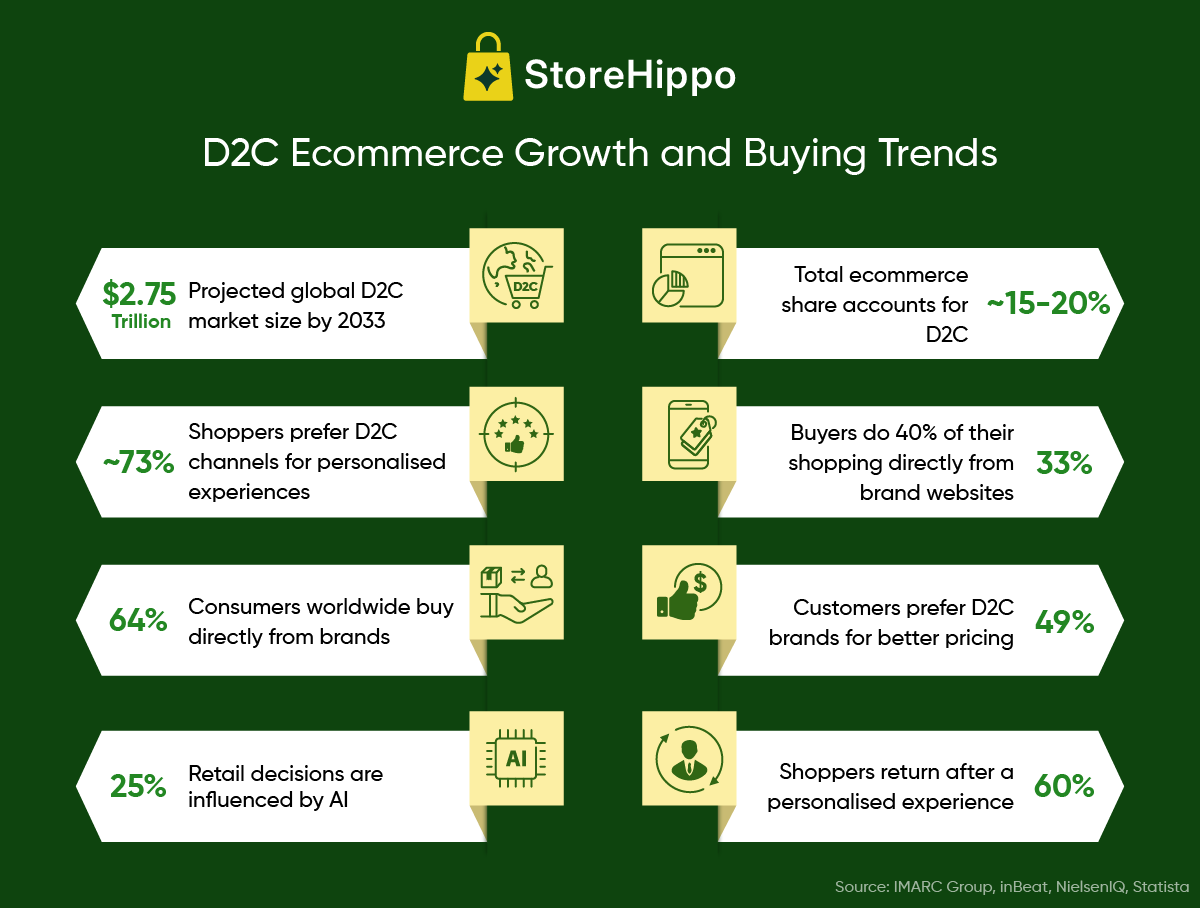
- $2.75 Trillion is the projected global D2C market size by 2033
- ~15-20% of the total ecommerce share accounts for D2C
- ~73% of shoppers prefer D2C channels for personalised experiences
- 33% of buyers do 40% of their shopping directly from brand websites
- 64% of consumers worldwide buy directly from brands
- 49% of customers prefer D2C brands for better pricing
- 25% of retail decisions are influenced by AI
- 60% of shoppers return after a personalised experience
Source: IMARC Group, inBeat, NielsenIQ, Statista
Together, these trends show that growth in D2C ecommerce is no longer just about reach, it’s about relevance, consistency, and experience. For D2C brands, meeting rising customer expectations is now the baseline for long-term success.
These shifts make it clear that choosing the right ecommerce platform is more important than ever. To help D2C brands navigate this decision, here are the 10 most important questions to ask when evaluating Shopify alternatives.
10 FAQs to Help D2C Ecommerce Brands Choose the Right Shopify Alternative
Here are the 10 must-ask questions from Shopify alternative platforms for D2C brands:
1. What are the 5 unmissable indicators that signal it’s time for a D2C brand to migrate to a more scalable Shopify alternative?
D2C brands should consider moving from Shopify when platform limitations start slowing down growth and increasing operational complexity. As businesses scale, these constraints become more visible across performance, flexibility, and cost.
Some key indicators that it’s time to evaluate Shopify alternatives include:
- Frequent need for third-party apps to add essential features
- Difficulty managing large product catalogues and handling high traffic volumes
- Limited capabilities for multi-language, multi-currency, and region-specific selling, forcing an app debt
- Challenges in running B2B and D2C models on a single platform
- Rising costs due to plan upgrades and multiple app subscriptions
These challenges signal the need for a more scalable, flexible, and cost-efficient ecommerce solution.
StoreHippo emerges as a powerful Shopify alternative, built on a headless and cloud-native architecture designed for enterprise-grade performance. With 300+ built-in features, it enables D2C brands to manage and scale their operations seamlessly without relying heavily on external tools.
It offers native support for multi-store, multilingual, and multi-currency commerce, along with advanced catalogue and order management tools. Additionally, StoreHippo is designed to support both B2B and B2C business models on a single platform, giving brands the flexibility to diversify and expand.
With 150+ pre-integrations across payments, logistics, ERP, accounting, and marketing tools, along with 350+ APIs for custom connectivity, StoreHippo significantly reduces dependency on third-party apps. This not only lowers costs but also creates a more unified and efficient ecommerce ecosystem, making it an ideal choice for D2C brands ready to scale beyond Shopify’s limitations.
2. What core capabilities should a D2C ecommerce platform offer to sustain long-term growth for a rapidly scaling brand?
When selecting the best ecommerce platform, D2C brands should prioritise future-ready capabilities that support long-term growth, flexibility, and rapid innovation. The right enterprise ecommerce platform should not just meet current needs, it should evolve with the business.
Key capabilities to evaluate include:
- Scalable infrastructure to handle high traffic and growing demand
- Advance customisation options for unique brand experiences
- AI-driven capabilities to enable faster, smarter operations and support
- Omnichannel commerce to engage customers across multiple channels
- Strong integration capabilities to connect seamlessly with existing systems
- Native support for multiple business models like B2B, B2C, and hyperlocal commerce
- Built-in global commerce features such as multi-currency, multilingual support, and localisation
D2C brands should choose a Shopify alternative platform that enables them to expand into new markets, channels, and business models without the need for repeated migrations or heavy technical rework.
StoreHippo is built on a MACH-based architecture (Microservices, API-first, Cloud-native, Headless), enabling unmatched scalability and flexibility. It empowers brands with seamless integrations, rapid customisation, and the agility to innovate without constraints.
With built-in support for multi-store, multi-currency, and omnichannel commerce, StoreHippo ensures that D2C brands can scale effortlessly, whether expanding across India or entering global markets without facing operational limitations.
3. Why is it important to consider an AI-powered e-commerce platform when searching Shopify alternatives for growing D2C brands?
We are in the era of AI, and brands that fail to implement it into their growth strategy risk falling behind. In an already highly competitive ecommerce landscape, choosing an enterprise platform without AI at its core not only increases operational overhead but also limits the ability to deliver personalised customer experiences at scale.
When evaluating platforms, D2C brands should look for:
- AI-powered product recommendations and intelligent discovery
- Automated cataloguing, tagging, and content generation
- AI-driven search with intent and context understanding
- Image optimisation and visual enhancement tools
- Agentic AI chatbots for assisted and conversational buying journeys
These AI capabilities help brands improve conversions, increase average order value, and deliver highly engaging, personalised shopping experiences.
StoreHippo is one of the best AI-powered e-commerce platforms, offering built-in AI tools to automate operations, enhance product discovery, and deliver personalised shopping experiences for enterprises. Its AI-powered cataloguing helps businesses create engaging product titles and descriptions, while automating product tagging, categorisation, and attribute mapping.
StoreHippo also offers an advanced AI image editing tool, Magic Edit, which helps generate stunning product visuals from raw images by clearing backgrounds and adjusting aspect ratios. Its AI semantic search delivers highly accurate results by analysing buyer intent and context, while AI recommendations suggest relevant products to improve conversions.
Additionally, StoreHippo enables enterprises to build custom AI chatbots that can be voice-enabled and multilingual, assisting buyers throughout their purchasing journey. These AI tools make StoreHippo one of the most advanced Shopify alternatives for AI-driven ecommerce growth.
4. Why is mobile-first omnichannel architecture critical when evaluating Shopify alternatives for modern D2C ecommerce businesses?
With mobile commerce driving a significant share of D2C sales, especially in emerging markets, brands must prioritise platforms built with a mobile-first and omnichannel approach. A fragmented experience across devices and channels can lead to lost conversions and inconsistent brand interactions.
When evaluating Shopify alternatives, D2C brands should look for:
- Mobile-optimised storefronts for seamless browsing and checkout
- Built-in capabilities to create native Android and iOS apps
- Progressive Web App (PWA) support for app-like experiences
- Unified omnichannel commerce across web, mobile, and social channels
- Consistent user experience across all customer touchpoints
These capabilities ensure that brands can engage customers effectively, regardless of how and where they choose to interact.
StoreHippo’s ecommerce solution is built on a mobile-first architecture and offers a built-in mobile app builder. Enterprise brands can create fully functional Android and iOS apps directly from the admin dashboard, at no additional cost and without any coding expertise.
With StoreHippo, brands can also launch Progressive Web App (PWA) stores that deliver app-like experiences even on entry-level devices and in low-connectivity areas. Additionally, StoreHippo offers built-in apps for admins, vendors, and custom delivery boy apps, enabling all users to manage their operations efficiently on the go. Together, these features ensure a seamless and engaging mobile experience for both businesses and their customers.
5. What scalability challenges should brands consider when choosing between Shopify and an alternative enterprise ecommerce platform?
As D2C brands grow, platform scalability becomes a non-negotiable factor when evaluating Shopify alternatives. What works at an early stage often starts to break under pressure as operations expand and customer demand increases.
Common scalability challenges D2C brands face include:
- Handling traffic spikes during high-volume sales campaigns
- Managing large and complex product catalogues
- Expanding into multiple geographies and markets
- Supporting increasingly complex business workflows
- Maintaining consistent performance during rapid growth phases
To overcome these challenges, brands need a platform that is built for scale from the ground up, not one that relies on patches, plugins, or constant technical intervention.
StoreHippo addresses these needs with its cloud-native infrastructure and API-driven architecture, enabling seamless scalability across all business functions. With 300+ APIs, brands can easily extend capabilities, integrate new workflows, and adapt to evolving business requirements, without compromising speed or performance.
This makes StoreHippo a dependable and future-ready Shopify alternative for D2C brands aiming for sustained, enterprise-level ecommerce growth.
6. What platform capabilities should D2C brands look for when scaling from a single brand store to multi-store or global ecommerce operations?
For D2C brands planning multistore setups or global expansion, it is essential to evaluate whether the ecommerce platform comes with built-in multi-store and cross-border commerce capabilities. Without these, scaling across regions can quickly become complex, costly, and heavily dependent on third-party plugins.
When assessing Shopify alternatives, D2C brands should prioritise features such as:
- Centralised multi-store management from a single admin
- Multi-currency, multilingual, and localisation support
- Region-wise pricing and catalogue customisation
- Integrated logistics partners for global fulfilment
- Multiple international payment options with automated tax and invoicing compliance
The best ecommerce platform for global growth should offer a unified, scalable ecosystem, one that minimises manual effort, reduces technical dependencies, and eliminates the need for multiple plugins.
StoreHippo enables seamless global expansion with its built-in multi-store architecture, enabling brands to create and manage multiple location-based storefronts from a single dashboard. Each sub-store can have its own design, catalogue, pricing, discounts, and language tailored to specific regional audiences.
In addition, StoreHippo offers robust global commerce capabilities, including multi-currency and multilingual support, advanced tax logic, and region-wise pricing controls. With pre-integrated international payment gateways and logistics partners, brands can streamline cross-border operations and deliver consistent customer experiences across markets.
This makes StoreHippo a powerful choice for D2C brands looking to scale globally without the operational complexity of managing multiple systems.
7. Why is it important to look for built-in marketing and personalisation tools while choosing Shopify alternatives for D2C brands?
To reach and engage a wider audience, D2C brands need more than just external tools, they need an ecommerce platform with built-in marketing and personalisation capabilities. As brands scale, relying heavily on multiple third-party apps not only increases costs but also fragments the customer experience.
When evaluating Shopify alternatives, growing D2C brands should look for platforms that offers tools to:
- Launch targeted offers across products, users, and regions with precision
- Run flexible, campaign-ready promotions without operational complexity
- Go live with high-conversion campaigns tailored to specific audience segments
- Capture and utilise customer data seamlessly to drive smarter marketing
- Recover lost revenue by re-engaging abandoned shoppers automatically
- Engage customers in real time across channels with consistent messaging
- Strengthen organic visibility and drive sustained, high-intent traffic
These capabilities help brands deliver personalised shopping experiences while keeping operations streamlined and efficient.
StoreHippo offers AI-powered product recommendations and intelligent product discovery to create tailored buying journeys for every customer.
In addition, StoreHippo comes with a host of built-in marketing tools, including built-in SEO tools to create unique URLs, meta tags, meta descriptions, etc right from the admin dashboard and rank higher on SERPs. Its powerful discount engine enables multi-level, personalised offers and coupon strategies, while the abandoned cart recovery feature helps re-engage users with automated follow-ups. D2C brands can also leverage detailed reports based on location, bestsellers, buyer groups, and more to build data-driven growth strategies and optimise marketing performance.
8. How should D2C brands evaluate integrations, APIs, and ecosystem capabilities in a Shopify alternative?
Modern D2C ecommerce businesses rely on multiple tools such as CRMs, marketing automation platforms, analytics systems, and logistics providers. That’s why integration capability becomes a critical evaluation factor when considering Shopify alternatives.
An ideal enterprise ecommerce platform should enable effortless connectivity and long-term flexibility. Key capabilities to look for include:
- Robust APIs for seamless backend and frontend integrations
- Smooth connectivity with CRMs, ERPs, logistics providers, and payment systems
- Flexibility to integrate third-party tools without impacting performance
- A low-code architecture that rolls out custom workflows and innovations quickly
These capabilities empower D2C brands to build a fully customised ecommerce ecosystem aligned with their unique operational and customer experience needs, without being restricted by platform limitations.
StoreHippo stands out with its API-first architecture, enabling seamless connectivity through 350+ APIs across critical business functions. From customising themes and checkout flows to optimising order management, brands get complete control over their ecommerce stack.
Additionally, StoreHippo comes pre-integrated with 150+ service providers across payments, logistics, ERP, accounting, and marketing tools. This ensures faster implementation, reduced dependency on third-party apps, and a more streamlined, scalable ecosystem, making it a powerful and flexible Shopify alternative for enterprise D2C brands.
9. What technical and business factors should D2C brands evaluate before planning migration to a Shopify alternative for long-term?
Migrating to a new ecommerce platform is not just a technical shift, it’s a long-term business decision that directly impacts growth, agility, and customer experience. Before moving to Shopify alternatives, D2C brands should carefully evaluate a mix of technical and business-critical factors, such as:
- Migration complexity and potential downtime risks
- Platform scalability and performance under growth
- Total cost of ownership (including subscriptions, third-party apps, and maintenance)
- Security, compliance, and data ownership
- Customisation flexibility, and headless commerce readiness
Choosing the right enterprise ecommerce platform ensures that migration is not just smooth, but also aligned with your long-term ecommerce strategy.
With StoreHippo, D2C brands can execute a guided, zero-disruption migration, ensuring SEO rankings, product catalogues, customer data, workflows, and integrations remain intact. This eliminates the typical risks associated with platform migration while enabling faster go-live timelines.
StoreHippo is a PCI-DSS, ISO, and SOC-compliant platform, offering robust security and complete data control. Its headless, API-first architecture empowers brands with unmatched flexibility, enabling deep customisation, seamless integrations, and faster innovation cycles.
Combined with transparent enterprise pricing and a scalable cloud-native infrastructure, StoreHippo makes migration from Shopify not just easier, but a future-proofing move for D2C brands aiming to scale sustainably and efficiently.
10. What key factors help D2C brands determine if a Shopify alternative can support their next phase of ecommerce growth?
The right Shopify alternative should support both the current needs and future ambitions of a D2C ecommerce brand. Decision makers should evaluate factors such as:
- Ability to handle multi-store, multi-language, and multi-currency operations
- AI-powered tools and personalised experiences
- Omnichannel sales and mobile-first approach
- Customisation flexibility for branding and operations
- Transparent pricing and cost efficiency
Choosing the best ecommerce platform ensures that your D2C brand can innovate, expand, and adapt to changing ecommerce trends.
StoreHippo enterprise ecommerce platform offers AI-native commerce capabilities, MACH architecture, global ecommerce tools, mobile-first design, and enterprise scalability, making it one of the most comprehensive Shopify alternatives for D2C ecommerce brands preparing for long-term growth.
Conclusion
Choosing the right ecommerce platform is a critical decision for D2C brands looking to scale, innovate, and deliver personalised experiences. While Shopify is a well-known option, its limitations and costs can hold fast-growing brands back.
StoreHippo stands out as a comprehensive Shopify alternative, offering a future-ready enterprise ecommerce platform with AI-powered automation, mobile-first design, multi store architecture, global commerce capabilities. From managing multiple storefronts and large catalogues to creating personalised customer journeys, StoreHippo equips D2C brands with everything needed to grow without compromise.
If your D2C brand is ready to scale, expand globally, and deliver exceptional experiences at every touchpoint, explore StoreHippo. Book your demo today and see how it can drive your next phase of growth.