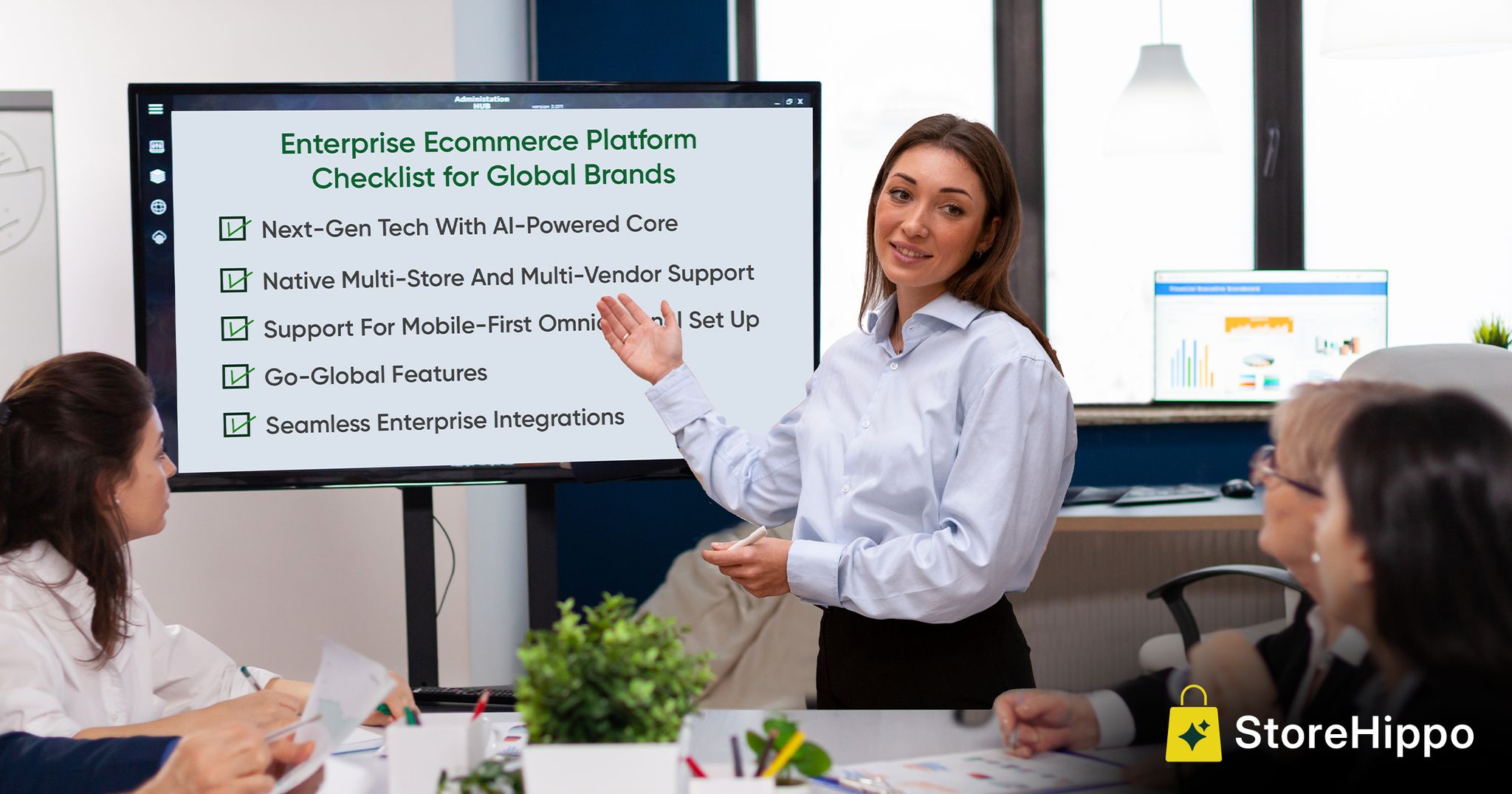



Global expansion today is not just about entering new markets for cross-border ecommerce. It is about choosing the right technology foundation to create a strong brand niche across regions. For large brands, selecting an enterprise ecommerce platform decides how smoothly they can scale across countries, manage operational complexity, and deliver consistent customer experiences across channels.
And for brands that want to build an enterprise marketplace or add multiple revenue models to existing sales channels, this is where strong, adaptable enterprise ecommerce solutions become essential. Enterprises with a global presence need a platform that can handle multi-country selling, integrations, and evolving buyer expectations without creating long-term operational strain.
One wrong choice can quickly spiral into operational chaos, while choosing the right platform accelerates growth by supporting scale without friction, adapting as the business evolves, and enabling steady innovation instead of constant firefighting. That is why this decision goes beyond operations; it shapes how confidently and quickly your brand can grow over the next several years.
This becomes even more critical as cross-border ecommerce rapidly turns into the primary growth engine for global brands.
Table of Contents
- How Cross Border Ecommerce Is Reshaping Global Enterprise Growth
- 10 Non-Negotiable Features Of An Enterprise Ecommerce Platform Built For Global Scale
- 1. Next-Gen Tech With AI-Powered Core
- 2. Multi-Model Commerce From A Single Backend
- 3. Native Multi-Store And Multi-Vendor Support
- 4. Support For Mobile-First Omnichannel Set Up
- 5. Go-Global Features
- 6. Seamless Enterprise Integrations
- 7. Low-Code Customisation And Configurable Workflows
- 8. Complete Operational Visibility And Control
- 9. Cloud-Native Scalability And Performance
- 10. Data Ownership & Advanced Analytics Control
- Quick Guide To Evaluate Enterprise Ecommerce Platform Capabilities For Global Expansion
- Enterprise Ecommerce Platform Selection: 10 Questions That Define The Right Choice
- 1. What are the non-negotiables while choosing an enterprise ecommerce platform for long-term cross-border growth?
- 2. What breaks first when an enterprise ecommerce platform is not built for global growth?
- 3. Which is better: an enterprise ecommerce platform with hundreds of plugins or one with strong native capabilities?
- 4. How can we identify whether an enterprise ecommerce platform is truly easy to integrate and customise for our business needs?
- 5. How easy is it to create personalised journeys for different buyer groups on a turnkey enterprise ecommerce platform?
- 6. Why is it important to choose an AI-powered enterprise ecommerce platform for future growth?
- 7. How much of our daily commerce operations can realistically be automated using AI-powered enterprise ecommerce solutions?
- 8. Why is it important to choose an enterprise ecommerce platform with multi-model and multi-channel support?
- 9. What hidden costs in enterprise ecommerce solutions typically surface only after the business scales?
- 10. How do we know we’re choosing an enterprise ecommerce platform we won’t outgrow in a few years?
- Why Choose StoreHippo For Your Cross Border Ecommerce Business
- Enterprise Cross-Border E-commerce Models You Can Build And Scale With StoreHippo
- Conclusion
How Cross Border Ecommerce Is Reshaping Global Enterprise Growth
Cross-border ecommerce is quickly moving from an expansion strategy to a primary revenue driver for enterprise brands. As global buyers grow more comfortable purchasing across borders, the opportunity to reach new markets and revenue streams has never been larger.
The following data highlights how rapidly cross-border commerce is scaling and why global brands are prioritising it as the next phase of growth.
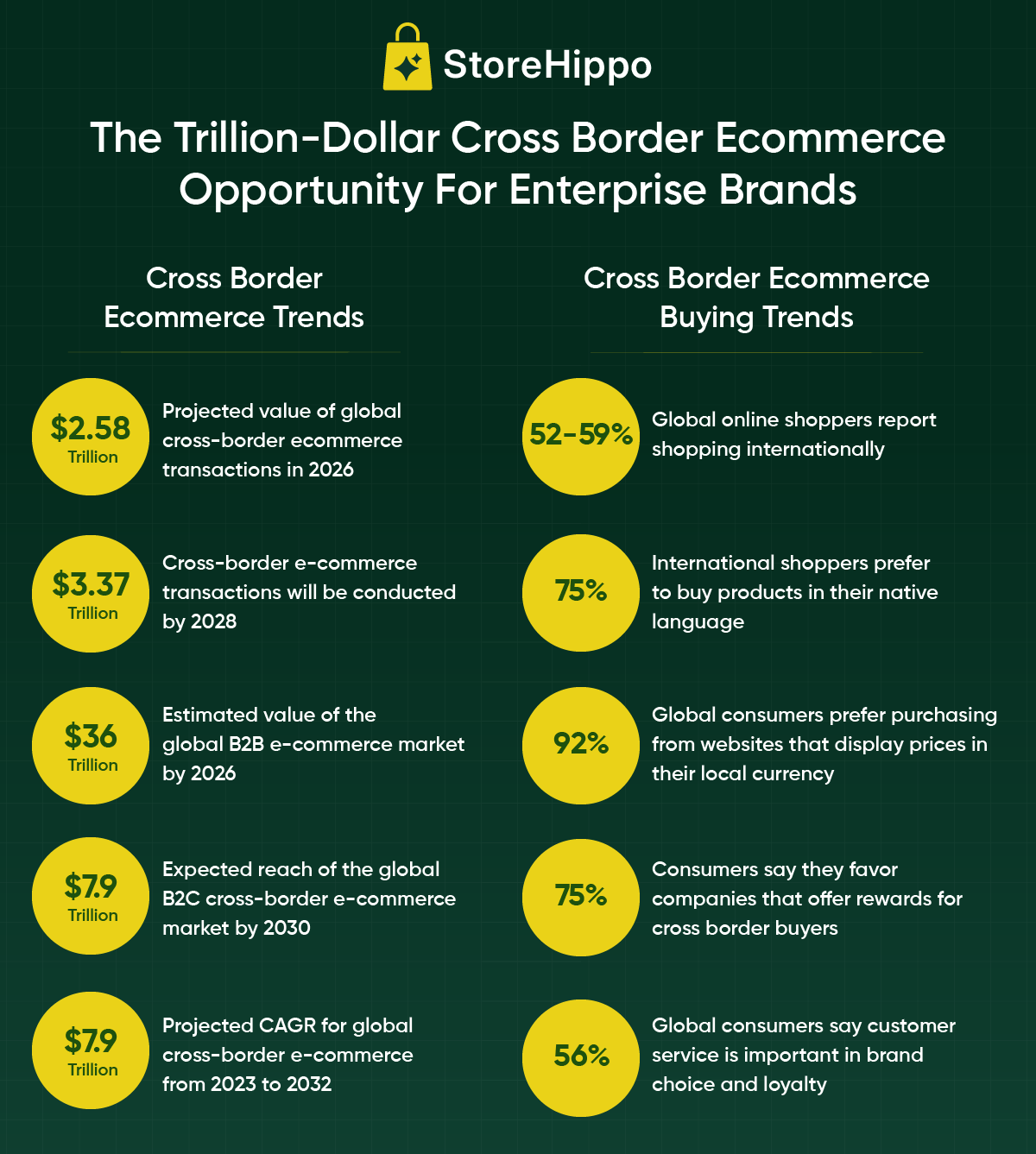
Cross Border Ecommerce Trends
- $2.58 Trillion is the projected value of global cross-border ecommerce transactions in 2026
- $3.37 Trillion in cross-border e-commerce transactions will be conducted by 2028
- $36 Trillion is the estimated value of the global B2B e-commerce market by 2026
- $7.9 Trillion is the expected reach of the global B2C cross-border e-commerce market by 2030.
- 27.4% is the projected CAGR for global cross-border e-commerce from 2023 to 2032
Cross Border Ecommerce Buying Trends
- 52% to 59% of global online shoppers report shopping internationally
- 75% of international shoppers prefer to buy products in their native language
- 92% of global consumers prefer purchasing from websites that display prices in their local currency
- 75% of consumers say they favour companies that offer rewards for cross border buyers
- 56% of global consumers say customer service is important in brand choice and loyalty
Source: Juniper Research, ITA, Forbes, Custom Market Insights, IPC, Capital One Shopping Research
The scale of cross-border growth and evolving buyer expectations make one thing clear, global expansion now demands far more than basic ecommerce capabilities.
To compete and grow across markets, enterprise brands need a platform built with the right features and flexibility from the start.
Image reference
10 Non-Negotiable Features Of An Enterprise Ecommerce Platform Built For Global Scale
Scaling globally demands more than basic ecommerce functionality. Enterprise brands need a platform built with the right capabilities from day one to support complexity, speed, and continuous growth across markets.
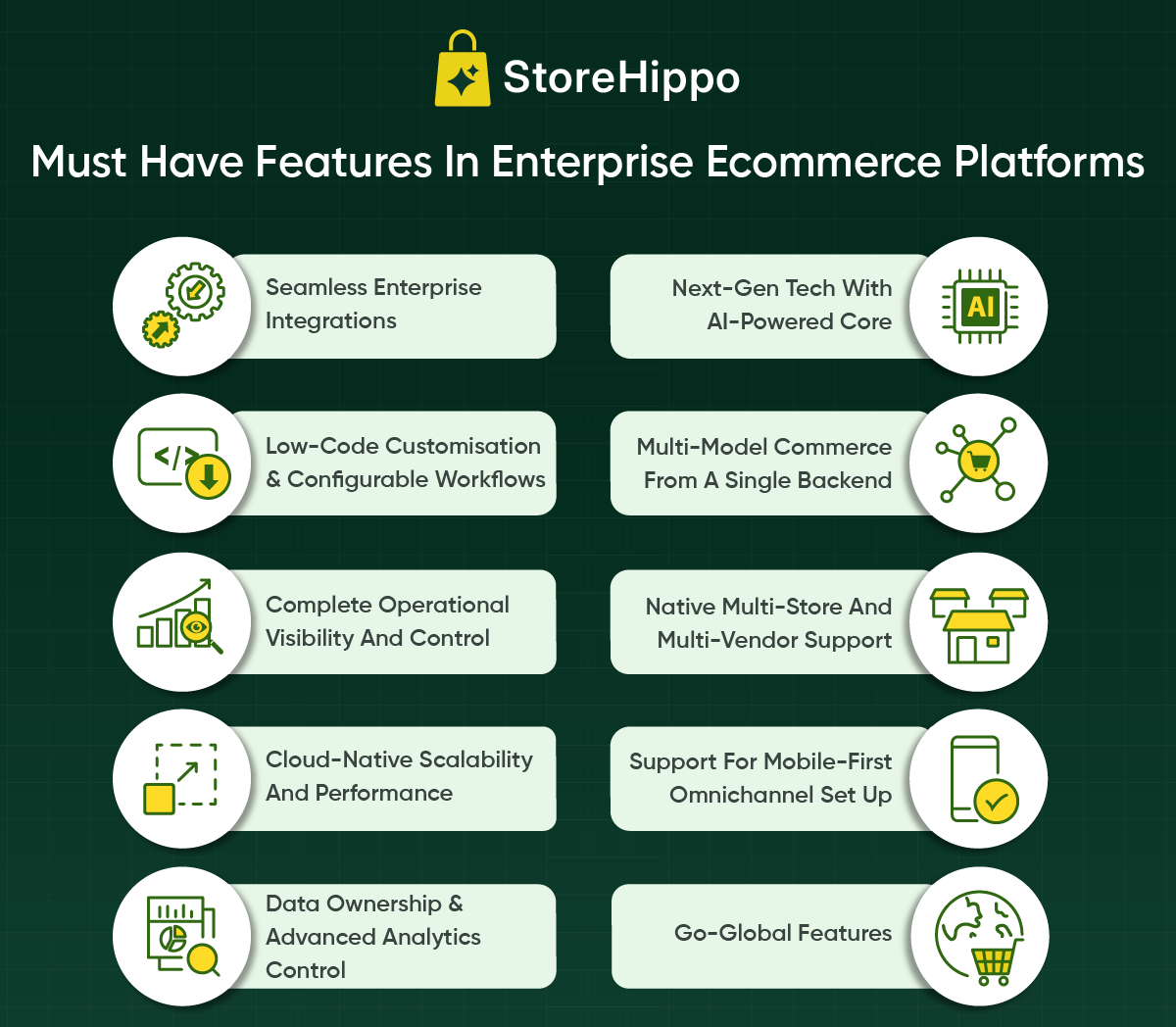
1. Next-Gen Tech With AI-Powered Core
A future-ready enterprise ecommerce platform should combine an AI-powered core with headless, composable, and MACH-based architecture. This ensures faster innovation, flexible integrations, and the ability to scale, customise, and evolve commerce experiences without rebuilding the core system.
2. Multi-Model Commerce From A Single Backend
A modern enterprise ecommerce platform should support B2B, B2C, D2C, B2B2C, Hybrid and multi-location marketplace models from one system. This flexibility allows brands to expand revenue streams and adapt business strategy without rebuilding technology every time they scale or diversify.
3. Native Multi-Store And Multi-Vendor Support
Global brands need the ability to manage multiple storefronts, sellers, and regions centrally. Strong enterprise ecommerce solutions ensure unified catalogues, pricing control, and reporting while supporting distributed operations across markets.
4. Support For Mobile-First Omnichannel Set Up
An enterprise ecommerce platform should be built mobile-first and support true omnichannel commerce with ease to grow to new channels like store, web, apps, WhatsApp, AI-assisted commerce, and more. A unified backend connecting multiple buying channels ensures consistent customer experiences and complete operational visibility across every touchpoint.
5. Go-Global Features
Multi-currency, multi-lingual capability, local tax logic, region-wise pricing, and international shipping integrations are essential for scaling cross border ecommerce without operational complexity. Global readiness should be native, not patched together.
6. Seamless Enterprise Integrations
The enterprise platform should have an API-first system that connects easily with ERP, CRM, logistics, payments, and external systems. Strong integration capability ensures enterprise ecommerce solutions remain adaptable as the tech stack evolves.
7. Low-Code Customisation And Configurable Workflows
Business teams should be able to configure pricing, catalogues, user journeys, and workflows without heavy development. A flexible enterprise ecommerce platform reduces long-term dependency on constant technical intervention.
8. Complete Operational Visibility And Control
Enterprise brands handling cross border ecommerce need complete transparency across orders, inventory, payments, and fulfilment. A strong enterprise ecommerce platform should offer real-time dashboards, centralised reporting, and clear visibility into every transaction and workflow to support faster decisions and tighter operational control at scale.
9. Cloud-Native Scalability And Performance
As transaction volumes grow across regions and channels, the platform should scale without performance drops. Going with an enterprise ecommerce platform with cloud-native infrastructure ensures stability during peak demand and global expansion.
10. Data Ownership & Advanced Analytics Control
Full access to commerce data enables better decisions, personalisation, and future AI adoption. Enterprise brands need clear data ownership and reporting visibility across all markets and channels.
These non-negotiable capabilities define whether an enterprise ecommerce platform can truly support global scale. Choosing a platform built with these foundations ensures your technology accelerates expansion instead of slowing it down.
Quick Guide To Evaluate Enterprise Ecommerce Platform Capabilities For Global Expansion
Use this quick evaluation guide to assess whether your enterprise ecommerce platform has the core capabilities needed to support seamless global expansion and long-term scale.
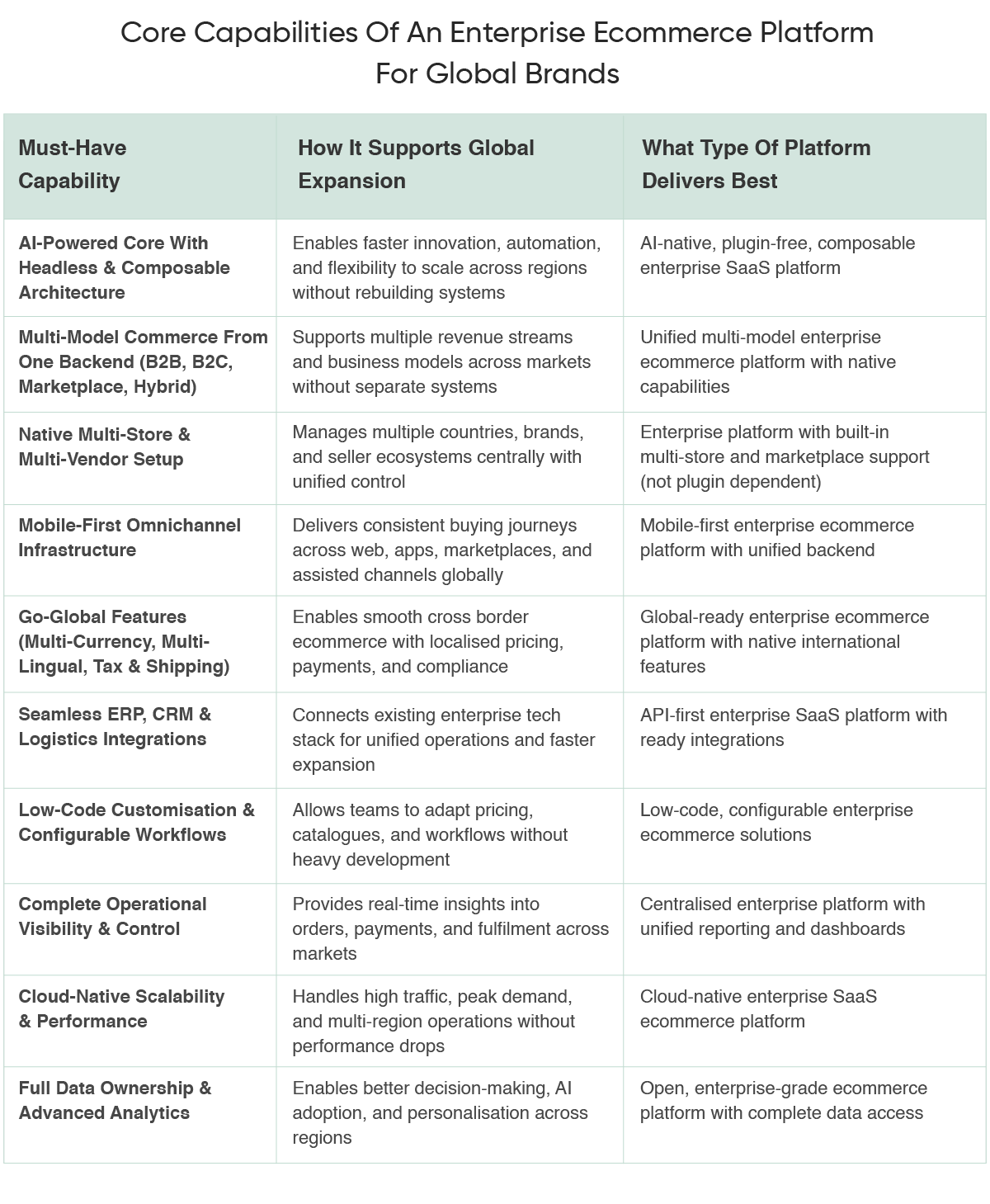
Enterprise Ecommerce Platform Selection: 10 Questions That Define The Right Choice
Selecting an enterprise ecommerce platform requires more than comparing features or pricing. It demands a clear understanding of how the platform will perform as the business scales across markets, channels, and business models.
Critical FAQs for Deciding An Enterprise Ecommerce Platform for Global Brand Presence
These questions reflect the real concerns enterprise teams face when evaluating a platform that will support global growth and operational complexity over the long term.
1. What are the non-negotiables while choosing an enterprise ecommerce platform for long-term cross-border growth?
Answer:
Choose an enterprise ecommerce platform that can scale across countries without rebuilding systems every time you enter a new market. The non-negotiables are unified operations, flexibility, and full control over data and integrations.
For long-term cross-border growth, the platform must support multi-country selling from a single backend. This includes local currencies, taxes, languages, catalogue variations, and region-wise fulfilment logic without creating separate tech stacks for each market. If expansion requires duplication of systems or heavy custom work, costs and operational complexity will rise quickly.
Look for strong native capabilities instead of heavy reliance on third-party plugins. Built-in features for unique storefrontsfor diverse geographies, multi-store and multi seller management, reporting, and integrations reduce long-term maintenance and risk. Clear data ownership is equally critical. Brands should have full access to customer, order, and operational data to make faster decisions and build future AI-driven experiences.
Finally, ensure the enterprise ecommerce platform can adapt as your business evolves. Whether you expand to new geographies, launch new channels, or introduce partner-led selling, the foundation should support growth without forcing frequent replatforming.
2. What breaks first when an enterprise ecommerce platform is not built for global growth?
Answer:
Operations break first, not the website. An enterprise ecommerce platform that is not built for global scale starts failing at the backend long before customers notice front-end issues.
The first cracks appear in order management, inventory visibility, and fulfilment coordination across regions. Teams begin managing multiple systems for different countries, leading to fragmented data and delayed decision-making. Pricing, taxation, and catalogue inconsistencies across markets create errors that directly impact customer experience and margins.
As complexity grows, integrations become harder to maintain. Manual workarounds increase, reporting becomes unreliable, and launching new markets takes longer than expected. This slows expansion and raises operational costs. Without strong native capabilities for multi-region management, even simple updates can require technical intervention.
A scalable enterprise ecommerce platform should keep operations unified as the business grows. When global expansion starts creating system fragmentation instead of efficiency, it is a clear sign the platform was not designed for long-term international scale.
3. Which is better: an enterprise ecommerce platform with hundreds of plugins or one with strong native capabilities?
Answer:
For enterprise scale, strong native capabilities are almost always the better choice.
An enterprise ecommerce platform built with core features in-house reduces risk, cost, and operational complexity over time.
A large plugin ecosystem may look attractive in the early stages. It offers flexibility and quick fixes. But at enterprise level, every additional plugin adds dependency, version conflicts, security exposure, and upgrade challenges. Over time, this creates a fragile system where simple updates can break critical workflows.
Native capabilities provide tighter integration between modules such as catalogue, pricing, checkout, marketplace logic, and reporting. This ensures consistent performance and smoother upgrades. It also reduces reliance on multiple vendors and external support teams.
When evaluating enterprise ecommerce solutions, leaders should ask whether core business functions rely on third-party add-ons or are built into the platform architecture. For long-term global growth, stability and control matter more than the sheer number of extensions available.
4. How can we identify whether an enterprise ecommerce platform is truly easy to integrate and customise for our business needs?
Answer:
Look at how much can be configured without heavy coding or external dependencies.
If most changes require developers or third-party tools, the platform will become difficult to manage at scale.
Start by evaluating native integrations. A strong enterprise ecommerce platform should already connect easily with common systems like ERP, CRM, payments, and logistics through built-in connectors or well-documented APIs. If every integration needs custom development, timelines and costs will rise quickly.
Next, assess how customisation works. Can pricing rules, workflows, catalogues, and user journeys be configured from the admin panel, or do they require backend development? Business teams should be able to make routine changes without depending on tech teams for every update.
Also check upgrade impact. Platforms that break customisations during updates create long-term operational risk. Choose enterprise ecommerce solutions where integrations remain stable and custom workflows can evolve without repeated redevelopment. Ease of integration and customisation should reduce effort over time, not increase it.
5. How easy is it to create personalised journeys for different buyer groups on a turnkey enterprise ecommerce platform?
Answer:
Personalised buyer journeys should be configurable, not custom-built every time.
A strong enterprise ecommerce platform lets teams create different experiences for different buyer groups without complex development.
Start by checking how the platform handles segmentation. It should allow you to define customer groups such as B2B buyers, distributors, retail customers, or regional audiences and assign them different pricing, catalogues, payment options, and checkout flows. If this requires custom coding or external tools, personalisation will become slow and expensive.
Look for built-in tools to manage promotions, recommendations, and content visibility based on user roles or behaviour. Business teams should be able to adjust journeys from the admin panel without relying on developers for every change.
Effective enterprise ecommerce solutions make personalisation scalable. Also look for AI capabilities to implement personalisation at different levels. As the business grows across markets and customer types, the platform should support consistent yet flexible experiences without creating operational complexity or fragmented systems.
6. Why is it important to choose an AI-powered enterprise ecommerce platform for future growth?
Answer:
AI should not be an add-on. It should improve daily commerce operations and decision-making.
An AI-powered enterprise ecommerce platform helps brands scale faster with less manual effort.
AI should be part of the enterprise ecomemrce solutions in a way that it supports smarter catalogue management, search, recommendations, pricing optimisation, and fraud detection. It should automate routine workflows such as tagging products, routing orders, segmenting customers, and predicting demand. Without built-in AI, teams often rely on multiple external tools, which increases cost and creates fragmented data.
More importantly, AI strengthens customer experience. Personalised product suggestions, intelligent search results, and dynamic promotions directly improve conversion rates and order value. These capabilities are becoming standard in competitive global markets.
When evaluating enterprise ecommerce solutions, leaders should assess whether AI is embedded in the core architecture or dependent on third-party integrations. A platform designed with AI at its foundation will adapt better to evolving commerce models and reduce long-term operational complexity.
7. How much of our daily commerce operations can realistically be automated using AI-powered enterprise ecommerce solutions?
Answer:
A significant portion of routine commerce operations can and should be automated.
If AI only supports reporting, the enterprise ecommerce solutions are underpowered.
AI can automate catalogue tagging, product recommendations, intelligent search, pricing rules, fraud checks, order routing, and inventory forecasting. It can also trigger personalised promotions, segment customers automatically, and assist support teams with faster query resolution. These are not experimental use cases. They directly reduce manual workload and operational errors.
The key is whether automation is embedded in the platform or dependent on external tools. Built-in AI within an enterprise ecommerce platform keeps workflows connected and data centralised. This improves accuracy and reduces system complexity.
Leaders should evaluate automation depth across merchandising, marketing, operations, and fulfilment. The goal is simple: free teams from repetitive tasks so they can focus on growth, partnerships, and strategy rather than daily operational firefighting.
8. Why is it important to choose an enterprise ecommerce platform with multi-model and multi-channel support?
Answer:
Growth rarely comes from one business model or one channel anymore. An enterprise ecommerce platform must support multiple models and channels from the same backend to stay future-ready.
Most brands today operate across B2B, D2C, marketplaces, and partner-based selling at the same time. Managing each model on separate systems creates fragmented data, inconsistent pricing, and operational delays. A platform with multi-model support allows teams to run different business lines with shared catalogues, inventory, and reporting while maintaining control from one place.
Multi-channel brand presence, especially on mobile and new-age channels like voice commerce, AI-assisted commerce etc. is equally important. Customers interact across websites, mobile, marketplaces, social channels, and assisted commerce touchpoints. Without a unified system, maintaining consistent pricing, inventory visibility, and customer experience becomes difficult.
Strong enterprise ecommerce solutions bring all models and channels together. This reduces duplication, improves decision-making, and allows businesses to expand into new revenue streams without rebuilding their technology stack each time the strategy evolves.
9. What hidden costs in enterprise ecommerce solutions typically surface only after the business scales?
Answer:
The biggest hidden costs appear in integrations, customisations, and performance upgrades.
Enterprise ecommerce solutions that seem affordable early on can become expensive as transaction volume and complexity grow.
At scale, brands often discover rising costs in third-party plugins, API usage, hosting upgrades, security patches, and custom development required to maintain workflows. If the platform relies heavily on external extensions, each upgrade can trigger compatibility fixes and additional vendor fees. Over time, maintenance becomes a recurring operational expense rather than a one-time investment.
Performance-related costs also increase. Handling peak traffic, multi-region operations, and complex catalogues may require infrastructure scaling or premium support tiers. If reporting and analytics require separate tools, data management expenses add up further.
When evaluating an enterprise ecommerce platform, leaders should look beyond licensing and subscription fees. Total cost of ownership includes integration stability, plugins, upgrade simplicity, infrastructure scalability, and the long-term effort required to keep systems aligned as the business expands globally.
10. How do we know we’re choosing an enterprise ecommerce platform we won’t outgrow in a few years?
Answer:
Look at how the platform performs for brands already operating at scale.
The case studies should show businesses implementing the features the platform is selling to you.
Start by reviewing real implementations. Check whether the enterprise ecommerce platform is running high-volume, multi-market, or multi-model businesses. If brands have stayed on the platform and expanded over time, that is a strong signal of stability.
Next, evaluate how the platform handles upgrades and expansion. Assess whether new markets, sales channels, or integrations can be added without rebuilding core systems. Ask clear questions about scalability, roadmap direction, and architectural flexibility to ensure alignment with your long-term strategy.
Strong enterprise ecommerce solutions should support continuous evolution. The right choice will enable steady growth without forcing disruptive replatforming decisions every few years.
Why Choose StoreHippo For Your Cross Border Ecommerce Business
Over the years, StoreHippo has helped enterprise brands build and scale complex digital commerce ecosystems across industries and geographies. This hands-on experience in powering multi-country, multi-model, and high-volume commerce has shaped a platform designed specifically for global enterprise needs.
Today, StoreHippo enterprise ecommerce platform brings together AI-powered automation, composable architecture, and enterprise-grade capabilities to help businesses build global commerce solutions of any scale whether it is a B2B network, D2C brand, distributor ecosystem, or a full-fledged marketplace spanning multiple regions.
StoreHippo comes with a comprehensive set of capabilities designed for global scale, including multilingual support (with RTL language support), multi-currency functionality, and the ability to build location-based multi-vendor marketplaces tailored for different countries and regions. Its powerful theme designer allows brands to create distinct storefront experiences for diverse markets, while the built-in mobile app builder enables quick launch of Android and iOS marketplace apps without additional development effort.
StoreHippo’s enterprise ecommerce platform also offers native AI capabilities that allow businesses to build custom AI agents for diverse use cases for AI-assisted selling, customer and vendor support, and automating operations. Its AI-powered core simplifies and automates cataloguing, image optimisation, search relevance, and product recommendations to improve efficiency and conversions. A robust tax engine supports region-wise taxation, compliance, and pricing logic, making cross-border operations easier to manage.
With 300+ native features, built-in marketing tools and seamless connectivity through 350+ APIs and 150+ pre-integrations across payments, logistics, ERP, accounting, and marketing tools, StoreHippo enterprise ecommerce solutions enable global brands to build and scale their unique ecommerce ecosystems with speed and confidence.
Enterprise Cross-Border E-commerce Models You Can Build And Scale With StoreHippo
Here are real-world global commerce models that enterprise brands can replicate, customise, and scale on the StoreHippo platform when planning to disrupt cross-border ecommerce:
- Build a B2B Marketplace like Amazon Business
Onboard multiple sellers, manage bulk pricing, rapidly create custom catalogues with AI cataloging, and handle multi-party transactions from a single backend. - Run a Global Retail Ecosystem like Macy’s
Manage multiple brands, regions, warehouses, and customer segments while delivering consistent experiences across online stores, apps, and partner channels. - Launch a Hybrid D2C + Distributor-Ped model like Nike
Sell directly to customers while empowering regional distributors and franchise partners with dedicated storefronts and pricing structures. - Create a Multi-Country Ecommerce Network like Unilever
Manage region-specific catalogues, currencies, taxation, and fulfilment logic while maintaining centralised operational control for cross border ecommerce. - Scale a Multi-Brand, Multi-Store Setup like Reliance Retail
Operate multiple digital storefronts and seller ecosystems with unified reporting, inventory visibility, and order management. - Experiment with New Revenue Models without Replatforming
Add subscriptions, partner selling, B2B bulk ordering, or hybrid, out-of-the-box marketplace models as the business evolves without rebuilding the tech stack.
With the right enterprise ecommerce platform, global expansion becomes easier to manage and faster to scale. StoreHippo gives enterprise brands the flexibility, control, and future-ready capabilities needed to build and grow cross-border commerce ecosystems without operational complexity.
Conclusion
Global growth looks exciting on a roadmap, but it gets real in execution. Cross border ecommerce brings new markets, languages, currencies, tax rules, fulfilment complexity, and new buyer expectations, all at once. That is why the enterprise ecommerce platform you choose cannot be a short-term fix or a patchwork of extensions.
It needs to be a long-term foundation that stays stable as your business adds new geographies, channels, and business models. If your strategy includes launching new storefronts, expanding into B2B, or planning to build an enterprise marketplace, the platform must support that evolution without slowing teams down or forcing a replatform within a few years. The strongest enterprise ecommerce solutions make global scale feel manageable by keeping operations unified, integrations clean, and innovation continuous.
If you are evaluating platforms right now, it is worth seeing what this looks like in practice. StoreHippo equips you with a strong tech foundation for expanding your business across geographies. Explore how you can build, run, and scale a global ceommerce ecosystem with confidence. Book a StoreHippo demo now.