


Building a B2B marketplace on a plugin-based platform like Shopify often feels like the right call at the beginning. It promises speed, flexibility, and a lower barrier to launch. For early traction, it can work well enough to get a B2B online marketplace off the ground.
The challenge emerges as complexity sets in. Each new requirement, seller management, negotiated pricing, approval workflows, regional rules, or backend integrations, adds another plugin, another dependency, another workaround. Over time, what looked flexible becomes fragile. Plugin conflicts slow teams down, upgrades turn risky, performance suffers, and operational costs quietly rise. Running global B2B online marketplaces on a stitched-together stack starts limiting growth instead of enabling it.
This is the point where enterprises reassess their B2B ecommerce platform and begin searching for a more resilient Shopify alternative.
Table of Contents
The Real Cost of Running B2B Marketplaces on Shopify
Shopify’s pricing appears straightforward at the start, especially for early-stage B2B operations. But B2B marketplaces don’t scale through subscriptions alone, they scale through added workflows, sellers, integrations, and custom logic. That’s where costs begin to shift.
As marketplace complexity grows, spend moves beyond the base plan into plugins, transaction-linked fees, custom development, and ongoing maintenance. What looks predictable early on becomes a compounding cost structure tied directly to growth. For enterprises running high-volume or multi-region B2B marketplaces, these hidden costs often outweigh the original platform fee.
The data below shows how the true cost of operating a B2B marketplace on Shopify increases as scale and complexity rise.
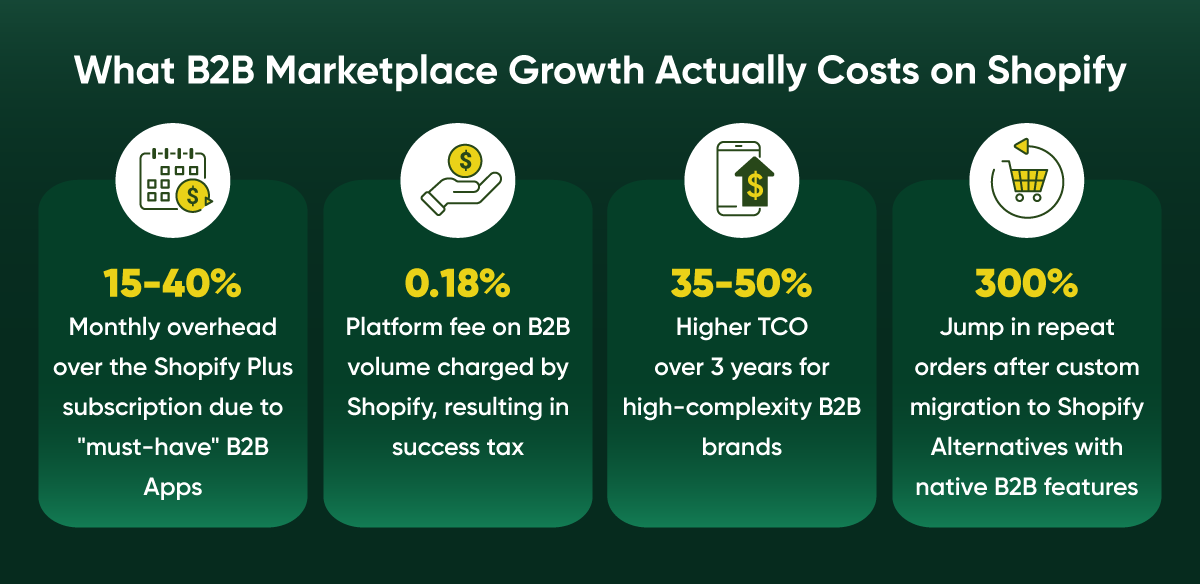
- 15% - 40% increase in monthly overhead over the Shopify Plus subscription due to "must-have" B2B apps
- 0.18% platform fee on B2B volume charged by Shopify, resulting in success tax
- 35% - 50% Higher TCO over 3 years for high-complexity B2B brands
- 300% jump in repeat orders after custom migration to Shopify Alternatives with native B2B features
Source: Rigby, Medusa, IRP, Mgroup, Aureate Labs
Taken together, these numbers tell a clear story. The challenge with Shopify in B2B marketplaces isn’t the starting cost, it’s the compounding cost of growth. As seller count, order complexity, and regional operations expand, plugin dependencies multiply, fees scale with success, and operational friction becomes harder to justify.
This is why enterprises don’t look for Shopify alternatives because it fails, they outgrow it because it wasn’t designed for enterprise wholesale marketplace set up at scale. The real question then becomes: what should a B2B marketplace-ready Shopify competitor actually offer to support scale without complexity?
What a Shopify Alternative For B2B Marketplaces Must Offer
Once a B2B marketplace outgrows plugin-based workarounds, the evaluation criteria change. The focus shifts from storefront features to operational depth: how well the platform can manage sellers, buyers, pricing, workflows, and scale without adding friction or cost at every step. A true B2B ecommerce platform must be designed for marketplace complexity from day one, not patched together as requirements grow.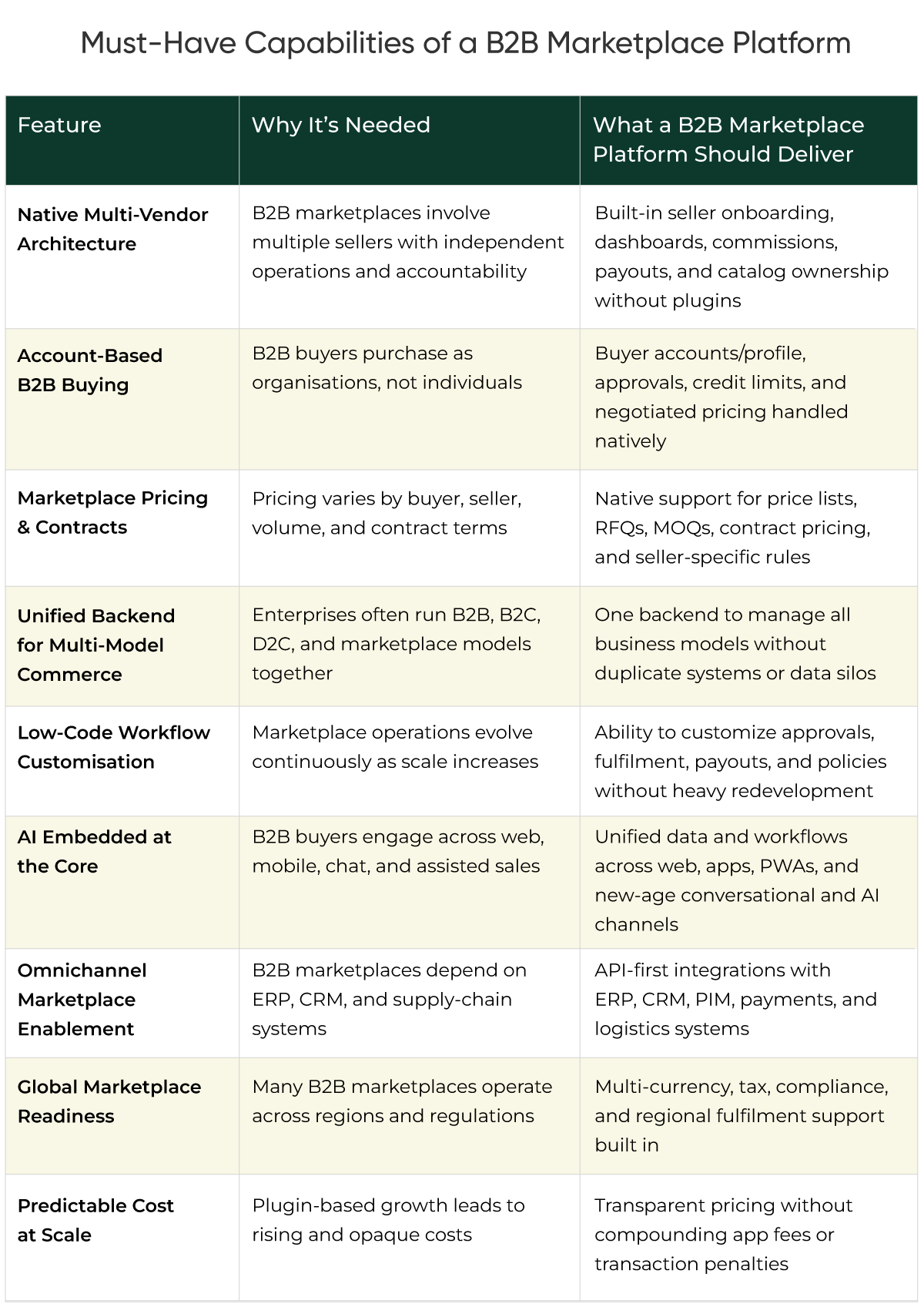
Below are the core capabilities enterprises should expect from a Shopify alternative built to support modern B2B marketplaces and global B2B online marketplaces.
For enterprises evaluating a Shopify alternative, the focus should be on native capabilities, long-term flexibility, and predictable costs, not how many plugins can be added to fill gaps. A modern B2B ecommerce platform should reduce operational friction, support multiple business models, and enable wholesale marketplaces to evolve without repeated replatforming. Choosing the right foundation today determines how efficiently your B2B online marketplace can grow tomorrow.
7 Most-Popular Shopify Alternatives For Building Global B2B Online Marketplaces
As B2B commerce scales beyond single storefronts, enterprises are moving toward global B2B online marketplaces that demand far more than patched up plugins. This list highlights the most popular Shopify alternatives enterprises choose when building scalable, marketplace-first B2B ecosystems designed for long-term growth.
Let us evaluate 7 Shopify alternatives for building B2B marketplaces, focusing on marketplace readiness, scalability, and long-term operational control.
1. StoreHippo – Native B2B Marketplace Ecommerce Platform
StoreHippo is an AI-powered enterprise-grade B2B ecommerce platform purpose-built to help enterprises design, operate, and scale global B2B online marketplaces from a single, unified platform. Unlike platforms that adapt B2C commerce for B2B use cases, StoreHippo is architected from the ground up to support marketplace operations, multi-vendor selling, and enterprise workflows.
Key Highlights
B2B Marketplace Readiness:
StoreHippo is a native B2B marketplace platform with built-in multi-vendor onboarding, seller dashboards, commission management, payouts, catalogue ownership, and role-based controls. Enterprises can run complex B2B online marketplaces without relying on third-party marketplace extensions.
B2B Commerce Features:
Comprehensive B2B capabilities including organisation hierarchies, buyer roles, custom price lists, contract pricing, RFQ, MOQ rules, approval workflows, credit limits, and account-based buying, fully integrated with marketplace operations.
Mobile Readiness:
Built-in mobile app builder for B2B marketplace apps, along with PWA support and ready-to-use vendor, admin and delivery boy apps. Enterprises can launch B2B marketplace mobile experiences without external development teams.
Core Architecture And Tech Stack:
Pure headless, API-first, composable architecture designed for enterprise scale. Supports multi-store, multi-entity, and multi-model commerce from a single backend, making it suitable for large and distributed B2B ecosystems.
AI Capabilities:
AI is embedded at the platform core, supporting intelligent catalogue creation, semantic search, recommendations, workflow automation, demand forecasting and custom, unified conversation dashboards, AI-powered assistants for buyers, sellers, and admins, without requiring external AI tools.
Customisation And Extensibility:
Low-code and no-code customisation for workflows, storefronts, and marketplace logic, combined with deep extensibility for advanced enterprise requirements. Customisation does not rely on plugins for core marketplace features.
Integrations And Ecosystem:
Seamlessly integrates with ERP, CRM, marketing, POS, accounting, payment gateways, and logistics providers. Designed to support global B2B marketplace operations with region-specific rules, currencies, taxes, and fulfilment models.
Omnichannel Support:
Unified backend powering web, mobile apps, PWAs, WhatsApp, and assisted commerce channels, ensuring consistent data, pricing, and workflows across the entire B2B marketplace ecosystem.
Performance And Scalability:
Enterprise-grade performance with auto-scaling infrastructure, optimised to handle large catalogues, high transaction volumes, and multi-region operations.
Security And Compliance:
Robust enterprise security, including role-based access, audit logs, SSL, PCI-DSS, ISO, SOC compliant and governance controls, suited for regulated B2B environments.
Agility And Maintenance Efficiency:
High operational agility due to native capabilities and minimal dependency on third-party apps. Faster upgrades, lower maintenance overhead, and easier evolution of marketplace models over time.
Pros
- Native AI-powered B2B marketplace capabilities without third-party dependencies.
- Unified platform for B2B ecommerce, multi-vendor marketplaces, and hybrid models.
- Built-in AI, mobile apps, and omnichannel support.
- Native cross-border B2B business support with built-in go global solutions, multilingual, multi-currency and multi-store network managed by a common admin for various countries.
- 150+ pre-integrations for payment gateways, logistics, marketing and more.
- Faster time-to-market, multi model support through 300+ native features, lower long-term operational complexity.
Cons
- Advanced enterprise modules are available only in higher-tier plans.
- Teams moving from plugin-based systems may require adapting to headless built-in workflows.
Pricing
Enterprise Plan – from $499/month
Platinum Plan – Custom pricing for large enterprises
Best For
Enterprises looking to build and scale a B2B marketplace with native multi-vendor capabilities, built-in AI, omnichannel reach, and full operational control without assembling multiple tools to function as a single B2B ecommerce platform.
2. BigCommerce B2B Edition
BigCommerce B2B Edition is a SaaS B2B ecommerce platform designed for brands and wholesalers looking to digitise B2B selling without managing infrastructure. While it supports core B2B commerce use cases, building a full-fledged B2B online marketplace typically requires external systems and integrations beyond the native platform.
Key Highlights
B2B Marketplace Readiness:
BigCommerce is not a native B2B marketplace platform. Multi-seller onboarding, vendor dashboards, commission management, and marketplace-level workflows are not built in and must be implemented using third-party marketplace solutions or custom middleware.
B2B Commerce Features:
Includes company accounts, customer groups, price lists, bulk pricing, purchase orders, and basic approval flows. These features support B2B ecommerce transactions but are not marketplace-native.
Mobile Readiness:
Responsive storefronts and PWA support are available. No built-in mobile app builder; B2B marketplace apps require third-party development.
Core Architecture And Tech Stack:
Cloud-native SaaS architecture with API-first capabilities. Supports headless commerce for frontend flexibility, while backend workflows remain governed by the BigCommerce platform.
AI Capabilities:
Provides basic AI-driven features such as product recommendations, search optimisation, and merchandising insights. Advanced AI use cases for marketplace intelligence or seller-level optimisation depend on third-party tools.
Customisation And Extensibility:
Highly extensible through APIs and headless frameworks, but complex B2B marketplace logic such as vendor-specific pricing, fulfilment rules, and payouts requires external development.
Integrations & Ecosystem:
Strong integration ecosystem for ERP, CRM, payments, and logistics. Global B2B marketplace integrations are possible but typically rely on partner solutions and middleware.
Omnichannel Support:
Supports omnichannel selling across web and integrated systems, but does not offer a unified backend for managing sellers, buyers, and channels within a single B2B online marketplace.
Performance And Scalability:
Reliable SaaS performance with automatic scaling suitable for high-volume B2B ecommerce operations across regions.
Security And Compliance:
PCI DSS compliant with SSL, GDPR support, and role-based access controls, making it suitable for enterprise-grade B2B ecommerce platforms.
Agility And Maintenance Efficiency:
Low infrastructure overhead due to SaaS model, but marketplace agility is constrained by dependence on third-party tools for critical B2B marketplace capabilities.
Pros
- Quick to launch as a B2B ecommerce platform with minimal infrastructure management.
- Native support for B2B pricing, accounts, and purchase workflows.
- Strong APIs for headless and composable builds.
- Stable performance for global B2B ecommerce operations.
Cons
- Not a native B2B marketplace or multi-vendor platform.
- Marketplace features rely heavily on third-party solutions.
- Limited control over deep operational workflows at marketplace scale.
Pricing
Subscription-based SaaS pricing with additional costs for B2B features and marketplace-related integrations.
Best For
Enterprises looking for a Shopify alternative to run B2B ecommerce with faster go-to-market, and that are comfortable assembling a B2B marketplace using integrations rather than native marketplace functionality.
3. Adobe Commerce (Magento)
Adobe Commerce, formerly Magento, is a flexible B2B ecommerce platform widely used by enterprises that need deep customisation and control. It is often chosen to build complex B2B marketplaces and global B2B marketplace experiences, but most marketplace capabilities are achieved through custom development rather than native functionality.
Key Highlights
B2B Marketplace Readiness:
Adobe Commerce does not offer native B2B marketplace features such as vendor onboarding, seller dashboards, commissions, or payouts. Building a B2B online marketplace typically involves custom modules or third-party marketplace extensions.
B2B Commerce Features:
Strong native B2B functionality including company accounts, shared catalogs, custom pricing, contract pricing, RFQ, requisition lists, and approval workflows suitable for enterprise procurement.
Mobile Readiness:
Supports responsive storefronts and PWAs. No native mobile app builder; mobile apps for a B2B marketplace require separate development.
Core Architecture And Tech Stack:
PHP-based, modular architecture with support for headless commerce. Offers strong backend flexibility but requires infrastructure management and experienced development teams.
AI Capabilities:
AI-driven features such as product recommendations, search, and personalisation are available through Adobe Sensei. Advanced AI capabilities often require integration with Adobe Experience Cloud products.
Customisation And Extensibility:
Highly customisable and developer-friendly. Enterprises can extend nearly every layer of the B2B ecommerce platform, but changes require skilled Magento developers and ongoing maintenance.
Integrations And Ecosystem:
Large ecosystem of extensions and system integrators. Integrates with ERP, CRM, PIM, and payment systems, though integration quality varies by vendor.
Omnichannel Support:
Supports omnichannel experiences through integrations and Adobe Experience Cloud, but orchestration across sellers and channels requires additional configuration.
Performance And Scalability:
Capable of scaling for large B2B ecommerce and marketplace implementations, but performance tuning and infrastructure optimisation are the enterprise’s responsibility.
Security And Compliance:
Enterprise-grade security features with role-based access, SSL, GDPR support, and regular security patches. Ongoing compliance depends on hosting and implementation choices.
Agility And Maintenance Efficiency:
High flexibility comes with higher maintenance overhead. Platform upgrades, extension compatibility, and performance optimisation can slow agility over time.
Pros
- Deep native B2B features for pricing, contracts, and procurement workflows.
- Extreme flexibility for building custom B2B marketplace logic.
- Large global partner and developer ecosystem.
- Suitable for complex, enterprise-scale B2B ecommerce platforms.
Cons
- Not a native B2B marketplace platform; heavy custom development required.
- High implementation and maintenance costs.
- Longer time-to-market compared to SaaS-based alternatives.
Pricing
Licensed as part of Adobe Commerce, with costs based on GMV and hosting. Additional expenses for extensions, infrastructure, and implementation partners.
Best For
Enterprises with strong technical teams that need a highly customised B2B ecommerce platform and are prepared to build and manage a global B2B marketplace through custom development and integrations.
4. OroCommerce
OroCommerce is a B2B-first ecommerce platform designed specifically for manufacturers, distributors, and wholesalers with complex selling structures. Unlike generalist ecommerce tools, OroCommerce focuses on operational depth for B2B commerce, and can be extended to support B2B marketplace models through configuration and custom development.
Key Highlights
B2B Marketplace Readiness:
OroCommerce is not a plug-and-play B2B marketplace platform. While it supports multi-organisation selling and complex account structures, building a full B2B marketplace with independent sellers, commissions, and vendor-level controls typically requires custom development.
B2B Commerce Features:
Strong native B2B features including organisation hierarchies, buyer roles, customer-specific pricing, contract pricing, RFQ workflows, and complex quoting processes suited for B2B ecommerce operations.
Mobile Readiness:
Responsive storefronts supported. No native mobile app builder; mobile experiences for a B2B marketplace require custom development or third-party frameworks.
Core Architecture And Tech Stack:
Symfony-based, open-source architecture with a modular backend. Designed to integrate tightly with ERP and backend business systems common in B2B environments.
AI Capabilities:
Limited native AI functionality. AI-driven recommendations, search intelligence, or marketplace analytics generally rely on third-party tools rather than built-in AI services.
Customisation And Extensibility:
Highly extensible at the backend level. Custom workflows, pricing logic, and marketplace-specific features can be built, but require experienced developers and longer implementation cycles.
Integrations And Ecosystem:
Designed for deep ERP, CRM, and PIM integrations. Ecosystem is smaller compared to larger platforms, but focused heavily on B2B and industrial use cases.
Omnichannel Support:
Supports omnichannel B2B selling through unified customer and pricing data, but orchestration across multiple sellers and channels requires additional configuration.
Performance And Scalability:
Built to handle complex catalogues and large order volumes typical of enterprise B2B ecommerce platforms. Scaling depends on hosting and infrastructure choices.
Security And Compliance:
Enterprise-grade security features including role-based access control, SSL support, and compliance readiness depending on hosting setup.
Agility And Maintenance Efficiency:
Flexible but developer-intensive. Updates, customisations, and marketplace extensions can slow agility without dedicated technical resources.
Pros
- Built specifically as a B2B ecommerce platform, not adapted from B2C.
- Strong support for complex pricing, quoting, and procurement workflows.
- Deep ERP and backend system integration capabilities.
- Well-suited for distributor- and manufacturer-led B2B commerce.
Cons
- Not a native B2B marketplace platform out of the box.
- Limited built-in AI capabilities.
- Requires significant development effort to scale into a global B2B marketplace.
Pricing
Open-source platform with costs associated with hosting, development, and enterprise support plans.
Best For
Manufacturers and distributors that need a B2B-first ecommerce platform with deep operational control, and are willing to invest in development to extend it into a B2B online marketplace.
5. Salesforce Commerce Cloud (B2B Commerce)
Salesforce Commerce Cloud B2B is an enterprise B2B ecommerce platform designed for organisations that want commerce tightly connected with sales, service, and customer data. Built on the Salesforce ecosystem, it enables enterprises to create connected buying journeys, but extending it into a full B2B marketplace or B2B online marketplace typically requires additional Salesforce products and custom development.
Key Highlights
B2B Marketplace Readiness:
Salesforce Commerce Cloud is not a native B2B marketplace platform. Multi-seller onboarding, vendor dashboards, commissions, and marketplace-level controls are not built in and must be implemented using custom objects, partner apps, or Salesforce Experience Cloud.
B2B Commerce Features:
Strong native B2B features including account-based buying, buyer roles, contract pricing, price books, approval workflows, and reorder management, supporting complex B2B ecommerce transactions.
Mobile Readiness:
Responsive storefronts supported. No native B2B marketplace mobile app builder; mobile apps require Salesforce SDKs or third-party development.
Core Architecture And Tech Stack:
Cloud-native SaaS architecture built on Salesforce core. Commerce, CRM, and data layers are tightly integrated, making it suitable for enterprises already standardised on Salesforce.
AI Capabilities:
Uses Salesforce Einstein AI for product recommendations, personalisation, search insights, and buyer behaviour analysis. Marketplace-level AI intelligence depends on how deeply Salesforce Data Cloud and other services are implemented.
Customisation And Extensibility:
Highly extensible through Salesforce’s low-code and developer tools. However, building B2B marketplace-specific workflows often requires experienced Salesforce developers and architectural planning.
Integrations And Ecosystem:
Extensive ecosystem with integrations across CRM, ERP, marketing automation, service, and analytics. Global B2B marketplace integrations are possible but often rely on multiple Salesforce products and partners.
Omnichannel Support:
Strong omnichannel capabilities across sales, service, marketing, and commerce, unified through Salesforce’s customer data model rather than marketplace-native orchestration.
Performance And Scalability:
Enterprise-grade scalability managed by Salesforce infrastructure, suitable for large B2B ecommerce platforms operating across regions.
Security And Compliance:
Robust enterprise security including role-based access, SSO, GDPR compliance, and industry certifications standard across the Salesforce ecosystem.
Agility And Maintenance Efficiency:
Low infrastructure maintenance due to SaaS delivery, but agility can be impacted by ecosystem complexity and dependency on multiple Salesforce modules.
Pros
- Deep integration between B2B ecommerce, CRM, sales, and service.
- Native AI capabilities through Salesforce Einstein.
- Strong account-based and contract-driven B2B commerce features.
- Enterprise-grade security and global scalability.
Cons
- Not a native B2B marketplace platform.
- Marketplace functionality requires significant customisation and additional products.
- Total cost can increase as more Salesforce modules are added.
Pricing
Enterprise SaaS pricing based on usage, features, and Salesforce product bundles. Costs vary depending on integrations and AI capabilities enabled.
Best For
Enterprises already invested in Salesforce that want a tightly integrated B2B ecommerce platform and are willing to extend it into a B2B marketplace using the broader Salesforce ecosystem.
6. commercetools
commercetools is a headless, API-first B2B ecommerce platform designed for enterprises that want maximum architectural flexibility. It is often used as a foundation to build highly customised B2B marketplaces or global B2B marketplace experiences, but almost all marketplace capabilities must be designed and built externally rather than configured natively.
Key Highlights
B2B Marketplace Readiness:
commercetools does not provide native B2B marketplace functionality. Vendor onboarding, seller management, commissions, payouts, and marketplace governance must be implemented through custom services and external systems, making it suitable for build-heavy B2B online marketplace models.
B2B Commerce Features:
Supports core B2B ecommerce platform capabilities like customer-specific pricing, catalogs, and custom data models, but complex procurement workflows such as RFQs, approvals, and contract pricing require custom development.
Mobile Readiness:
Frontend-agnostic by default. Mobile experiences, PWAs, and apps for a B2B marketplace must be built separately using custom or third-party frameworks.
Core Architecture And Tech Stack:
Cloud-native, microservices-based, API-first architecture. Designed for composable commerce where frontend, backend services, and integrations are fully decoupled.
AI Capabilities:
Provides limited native AI features. Advanced AI use cases such as recommendations, search intelligence, or marketplace analytics are typically delivered through third-party AI services or custom implementations.
Customisation And Extensibility:
Extremely flexible and developer-centric. Enterprises can build any B2B marketplace logic required, but this comes with higher dependency on engineering teams and long implementation timelines.
Integrations & Ecosystem:
Strong ecosystem of technology partners and integrations for search, payments, PIM, ERP, and analytics. Integration-heavy by design, suitable for global B2B marketplace architectures.
Omnichannel Support:
Enables omnichannel commerce through a unified API layer, but orchestration across sellers, channels, and regions must be handled by external systems.
Performance And Scalability:
Highly scalable and performant due to cloud-native microservices architecture, suitable for large-scale B2B ecommerce platforms operating across markets.
Security And Compliance:
Enterprise-grade security with compliance certifications, role-based access, and API security standards. Responsibility is shared across the composable stack.
Agility And Maintenance Efficiency:
High agility for teams with strong engineering capabilities. Ongoing maintenance and evolution depend on how many external services power the marketplace.
Pros
- Extremely flexible foundation for custom B2B marketplace builds.
- API-first architecture suited for global B2B ecommerce platforms.
- Scales well for high-volume, multi-region commerce.
- Strong partner ecosystem for composable commerce stacks.
Cons
- Not a native B2B marketplace platform.
- Heavy reliance on custom development for core marketplace features.
- Higher total cost of ownership due to engineering and integration complexity.
Pricing
Enterprise pricing based on usage, API calls, and services consumed. Overall cost depends on the number of external services used.
Best For
Large enterprises with mature engineering teams that want to build a highly customised B2B online marketplace or global B2B marketplace using a composable B2B ecommerce platform rather than an out-of-the-box solution.
7. SAP Commerce Cloud
SAP Commerce Cloud is an enterprise B2B ecommerce platform designed for large organisations running complex, backend-driven commerce operations. Built within SAP’s broader ecosystem, it enables enterprises to support sophisticated B2B buying journeys and regional operations. While it can be extended to support B2B marketplaces and global B2B online marketplaces, most marketplace capabilities depend on additional SAP modules and custom implementation rather than native functionality.
Key Highlights
B2B Marketplace Readiness:
SAP Commerce Cloud is not a native B2B marketplace platform. Multi-vendor onboarding, seller dashboards, commissions, and marketplace-level governance are not available out of the box and typically require custom development or complementary SAP solutions.
B2B Commerce Features:
Strong enterprise-grade B2B features including organisation hierarchies, buyer roles, custom pricing, contract management, RFQs, and approval workflows well suited for large procurement-led B2B ecommerce operations.
Mobile Readiness:
Responsive storefronts and PWA support are provided. There is no built-in mobile app builder for B2B marketplace use cases; mobile apps require SAP SDKs or third-party development.
Core Architecture And Tech Stack:
Java-based, modular architecture deployed on cloud infrastructure (commonly Azure). Deeply integrated with SAP ERP, S/4HANA, CRM, and supply chain systems.
AI Capabilities:
AI-driven recommendations, personalisation, and insights are enabled through SAP AI services and SAP Customer Data Cloud. Advanced AI capabilities are often tied to the broader SAP ecosystem rather than the commerce layer alone.
Customisation And Extensibility:
Highly flexible but developer-led. Customising workflows, extending marketplace logic, or integrating sellers typically requires SAP Commerce developers or certified implementation partners.
Integrations And Ecosystem:
Native integration with SAP ERP, SAP CRM, and SAP supply-chain solutions. Integration with non-SAP systems is possible through APIs and middleware, often increasing implementation complexity.
Omnichannel Support:
Supports omnichannel commerce across digital and assisted channels using shared SAP product and customer data, though orchestration across multiple sellers requires additional configuration.
Performance And Scalability:
Enterprise-grade scalability designed for high transaction volumes and multi-region B2B ecommerce operations when deployed and tuned correctly.
Security And Compliance:
Strong enterprise security with role-based access, SSO, audit controls, GDPR readiness, and regional compliance standards expected from SAP platforms.
Agility And Maintenance Efficiency:
Platform updates, dependencies on SAP modules, and implementation partner reliance can impact speed of change and increase long-term maintenance effort.
Pros
- Deep integration with SAP ERP, finance, and supply chain systems.
- Mature B2B commerce capabilities for complex procurement workflows.
- Proven scalability for large, global enterprise operations.
- Strong governance, security, and compliance controls.
Cons
- Not a native B2B marketplace or multi-vendor platform.
- Marketplace capabilities require custom development and additional SAP modules.
- High implementation and maintenance costs compared to marketplace-native platforms.
Pricing
Enterprise pricing based on licensing, usage, and SAP ecosystem modules. Typically bundled as part of broader SAP Commerce and ERP deployments.
Best For
Large enterprises already invested in SAP that need a tightly integrated B2B ecommerce platform and are prepared to extend it into a B2B marketplace or global B2B online marketplace through custom development and the SAP ecosystem.
A Quick Comparison Of Shopify Alternatives To Build B2B Marketplaces
This comparison offers a quick, side-by-side view of how leading Shopify alternatives support B2B marketplace requirements at scale. It highlights where platforms are marketplace-native versus where marketplace functionality depends on custom builds or integrations.
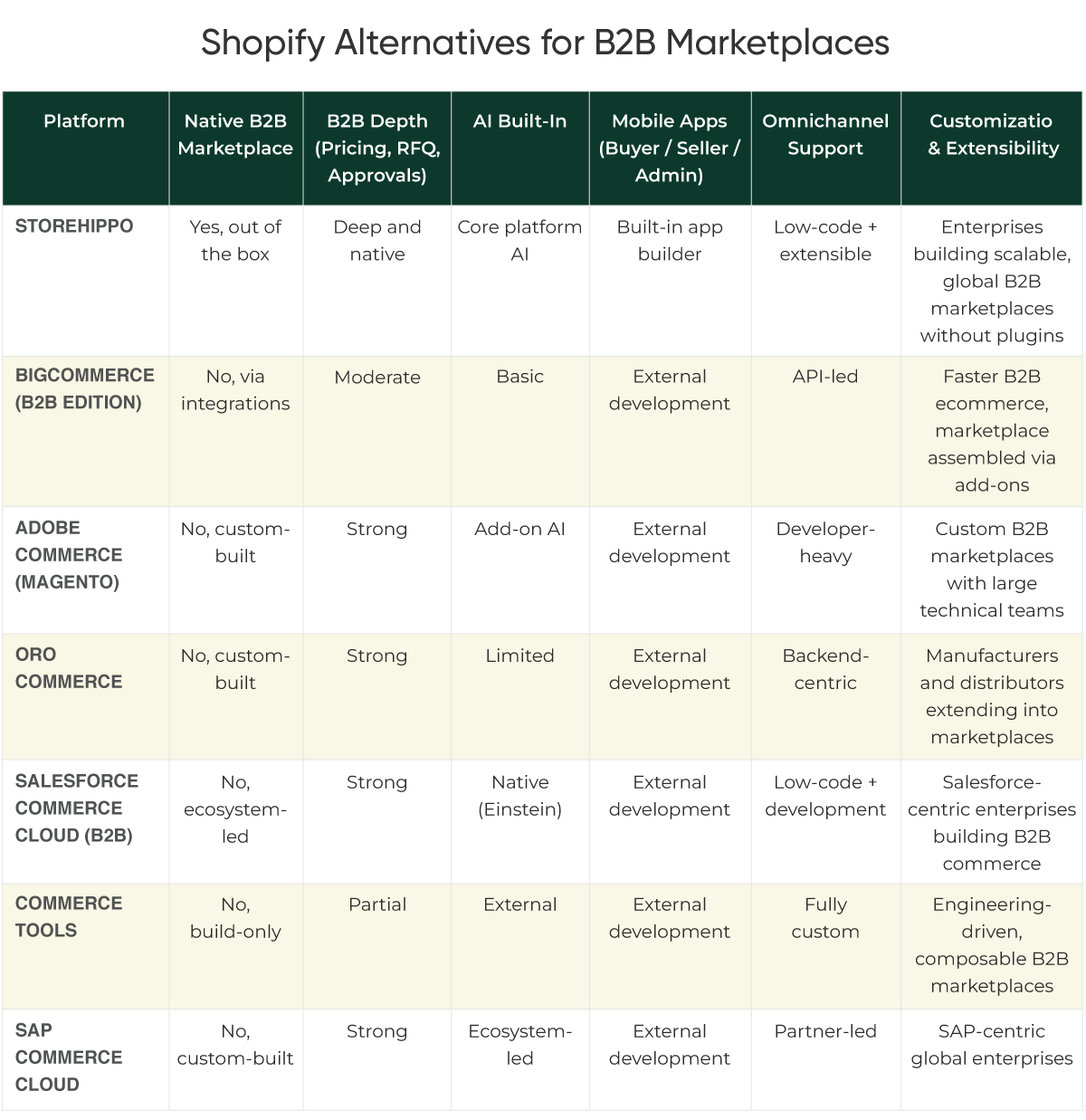
The differences make one thing clear: marketplace readiness is not evenly distributed across platforms. For enterprises building long-term B2B marketplaces, choosing a foundation designed for marketplace operations reduces complexity, cost, and future replatforming risk.
Conclusion
Building and scaling B2B marketplaces is no longer just about choosing an ecommerce tool; it’s about selecting the right operational foundation. As this comparison shows, not all platforms approach marketplace complexity the same way. While many Shopify alternatives can support parts of a B2B online marketplace, only a few are designed to handle multi-vendor operations, complex pricing, workflows, integrations, and regional scale without relying heavily on plugins or custom work.
For enterprises planning global B2B online marketplaces, the right B2B ecommerce platform should reduce operational friction as the business grows, not add to it. That’s why evaluating each platform against your marketplace model, growth plans, and long-term cost structure is critical before committing.
We recommend going through each platform in this guide to understand where it fits best. If your priority is a marketplace-native approach with built-in capabilities across B2B commerce, AI, mobile, and omnichannel operations, start with a StoreHippo demo right away.
FAQ
1. How do I know when Shopify is no longer the right fit for our B2B marketplace?
Shopify usually starts to feel limiting when your B2B marketplace requires multi-vendor operations, negotiated pricing, approval workflows, ERP-led fulfilment, or regional rules. If your team is relying on multiple plugins, custom workarounds, and rising transaction fees to keep things running, it’s a strong signal that a marketplace-native B2B ecommerce platform may be a better long-term fit.
2. What should we prioritise when evaluating a Shopify alternative for B2B marketplaces?
Decision-makers should prioritise native marketplace capabilities, not surface features. Look for built-in multi-vendor support, account-based buying, pricing and contract flexibility, workflow customisation, integrations, and predictable cost at scale. A strong Shopify alternative should reduce operational complexity as your B2B online marketplace grows.
3. Is it better to choose a platform with native marketplace features or build one using integrations?
For enterprise-scale and global B2B online marketplaces, native marketplace functionality is typically more sustainable. Platforms that rely heavily on integrations and custom builds can work, but they often increase time-to-market, maintenance overhead, and total cost of ownership over time.
4. How important is AI when choosing a B2B marketplace ecommerce platform?
AI is becoming a practical requirement, not a nice-to-have. In a B2B ecommerce platform, native AI can simplify catalogue management, improve search and discovery, automate workflows, and support buyers and sellers at scale. Platforms where AI is embedded at the core tend to adapt faster as marketplace complexity increases.
5. Which type of enterprise should consider starting with StoreHippo?
Enterprises building or scaling B2B marketplaces that want native multi-vendor capabilities, built-in AI, omnichannel reach, and long-term operational control should evaluate StoreHippo early. A StoreHippo custom walkthrough helps decision-makers understand how a marketplace-first platform operates compared to plugin-led or heavily customised alternatives.