


The next phase of ecommerce growth belongs to enterprises that can deliver seamless, intelligent, and mobile-first shopping experiences at scale. Your customers no longer shop through a single channel. They move across apps, websites, marketplaces, social platforms, and conversational touchpoints, expecting every interaction to feel smooth and connected.
This shift has transformed multivendor ecommerce apps from an additional sales channel into a core growth driver for modern marketplaces. A scalable marketplace app helps you unify vendors, products, and customer journeys while improving engagement and repeat purchases.
AI is accelerating this growth with smarter product discovery, personalised recommendations, and faster customer interactions. By combining mobile-first experiences with intelligent commerce capabilities, you can improve conversions, scale efficiently, and deliver seamless omnichannel commerce experiences.
Let’s see how marketplace apps and buyers expectations are evolving in this new AI-driven, mobile-first commerce landscape.
Table of Contents
How Ecommerce Marketplace Apps Are Driving Modern Commerce Growth
With more online buyers gravitating towards mobile shopping, enterprise brands are increasingly investing in ecommerce marketplace apps as a core part of their growth strategy. At the same time, AI-powered experiences are transforming how buyers discover products, interact with marketplaces, and complete purchases.
The following trends highlight how mobile apps and AI-powered experiences in apps are reshaping modern ecommerce marketplaces.
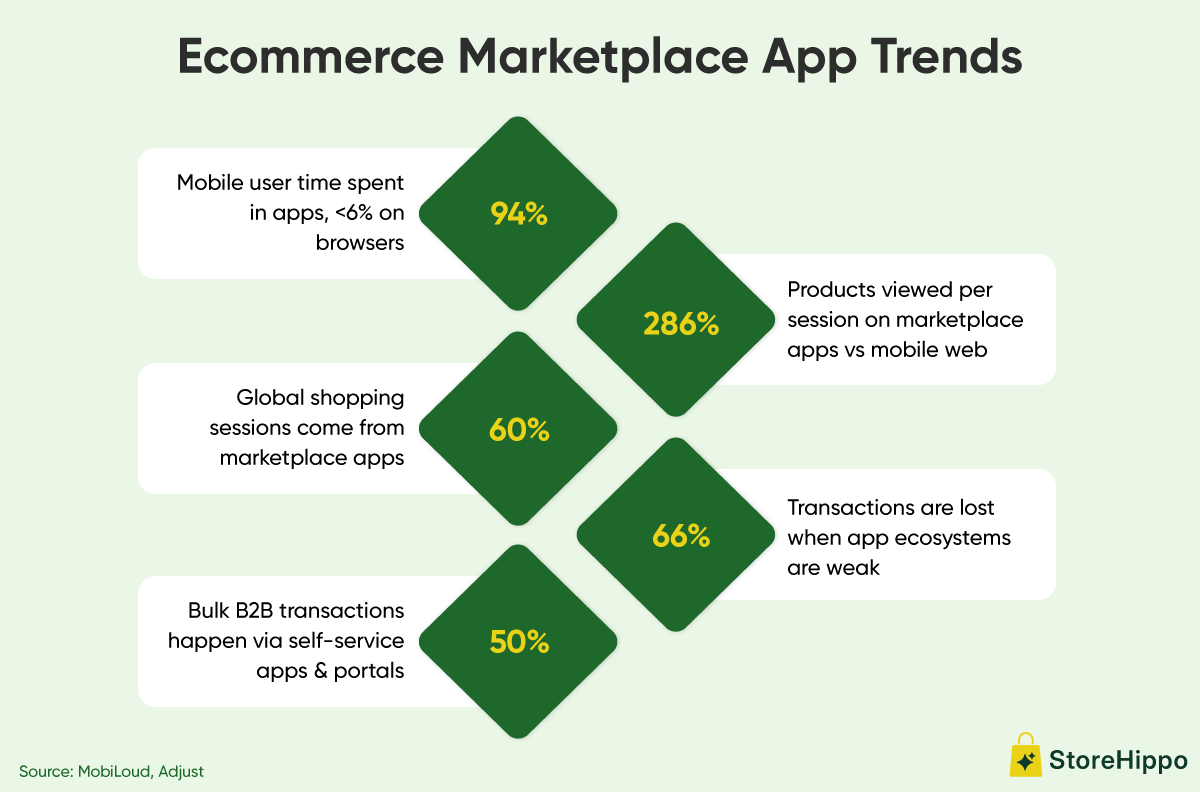
- 94% of mobile user time is now spent inside apps, with less than 6% on browsers
- 286% more products are viewed per session on marketplace apps than on mobile web
- 60% of global shopping sessions come from marketplace apps
- 66% of potential transactions are lost when marketplaces fail to build app ecosystems.
- 50% of bulk B2B transactions now happen through self-service apps and portals
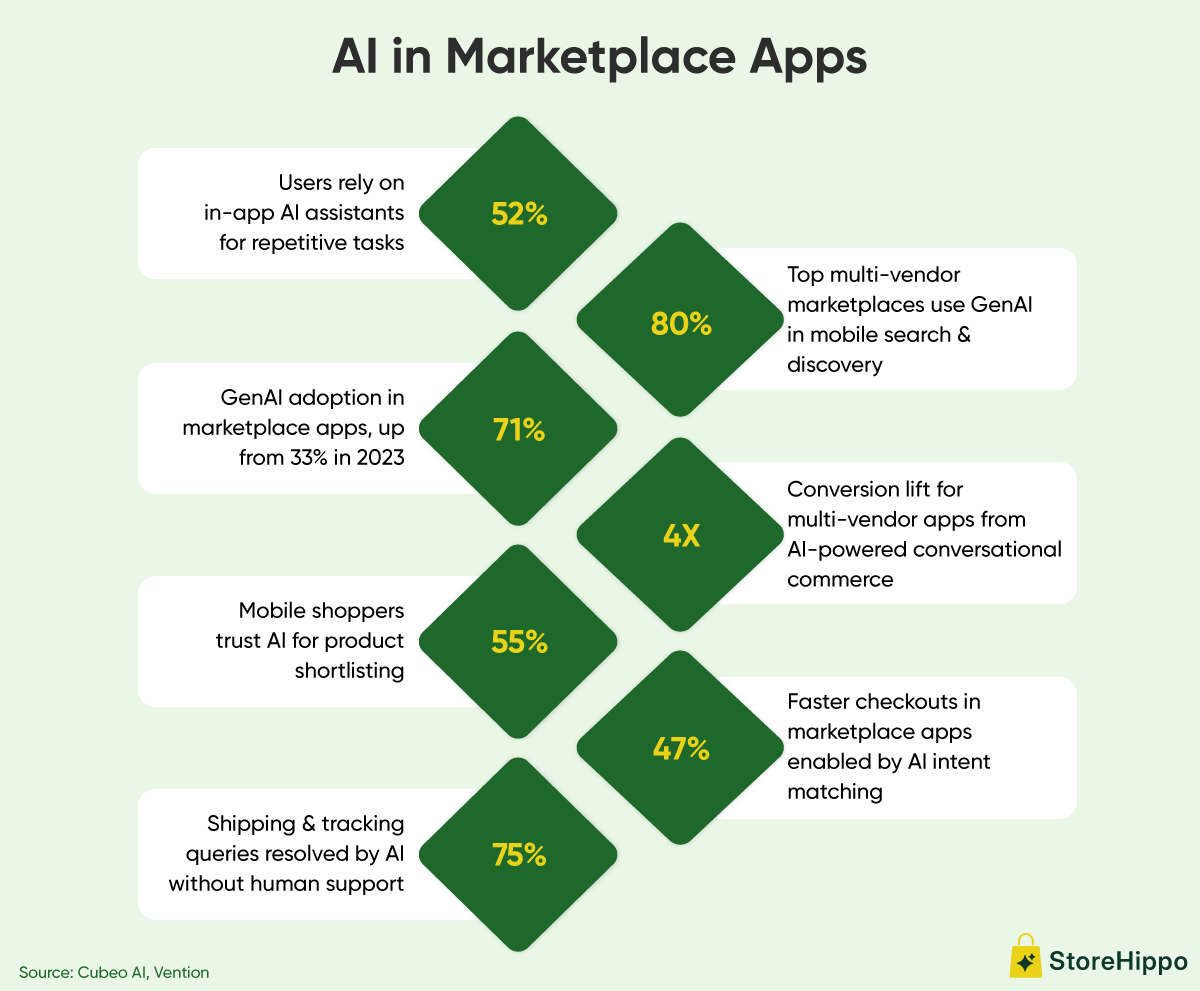
- 52% of users rely on in-app AI assistants to automate repetitive tasks
- 80% of top global multi vendor marketplaces now use Generative AI in core mobile search and discovery
- 71% adoption of Generative AI within marketplace apps jumped from 33% in 2023
- 4X conversion lift for multi-vendor apps using AI-powered conversational commerce
- 55% of mobile shoppers trust AI to shortlist marketplace products
- 47% faster checkouts enabled by AI-powered recommendations in marketplace apps
- 75% of multi-vendor shipping and tracking queries are now resolved by AI without human support
Source: Statista, Vention
The figures suggest that the winning formula for creating a strong niche in the ecommerce market lies in building robust AI-powered multi vendor ecommerce apps. Businesses that combine mobile-first experiences with intelligent commerce capabilities are better positioned to improve engagement, increase conversions, and drive long-term marketplace growth.
Key Benefits of Creating a Multivendor Marketplace App
Today, building a multivendor marketplace app isn’t really a choice anymore, it’s how buyers expect to shop: more options, quick availability, all in one place. When enterprises bring multiple sellers together behind a single app, they meet these expectations naturally while still staying in control of the experience and growth.
Let us look at the top 5 benefits of building your multivendor ecommerce app:
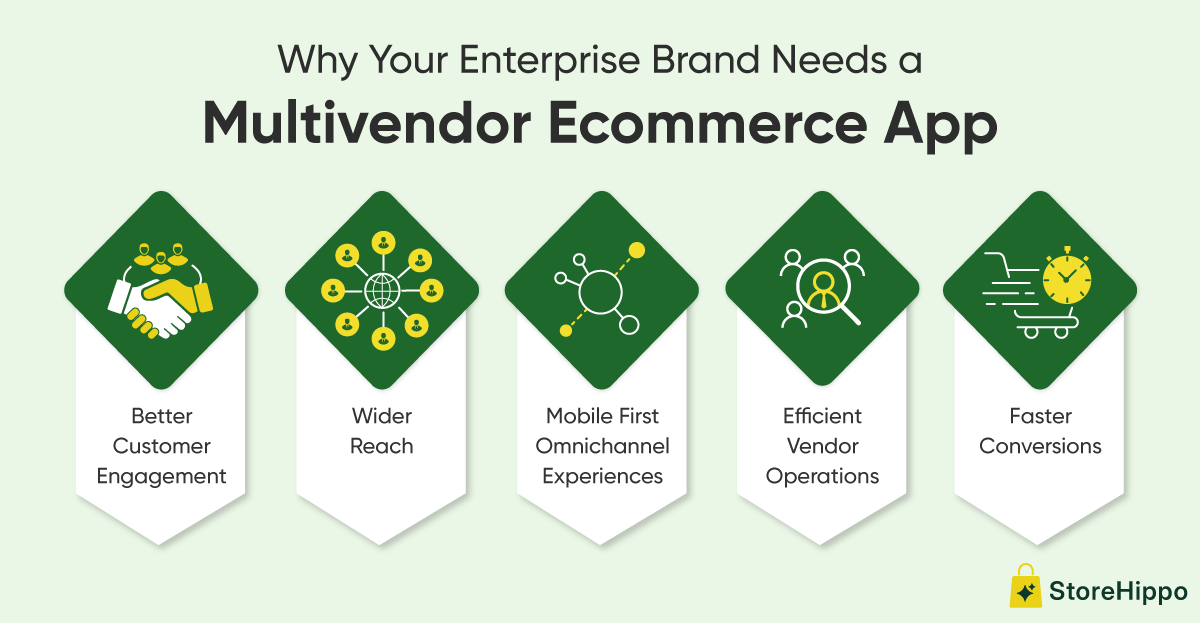
1. Improved Customer Engagement and Brand Visibility
A multivendor ecommerce app helps enterprises stay connected with customers through a direct and always-available shopping channel. Unlike websites that depend on customers returning on their own, a marketplace app keeps the brand visible on their phones, making it easier to drive engagement, repeat visits, and stronger brand recall.
For example, let’s suppose you run a fashion marketplace app and a customer browses ethnic wear during a festive sale. Even if they leave without making a purchase, your app can re-engage them later with personalised offers, price-drop alerts on recently viewed products, loyalty rewards, and recommendations for matching accessories based on their browsing behaviour. These timely and relevant interactions keep your brand top-of-mind, encourage customers to return to the app, and increase the chances of repeat purchases.
You can further enhance customer experiences on your multivendor ecommerce app with AI-powered recommendations that help buyers discover relevant products based on their browsing behaviour, preferences, and past purchases. By delivering more personalised and relevant shopping journeys, enterprises can improve customer engagement, increase repeat purchases, and drive long-term growth.
2. Wider Reach Across Mobile-First Customers
Mobile commerce is reshaping how customers shop, especially in categories where discovery and quick decision-making matter. Multivendor ecommerce apps help enterprises reach these mobile-first users more effectively by offering a fast and always-accessible shopping experience.
For example, imagine a grocery marketplace app serving customers across multiple cities. While travelling back home from work, a customer receives a notification about discounts on everyday essentials like milk, fruits, or household items. Instead of visiting a website and searching again, they simply open the app, compare prices, and place the order in a few minutes, all before reaching home.
Similarly, in low-bandwidth or tier-2 markets, a lightweight marketplace app or PWA enables users to browse catalogues smoothly even on slower networks. This ensures that enterprises don’t lose potential customers due to connectivity limitations.
These real-world scenarios show how multivendor ecommerce apps don’t just increase reach, they actively convert mobile usage into faster discovery, quicker decisions, and higher sales across diverse customer segments.
3. Mobile First Omnichannel Experiences
Modern customers interact with brands across multiple channels before making a purchase. This shift in behaviour has made omnichannel commerce essential for enterprise marketplaces.
A multivendor ecommerce app helps enterprises connect with customers across different channels and create a smooth shopping experience wherever users are active. Instead of depending only on a website, brands can reach customers through Android and iOS apps, PWAs, WhatsApp, social and conversational channels.
For example, businesses can launch mobile apps on Android and iOS to give customers a fast, easy, and personalised shopping experience that stays accessible on their phones. At the same time, PWAs help users in low-network or low-storage areas browse products and place orders without needing to download a full app. This makes it easier to reach customers in smaller towns and regions with connectivity challenges.
Beyond apps and web experiences, multivendor ecommerce platforms can also unlock strong opportunities through social and messaging channels. Enterprises can leverage platforms like WhatsApp, where over 92% of mobile users are active, to drive product discovery, customer engagement, and direct conversions. Customers can receive updates, explore products, and complete purchases within a familiar chat interface, making the buying journey faster and more convenient.
By combining mobile apps, PWAs, WhatsApp commerce, and social channels, enterprises can build a powerful omnichannel commerce strategy that expands reach, improves engagement, and increases conversion opportunities across diverse customer segments.
4. Easier Vendor Management and Operational Efficiency
A multivendor ecommerce app helps enterprises simplify vendor management by enabling faster communication, real-time updates, and smoother coordination across the marketplace.
As marketplaces scale, vendors need quick access to orders, inventory, pricing, and fulfilment updates. A marketplace app allows them to manage all key operations directly from their mobile devices, improving speed and reducing delays.
For example, in a B2B automobile parts marketplace, a distributor supplying spare parts to garages can instantly update stock availability across warehouses, adjust pricing for bulk orders, confirm delivery timelines, and manage dispatch with logistics partners in real time. This helps garages get accurate availability information and reduces delays in vehicle servicing.
Marketplace apps also make it easier to handle daily tasks like product updates, order tracking, and inventory management through a single interface, improving accuracy and efficiency.
For large enterprise marketplaces, these mobile-first capabilities help manage distributed vendor networks more effectively, improve coordination, and ensure smoother operations at scale.
5. Faster Purchases and Higher Order Volumes
Convenience is one of the key reasons customers prefer shopping through marketplace apps. Faster browsing, simple checkout flows, saved payment methods, and personalised experiences help customers complete purchases quickly and more frequently.
Research shows that impulse buying accounts for nearly 40% to 80% of purchases made through mobile channels, highlighting how mobile-first experiences directly influence buying behaviour and order volumes.
For example, a customer receiving a limited-time offer notification can open the marketplace app, view recommended products, apply the discount, and complete the purchase within minutes. The reduced friction in the buying journey encourages faster decisions and higher conversions.
Marketplace apps also support repeat purchases by making reordering simple and quick. Customers can easily access past orders, reorder frequently used products, and shop across multiple vendors within a single platform.
As marketplaces scale, seamless checkout and payment experiences become essential for improving conversions. Combined with AI-powered recommendations, better product discovery, and omnichannel capabilities, multivendor ecommerce apps help enterprises improve customer convenience, increase order volumes, and drive sustainable marketplace growth.
How StoreHippo Helps Enterprises Build Future-Ready AI powered Multivendor Ecommerce Apps
Building a successful multivendor ecommerce app requires more than just a mobile storefront. Enterprises need a scalable commerce marketplace app that can support multiple vendors, large product catalogues, omnichannel operations, and evolving customer expectations while delivering seamless shopping experiences across channels.
Here's how StoreHippo is the right platform for building scalable multivendor ecommerce apps.
- Mobile-first commerce architecture designed for modern marketplace growth and seamless mobile shopping experiences.
- AI-native ecommerce platform where core business operations are powered by AI to improve efficiency, automation, and customer experiences.
- No-code built-in mobile app builder that helps enterprises create Android and iOS marketplace apps directly from the admin dashboard without coding.
- Progressive Web App (PWA) capabilities for delivering lightweight and fast shopping experiences in low-connectivity or low-storage environments.
- Omnichannel ecommerce capabilities to unify websites, mobile apps, marketplaces, social commerce, and conversational commerce channels into one ecosystem.
- Built-in multivendor marketplace solution to manage vendors, catalogues, orders, inventory, payments, and fulfilment operations from a unified backend.
- MACH architecture support (Microservices, API-first, Cloud-native, and Headless) for enterprise scalability, flexibility, and faster innovation.
- Headless commerce capabilities that allow enterprises to customise frontend experiences and scale across multiple business models.
- API-first architecture with 350+ API endpoints for easy third-party integrations and custom commerce workflows.
- Built-in apps for vendors and admins to manage products, inventory, orders, and business operations on the go.
- Custom delivery boy apps to streamline delivery management, order tracking, and fulfilment processes.
- Seamless integrations with ERP, CRM, payment gateways, logistics, marketing, and analytics tools to unify the entire commerce ecosystem and enable real-time data flow across systems.
- Multi model support to launch and manage B2B, B2C, D2C, B2B2C, hyperlocal and hybrid business models on a single platform.
With AI native solutions, 300+ enterprise features, 150+ integrations and 350+ API endpoints, StoreHippo enables enterprises to build high-performance multivendor ecommerce apps designed for long-term omnichannel commerce growth.
Conclusion
Multivendor ecommerce apps have become essential for enterprises looking to improve customer engagement, expand mobile reach, streamline marketplace operations, and deliver seamless omnichannel commerce experiences. As mobile-first shopping and AI-powered commerce continue to grow, businesses need scalable marketplace apps that can support evolving customer expectations and long-term growth.
StoreHippo helps enterprises build future-ready multivendor ecommerce apps with mobile-first architecture, omnichannel commerce capabilities, built-in marketplace management, and AI-powered commerce features.
Ready to scale your marketplace business? Explore StoreHippo’s multivendor app solutions by booking your personalised demo today.
FAQs
1. How can enterprises ensure their multivendor ecommerce app stays scalable as vendor onboarding and order volumes increase?
Enterprises should choose a multivendor ecommerce app solution built on a scalable, API-first, and cloud-native architecture from the beginning. This helps handle growing vendors, large catalogues, and increasing order volumes without slowing down operations.
2. What should enterprises prioritise while selecting a marketplace app solution for long-term omnichannel commerce growth?
Enterprises should focus on whether the marketplace app can unify multiple channels, vendors, logistics, and customer journeys from one platform. A future-ready solution should support mobile apps, PWAs, WhatsApp commerce, and conversational commerce together.
Businesses should also look for flexibility, integrations, and AI-powered automation to scale operations without rebuilding systems later.
3. How can a multivendor ecommerce app help enterprises improve vendor retention and marketplace efficiency?
A multivendor ecommerce app helps vendors manage inventory, orders, pricing, and fulfilment more easily through mobile-first tools. Faster operations and better visibility improve vendor experience and reduce operational delays.
For enterprises, this creates smoother coordination across sellers and helps manage large vendor networks more efficiently.
4. Why are AI capabilities becoming essential in modern marketplace app strategies?
AI helps enterprises automate marketplace operations, improve product discovery, and deliver more personalised shopping experiences. It also reduces manual effort across catalogue management, customer support, and search.
An AI-native multivendor ecommerce app enables businesses to improve efficiency, increase conversions, and scale omnichannel commerce more effectively.
5. How can enterprises future-proof their marketplace app for changing customer expectations and business models?
Enterprises should invest in flexible, AI-native, and headless commerce platforms that can adapt quickly to new channels, customer behaviour, and business models. This allows faster innovation without disrupting existing operations.
A scalable multivendor ecommerce app built on MACH and API-first architecture helps businesses expand into new markets, launch multiple storefronts, and deliver seamless omnichannel commerce experiences at scale.