


Many growing B2B marketplace brands begin their digital journey on Shopify, but as complexity increases, they quickly start evaluating best Shopify alternatives that can support scale without fragmentation. What works well for simple commerce often struggles when marketplaces introduce multiple sellers, buyer-specific pricing, approvals, integrations, and regional operations.
This shift is rarely sudden. It usually begins with small workarounds, adding apps to manage pricing, approvals, logistics, or integrations. Over time, those workarounds become dependencies, making operations harder to manage and growth harder to predict.
Enterprise teams then face a critical question: should they keep patching the system, or move to a Shopify competitor platforms designed to handle wholesale marketplace complexity at its core?
This blog explores the structural reasons that push B2B marketplace brands to rethink Shopify and consider platforms built for long-term scale and operational control.
Table of Contents
- Why B2B Marketplace Brands Migrate from Shopify as They Scale
- 1. Shopify Is Built for D2C, Not B2B Marketplaces
- 2. Plugin Dependency Breaks at B2B Scale
- 3. No Native Multi-Vendor Marketplace Solutions
- 4. No Native AI Core or Custom Agentic Capabilities
- 5. Workflow Customisation Is Severely Limited
- 6. Omnichannel and Multi-Store B2B Is Not Native
- 7. B2B Pricing and Payment Solutions Are Not Seamless
- 8. Total Cost of Ownership Becomes Unpredictable
- 9. API and Integration Limits Slow Down Enterprise Systems
- 10. Complex Multi-Model Commerce Is Hard to Sustain on Shopify
- B2B Marketplace Capabilities: Shopify vs StoreHippo at a Glance
- Conclusion
- FAQ
Why B2B Marketplace Brands Migrate from Shopify as They Scale
As B2B marketplace businesses mature, the conversation shifts from launching faster to operating smarter. Leadership teams begin examining whether their platform can support long-term efficiency, governance, and expansion without constant technical intervention.
For many, Shopify starts to feel less like a growth enabler and more like an operational bottleneck. This is the stage where platform decisions are revisited, not because of missing features, but because scalability, control, and predictability become critical.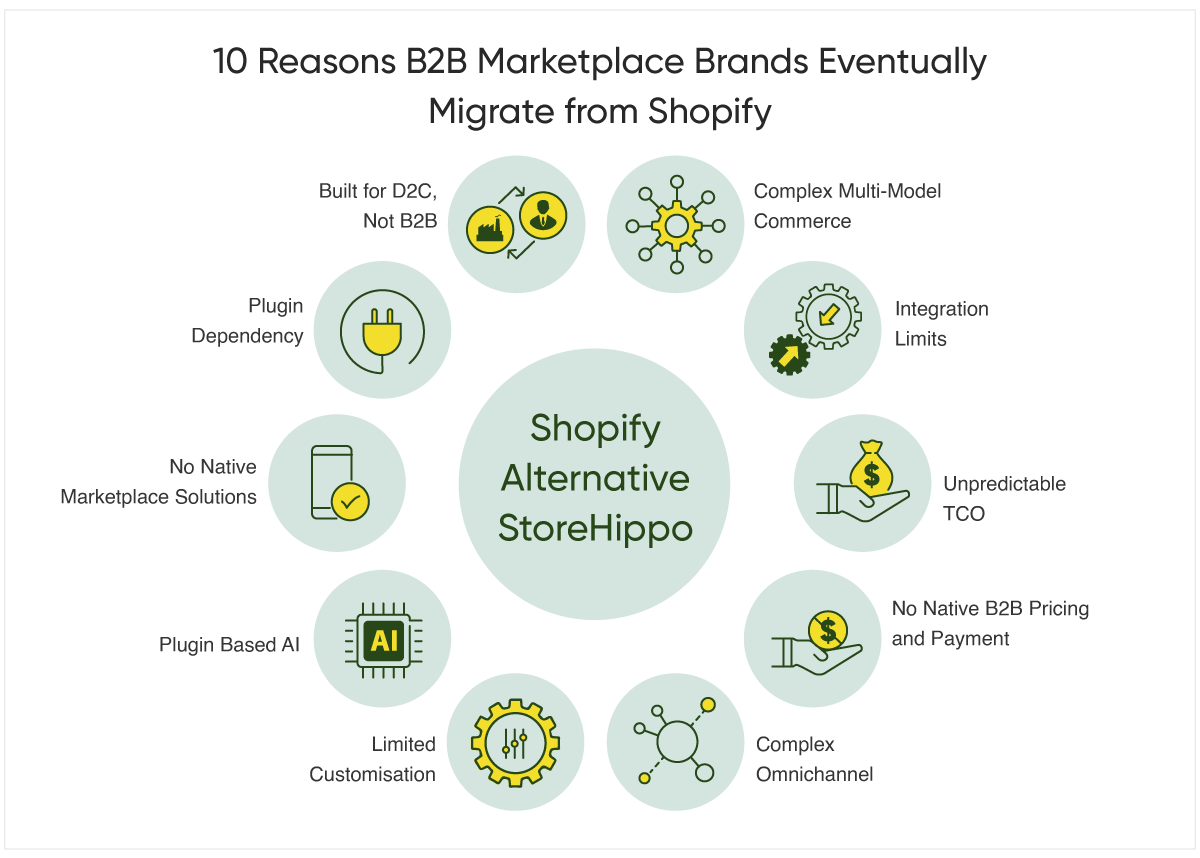
Here are the top 10 reasons that compel enterprise wholesale marketplaces to explore Shopify competitors:
1. Shopify Is Built for D2C, Not B2B Marketplaces
Many B2B marketplace brands start on Shopify because it’s a popular choice among ecommerce platforms designed for quick launches and turnkey B2B ecommerce solutions. However, Shopify is fundamentally designed for D2C use cases, focusing on a simple product–cart–checkout flow.
As B2B marketplace operations grow, brands need RFQs, negotiated pricing, buyer-specific catalogs, approval workflows, credit limits, and vendor management. On Shopify, these capabilities are not native and must be stitched together using apps and custom development. This is often the first point where B2B brands begin evaluating best Shopify alternatives as operational complexity increases.
How StoreHippo helps:
- Built natively for B2B marketplace and multi-vendor business models
- Supports buyer segment-specific pricing, catalogs, and approval workflows out of the box
- Handles RFQs, MOQ, credit limits, and negotiated pricing without external apps
- Centralises vendor management, buyers, and transactions in one system
- Scales complex B2B operations without relying on plugin-heavy workarounds
2. Plugin Dependency Breaks at B2B Scale
As B2B marketplace operations grow, different parts of the business, pricing, vendor management, tax logic, logistics, and order workflows; must work together seamlessly. On Shopify, this coordination depends heavily on apps. Each function is typically handled by a separate plugin, often built by different vendors and updated on different cycles.
As complexity increases, these apps don’t share context, leading to data mismatches, broken workflows, and frequent operational issues. For many B2B brands, this app overload becomes the tipping point to reassess Shopify competitors and consider sites like Shopify that can support scale without constant patching.
How StoreHippo contrasts:
- Eliminates plugin dependency with 300+ native enterprise features
- Uses a unified backend logic across pricing, vendors, orders, and logistics
- Reduces system breakage caused by third-party app conflicts
- Simplifies operations by keeping workflows inside one platform and central control
- Scales B2B marketplace complexity without increasing technical overhead
3. No Native Multi-Vendor Marketplace Solutions
Running a true B2B marketplace means managing multiple sellers, each with their own products, inventory, pricing rules, commissions, settlements, and performance visibility. On Shopify, these capabilities are not available natively. Seller onboarding, vendor dashboards, commission management, and settlement logic typically require heavy custom development or third-party marketplace apps.
Even on Shopify Plus, core marketplace controls like vendor management, complex fulfilment flows, and hybrid B2B2C models remain fragmented. As operational risk and cost rise, many brands start evaluating sites like Shopify and planning to migrate from Shopify to platforms built for marketplaces.
How StoreHippo contrasts:
- Provides native multi-vendor marketplace support out of the box
- Supports seller onboarding, commissions, and settlements without plugins
- Offers dedicated vendor dashboards, dedicated seller pages/storefronts on the B2B marketplace with inventory, order and fulfilment control
- Enables centralised governance across sellers and fulfilment workflows
- Scales B2B and B2B2C marketplace models without custom builds
4. No Native AI Core or Custom Agentic Capabilities
Modern B2B marketplaces are no longer driven only by listings and transactions. They increasingly rely on AI to manage large catalogs, improve product discovery, assist buyers in decision-making, onboard sellers faster, and reduce operational load.
On Shopify, AI capabilities are largely tool-led or app-driven, focused on isolated use cases rather than the entire marketplace lifecycle. This limits how deeply intelligence can be embedded into workflows. As B2B brands look to scale efficiently and differentiate experiences, the absence of a native AI foundation becomes a key reason to explore Shopify competitors, especially when planning to migrate from Shopify.
How StoreHippo AI-Core Helps:
- Embeds AI natively across cataloging, search, and workflows
- Supports custom agentic AI development for buyers, sellers, and support solutions
- Improves discovery, onboarding, and support without external tools
- Enables AI-driven automation through easy cataloging and image edit via Magic Edit across marketplace operations
- Same AI intelligence powers every layer and model of ecommerce as part of the core platform, not as add-on
5. Workflow Customisation Is Severely Limited
B2B marketplaces rarely follow a linear order flow. They depend on approval hierarchies, role-based access, custom order states, internal validations, and operational checkpoints that vary by buyer, seller, region, or deal size.
On Shopify, workflow flexibility is limited by design. Most advanced workflows require external automation tools, custom scripts, or higher-tier plans, making them difficult to maintain as complexity grows. Over time, B2B brands find that even small process changes take disproportionate effort, pushing them to evaluate Shopify alternatives that offer deeper control when they migrate from Shopify.
How StoreHippo contrasts:
- Headless and composable architecture with microservices allows native customisation of B2B workflows without external tools
- Supports approval flows, role-based access, and audit logs etc
- Headless platform and extensible entities can be tweaked easily without disturbing core workflow logic across buyers, sellers, payments, and fulfilment
- Easily adapts with operational processes as business models evolve
- With detailed B2B features and multi vendor, multi store, dealer, admin and other modules built-in does not require additional scripts, apps, and manual interventions
6. Omnichannel and Multi-Store B2B Is Not Native
As B2B marketplace brands expand, they rarely operate through a single marketplace storefront or channel. They need multiple offline and online channels, buyer portals, regional stores, dealer networks, private catalogs, and language or currency variations often all running in parallel.
On Shopify, managing multi-store and omnichannel B2B setups quickly becomes complex. Each new channel or region adds operational overhead, duplicate configurations, and integration challenges. Also building mobile apps or new digital touchpoints requires separate development efofrt. What starts as growth soon turns into fragmented systems that are hard to govern. This is a common trigger for enterprises to reassess Shopify competitors and look for alternatives that can support omnichannel presence.
Why Enterprise B2B Companies migrate from Shopify to StoreHippo:
- Supports multi-store and multi-region B2B operations natively
- Manages multiple region, brand or customer segment specific marketplace storefronts from a single unified backend
- With central master catalog enables consistent catalogs, pricing, and inventory across channels
- Native omnichannel capabilities and mobile apps builder power web, mobile apps, PWAs, and other digital touchpoints like Agentic Interfaces, WhatsApp etc from a single platform
- Scales omnichannel B2B without duplicating systems or workflows
7. B2B Pricing and Payment Solutions Are Not Seamless
B2B marketplaces depend on complex pricing and payment structures that go far beyond a standard checkout. Tiered pricing, customer-specific price lists, MOQs, RFQs, volume-based discounts, negotiated contracts, credit terms, partial payments, and tax or GST logic must all work together.
On Shopify, these requirements are handled through multiple apps, each solving a small part of the problem. As scale increases, pricing mismatches, tax errors, and payment inconsistencies become common. This fragmentation often forces B2B brands to evaluate platforms and apps like Shopify or plan to migrate from Shopify to avoid operational and financial risk.
How StoreHippo simplifies these B2B challenges:
- Supports natively tiered pricing, RFQ, MOQ and admin-vendor- buyer chats for custom pricing
- Handles credit limits, partial payments and B2B payment flows without plugins
- Built-in tax engine simplifies tax and GST logic consistently across pricing and checkout
- Unifies pricing, payments, and invoicing in one system along with multi currency invoicing
- With 60+ pre-integrated payment gateways simplifies B2B payment complexity without issues
8. Total Cost of Ownership Becomes Unpredictable
For many B2B marketplace brands, Shopify appears cost-effective at the start. But as operations grow, the real expenses surface quietly. App subscriptions multiply, transaction fees add up, middleware is introduced to connect systems, and custom development becomes unavoidable.
Each new requirement, pricing logic, vendor management, approvals, or integrations often means another paid tool. Over time, finance and technology teams struggle to forecast costs accurately. This unpredictability is a common reason enterprises begin comparing Shopify competitors and Shopify alternatives, eventually deciding to move from Shopify when ongoing operating costs outweigh the effort of replatforming.
How StoreHippo offers Transparent Costs:
- Reduces reliance on paid third-party apps with native capabilities which prevents costs from snowballing
- Keeps platform costs predictable as scale and complexity increase
- Eliminates hidden transaction and maintenance overheads
- Auto updates, support for mobile apps and different business models lowers long-term costs for expansion and
- Makes enterprise growth cost effective and transparent which helps with better budget allocation and growth planning
9. API and Integration Limits Slow Down Enterprise Systems
B2B marketplaces don’t operate in isolation. They rely heavily on ERP, CRM, finance, inventory, supply-chain, and analytics systems to function as one connected custom ecosystem for each brand.
On Shopify, integrations are often constrained by API limits, partial data exposure, and reliance on middleware or connector apps. As transaction volumes and system dependencies grow, real-time synchronisation becomes harder to maintain. Delays, data gaps, and manual reconciliation start impacting operations. At this stage, many enterprises reassess Shopify competitors and explore alternatives that can support deep, seamless integrations when they decide to migrate from Shopify.
How Shopify alternative StoreHippo handles integrations:
- Built on an API-first, headless architecture enables seamless integrations to build tailored B2B marketplace ecosystems
- Offers 300+ REST APIs and 150+ pre-integrations across different ecommerce layers
- Enables real-time data sync through webhooks and events
- Integrates seamlessly with preferred ERP, CRM, finance, tax, marketing, payment and supply-chain systems
- Microservices architecture makes it quick and easy to add, remove or replace enterprise integrations without bottlenecks
10. Complex Multi-Model Commerce Is Hard to Sustain on Shopify
As B2B marketplace brands mature, they rarely operate under a single business model. Many need to run B2B, D2C, B2B2C, cross border commerce and marketplace models together, often sharing inventory, pricing logic, vendors, and fulfilment workflows.
While Shopify (even Shopify Plus) supports B2B and D2C and other models, it does so largely in isolation. Managing multiple models side by side introduces duplication, custom workarounds, and operational friction. Over time, this lack of cohesion makes it difficult to scale or adapt. This is when enterprises actively compare apps like Shopify and Shopify competitors, and seriously consider whether it’s time to migrate from Shopify.
How StoreHippo built-in Multi Model Support helps:
- Supports B2B, D2C, B2B2C, hyperlocal, go global, multi store and marketplace models natively
- Runs multiple business models from a single unified backend
- Shares inventory, pricing, vendors, and fulfilment logic seamlessly
- Eliminates duplication across storefronts and workflows
- Enables enterprises to pivot to new hybrid or out-of-box models without replatforming
As B2B marketplaces mature, the real challenge shifts to sustaining control as operational complexity increases. When plugin-based platforms like Shopify begin to add friction instead of flexibility, enterprise teams reassess their long-term suitability. This is where StoreHippo is often considered the best Shopify alternative, designed to support B2B marketplace complexity natively with its rich feature set and tools.
B2B Marketplace Capabilities: Shopify vs StoreHippo at a Glance
This comparison looks at how each platform handles B2B marketplace requirements as complexity increases. It highlights the structural differences in how Shopify and StoreHippo approach the demands of an enterprise wholesale marketplace.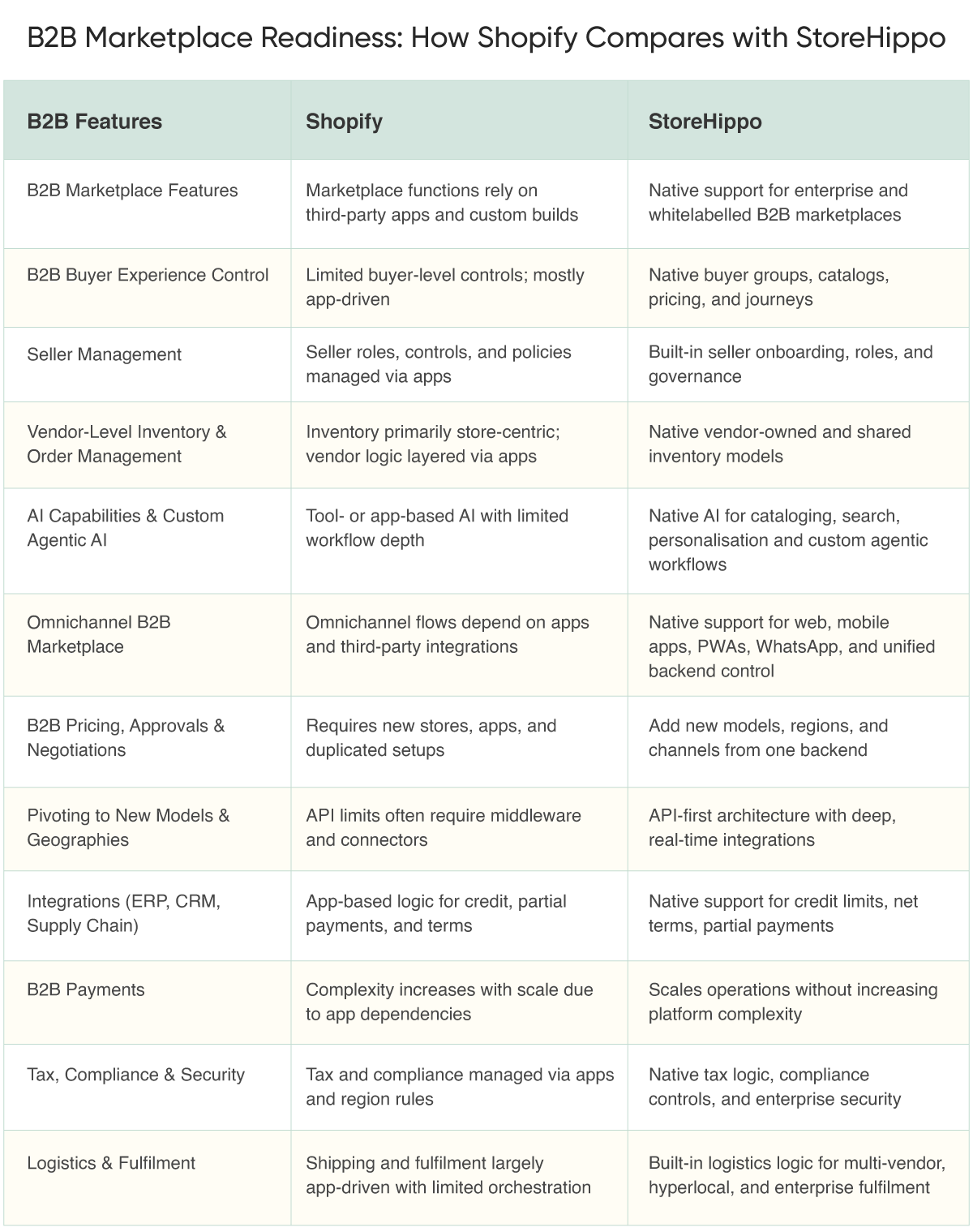
From an enterprise perspective, this comparison highlights a clear structural difference in how platforms handle B2B marketplace complexity. Shopify can support B2B use cases, but largely through an expanding stack of apps, custom builds, and integrations that increase operational overhead as scale grows. This approach often works in the early stages but becomes harder to manage when marketplaces introduce multiple sellers, buyer-specific pricing, approvals, omnichannel touchpoints, and region-specific compliance.
In contrast, the best Shopify alternative StoreHippo approaches B2B marketplace requirements at the platform level. Core capabilities such as seller governance, buyer experience control, pricing logic, payments, AI-driven workflows, omnichannel operations, and compliance are designed to work together from a single backend. For enterprise teams, the distinction is less about features and more about predictability, how easily the platform can absorb growth, new business models, and geographic expansion without increasing complexity or cost.
Conclusion
For B2B marketplace leaders, the decision to migrate from Shopify is rarely driven by a single limitation. It’s usually the result of accumulated complexity, more sellers, more buyers, more regions, and more operational rules than an app-led platform can comfortably support. As marketplaces evolve, the focus shifts from adding features to maintaining control, predictability, and scalability.
This is where many enterprises begin evaluating Shopify alternatives that are better aligned with long-term B2B growth. Platforms like StoreHippo are considered not as Shopify competitors, but as foundations that can support evolving marketplace models without constant restructuring.
If your B2B marketplace roadmap demands flexibility without fragmentation, it may be time to reassess your platform choice. Explore how StoreHippo can support your next phase of growth. Book a demo now.
FAQ
1. What should enterprises evaluate when choosing Shopify alternatives for a B2B marketplace?
When evaluating Shopify alternatives, enterprises should focus on how the platform handles B2B complexity at scale, especially overall management, pricing logic, integrations, and long-term flexibility. The key question is whether these capabilities are native to the platform or dependent on apps and custom workarounds.
2. Can Shopify support long-term growth for a complex B2B marketplace model?
Shopify can support early-stage B2B use cases, but long-term growth often introduces operational complexity that requires deeper workflow control, multi-seller management, and system-level integrations. Enterprises usually reassess when scale increases faster than platform flexibility.
3. How important is platform architecture when building a scalable B2B marketplace?
For a B2B marketplace, platform architecture determines how easily the system adapts to new workflows, regions, and business models. API-first and modular architectures like StoreHippo reduce dependency on external tools and make scaling more predictable for enterprise teams.
4. Do B2B marketplaces need AI as a core capability or as an add-on?
For enterprise B2B operations, AI delivers the most value when it is part of the core platform rather than an external add-on. Native AI enables consistent cataloging, discovery, automation, and assisted workflows without fragmenting operations across tools.
5. When does it make sense to move to StoreHippo as a Shopify alternative for B2B marketplaces?
It usually makes sense to consider StoreHippo when B2B marketplaces start feeling constrained by multiple apps that don’t work together as one system. As seller count, pricing complexity, approvals, integrations, and regional operations grow, app-based setups often create operational friction instead of flexibility. At this stage, decision-makers look for a Shopify alternative that can handle marketplace logic, workflows, and integrations natively, so growth doesn’t come at the cost of control or predictability.