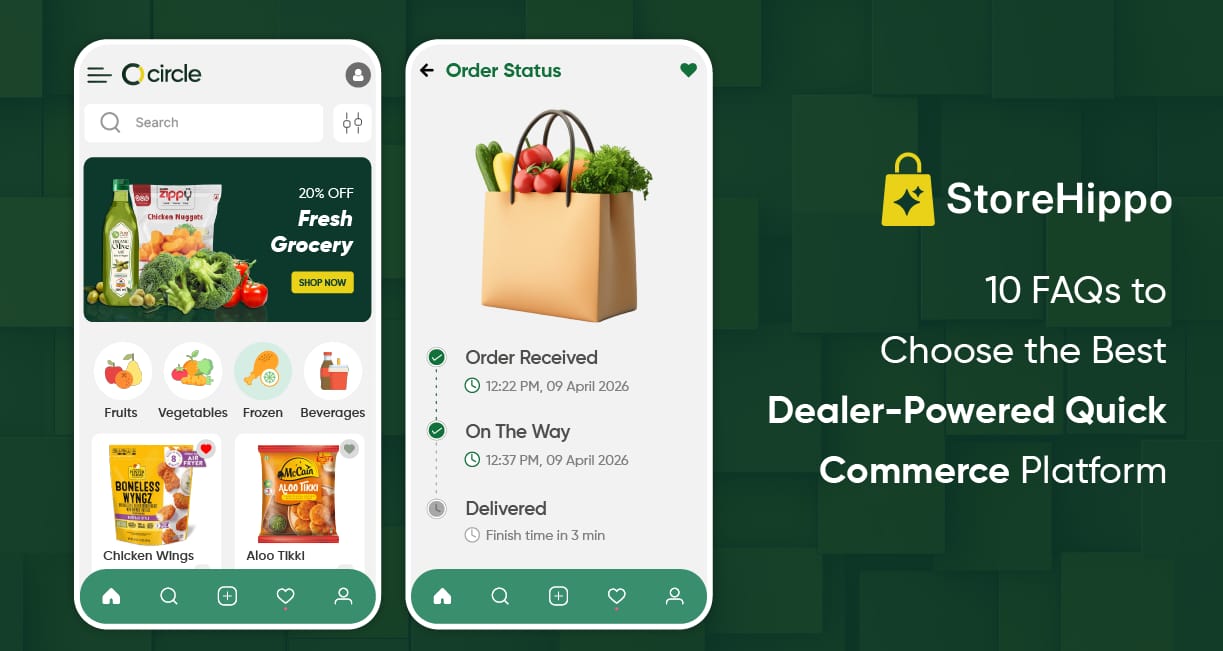



Quick commerce scaled on speed, but the model behind that speed is beginning to show its limits.
Warehouse-heavy and dark store-led setups worked well in the early growth phase. However, at enterprise scale, they start to strain. High setup and operating costs, fragmented inventory across locations, and rising last-mile expenses are making “faster” increasingly expensive to sustain. What once enabled rapid expansion is now adding layers of complexity and putting pressure on margins.
The question is no longer how to deliver faster. It’s how to deliver efficiently at scale.
This is where the model is evolving. Enterprises are moving toward dealer-powered quick commerce, shifting fulfilment from infrastructure-heavy networks to existing dealer and distributor ecosystems that are already closer to demand. It’s a more distributed, asset-light approach that improves reach while keeping costs in control.
Table of Contents
- Dealer-Powered Quick Commerce: The Next Phase of Scalable Growth
- 10 Strategic Questions to Evaluate Before Launching a Dealer-Powered Quick Commerce Marketplaces
- 1. Can the platform support dealer-powered quick commerce with location-based fulfilment from nearby dealers?
- 2. How efficiently can vendors and dealer networks be onboarded, managed, and scaled on the hyperlocal marketplace?
- 3. Can enterprises create a hyperlocal marketplace with location-based storefronts that support different catalogues, pricing, and branding for each region?
- 4. Does the hyperlocal marketplace platform support multilingual and multi-currency experiences for domestic and international expansion?
- 5. What payment options are available for dealer-powered quick commerce, including COD, UPI, wallets, etc?
- 6. How does the quick commerce platform manage order routing, fulfilment, and logistics across multiple dealers and locations?
- 7. Can AI automate key operations like product discovery, catalogue management, and personalised buying experiences on the hyperlocal marketplace platform?
- 8. Does the dealer powered quick commerce platform provide AI-powered support bots for buyers, sellers, and dealers to handle routine queries and operations?
- 9. Can the dealer powered quick commerce platform unify web, mobile apps, WhatsApp, and other channels for a seamless quick commerce experience?
- 10. How can enterprises monitor performance, optimise operations, and scale dealer powered quick commerce marketplaces efficiently?
- Conclusion
Dealer-Powered Quick Commerce: The Next Phase of Scalable Growth
Quick commerce is maturing. What began as a convenience layer is now becoming a core part of enterprise commerce strategy.
As demand expands across cities, categories, and customer segments, the limitations of centralised inventory and dark store models are becoming harder to ignore. Enterprises need a model that can scale without replicating infrastructure in every new market.
Dealer-powered quick commerce addresses this shift. By leveraging existing networks for fulfilment, businesses can move closer to customers, reduce delivery timelines, and scale faster, without proportionally increasing operational overhead.
The data that follows highlights how this shift is taking shape and why enterprises are rethinking their approach to quick commerce.
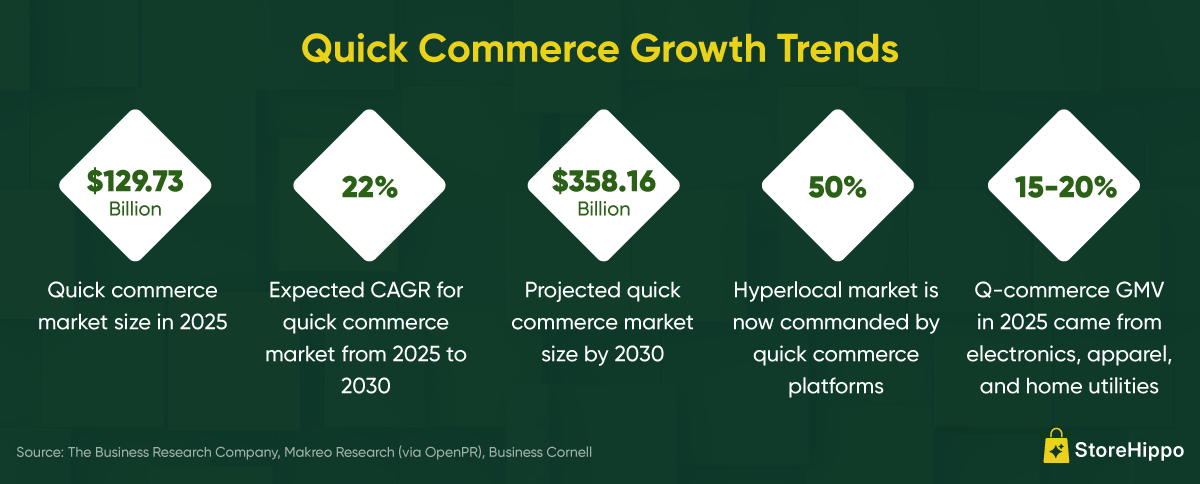
- $129.73 bn was the quick commerce market size in 2025
- 22 % is the expected CAGR for the quick commerce market from 2025 to 2030
- $358.16bn is the projected quick commerce market size by 2030
- 50% of the hyperlocal market is now commanded by quick commerce platforms
- 15-20% of Q-commerce GMV in 2025 came from electronics, apparel, and home utilities
Source: The Business Research Company, Makreo Research (via OpenPR), Business Cornell
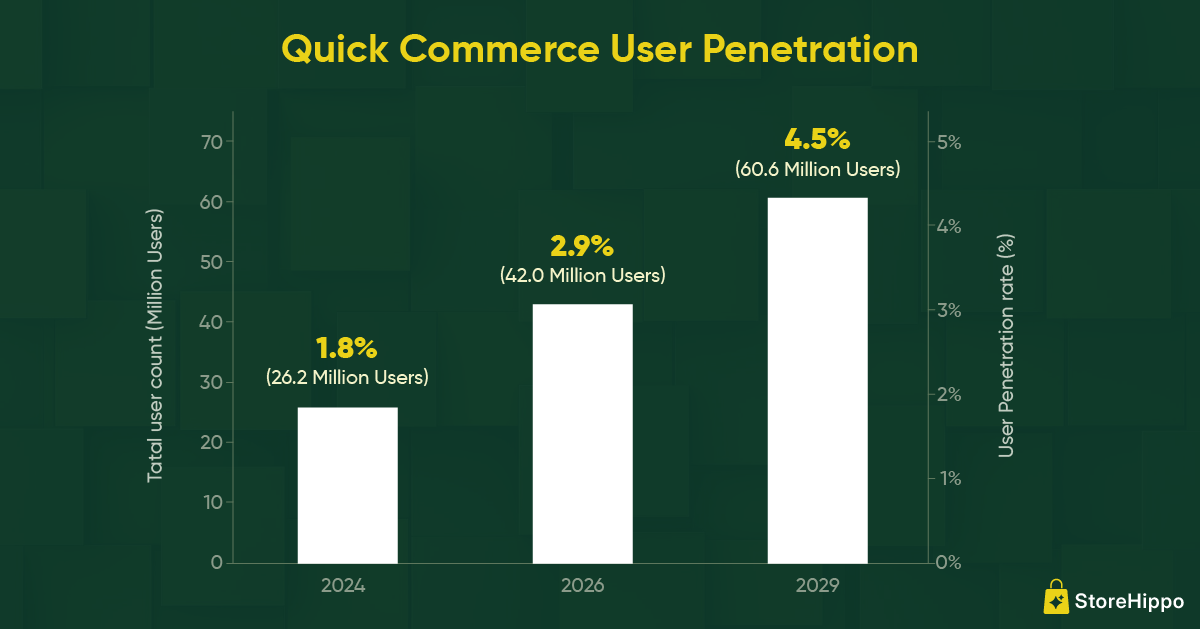
- 1.8% -Penetration of Indian consumers using Q-commerce in 2024 (26.2 million users)
- 2.9%-Penetration by 2026, representing 42 million users
- 4.5%- Penetration by 2029, representing 60.6 million users
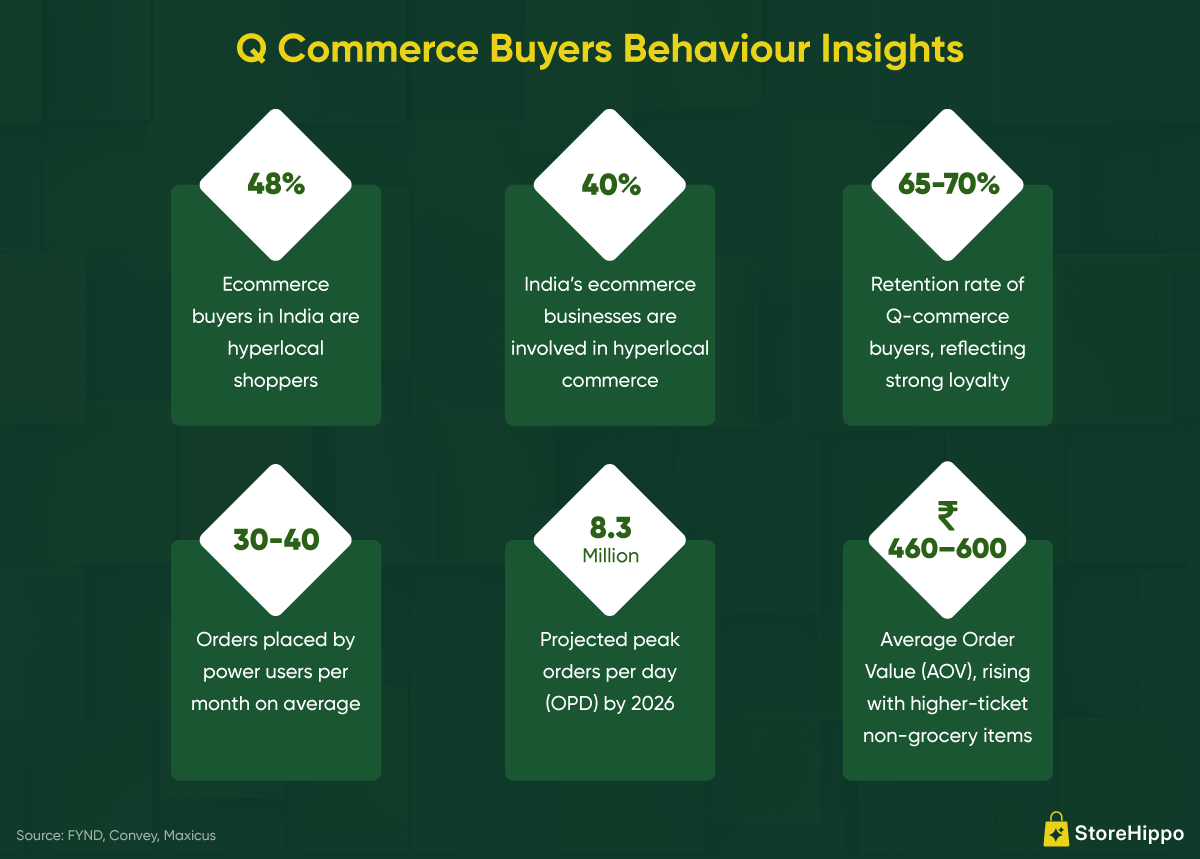
- 48% of all e-commerce buyers in India are hyperlocal shoppers
- 40% of India’s ecommerce businesses are involved in hyperlocal commerce
- 65-70% is the retention rate of Q-commerce buyers, reflecting strong loyalty
- 30-40 orders placed by power users per month on average
- 8.3 million is the projected peak orders per day (OPD) by 2026
- ₹460-₹600 is the Average Order Value (AOV), rising with higher-ticket non-grocery items.
Source: FYND, Convey, Maxicus
The takeaway isn’t just the growth of quick commerce, it’s how ecommerce itself is changing. Fulfilment is moving closer to the customer, and enterprises that use dealer-powered networks can deliver faster, operate more efficiently, and scale more easily.
10 Strategic Questions to Evaluate Before Launching a Dealer-Powered Quick Commerce Marketplaces
Here are the key questions enterprises must ask before building a dealer-powered quick commerce marketplace:
1. Can the platform support dealer-powered quick commerce with location-based fulfilment from nearby dealers?
A robust dealer-powered quick commerce platform should enable real-time, location-based fulfilment by automatically assigning orders to the nearest available dealer based on inventory and proximity. Enterprises should evaluate this capability of the q-commerce platform to ensure faster deliveries, reduce logistics costs, and maintain efficiency as order volumes grow and new geographies are added.
For instance, an electronics D2C hyperlocal brand selling smartphones and accessories across different pin codes may receive thousands of same-day delivery requests during a festive sale. Instead of shipping every order from a central warehouse, the brand should automatically route each order to the nearest authorised dealer based on stock availability and delivery radius. This helps reduce delivery timelines from days to hours while lowering last-mile logistics costs and preventing fulfilment bottlenecks during peak demand.
Enterprises should evaluate whether the quick commerce platform:
- Automatically routes orders to the nearest dealer based on location and inventory availability
- Uses real-time data to ensure accurate and efficient order allocation
- Reduces delivery timelines and optimises logistics costs
- Handles high-order volumes without delays in routing decisions
- Maintains accurate inventory visibility across all dealer locations
2. How efficiently can vendors and dealer networks be onboarded, managed, and scaled on the hyperlocal marketplace?
Enterprises should assess how easily the quick commerce platform enables onboarding and management of dealers and distributors, as this directly impacts the growth of a hyperlocal enterprise across regions. A dealer-powered quick commerce platform should simplify onboarding, enable self-service management, and support rapid expansion of dealer networks without adding operational complexity.
For instance, as enterprises with hyperlocal business expand into new locations, they may need to onboard multiple dealers quickly with their catalogues, pricing, and inventory. If onboarding requires manual intervention or technical support, it delays go-to-market timelines. A streamlined hyperlocal platform with self-service capabilities enables enterprises to onboard dealers faster, manage operations independently, and scale without complexity.
Enterprises should evaluate whether the hyperlocal marketplace platform:
- Offers easy and streamlined onboarding workflows for dealers
- Provides self-service dashboards for each dealer to manage catalogues, orders, and inventory
- Offers centralised master catalogue to keep product information consistent across all dealers
- Offers centralised admin access to monitor dealers’ day-to-day business operations
3. Can enterprises create a hyperlocal marketplace with location-based storefronts that support different catalogues, pricing, and branding for each region?
Modern hyperlocal marketplace platforms with dealer powered model should enable enterprises to create location-based storefronts with customised themes, catalogues, pricing, and branding while managing everything from a single backend.
Customer preferences, product availability, and pricing often vary across regions. A single uniform storefront may not effectively meet local demand. With location-based storefronts, businesses can tailor offerings for each region while maintaining centralised control.
For instance, a grocery and daily essentials multi-vendor hyperlocal marketplace may need different product catalogues, pricing, and promotions for each city. Customers in metro cities may prefer ready-to-cook meals and premium imported products, while customers in Tier 3 cities may order larger family packs and regional staples. At the same time, local dealer inventory and pricing may differ across cities. By creating location-based online storefronts for each region, enterprises can seamlessly customise product visibility, pricing, offers, and more for every market while managing all operations centrally.
Enterprises should evaluate whether the hyperlocal marketplace platform:
- Offers built-in multistore solutions to create multiple location-based storefronts from one backend
- Supports region-specific catalogues, pricing, and promotions
- Offers a built-in theme library and drag and drop design tools to create unique store designs
- Allows custom branding, promotions and discounts for different location based substores
- Enable enterprises to manage all storefronts from a unified backend
4. Does the hyperlocal marketplace platform support multilingual and multi-currency experiences for domestic and international expansion?
Dealer powered quick commerce platform with localisation capabilities must offer built-in multilingual and multi currency capabilities.
Enterprises should look for dealer-powered quick commerce platforms where they don't have to rely on third-party tools or patchy plugins to expand business in international markets. They should choose a quick commerce platform that supports multiple domestic and international languages and currencies to improve customer experience and conversion rates.
For instance, an Indian beauty products brand running a dealer-powered qcommerce marketplace now wants to expand into the UAE and build storefronts with Arabic and Urdu language support for UAE buyers. A hyperlocal ecommerce platform with built-in multilingual capabilities helps the brand create multilingual storefronts and deliver localised buying experiences without managing separate systems.
Enterprises should evaluate whether the quick commerce platform:
- Offers built-in multilingual capabilities for domestic and international markets
- Enables multilingual storefronts to deliver localised user experiences
- Supports multi-currency payments to engage customers across diverse regions
- Allows region-specific pricing and tax configurations
- Delivers consistent experiences across languages, currencies, and markets
5. What payment options are available for dealer-powered quick commerce, including COD, UPI, wallets, etc?
A reliable dealer-powered quick commerce platform should support multiple payment options to cater to diverse customer preferences across regions. Having flexible payment capabilities directly impacts conversion rates and customer convenience for a hyperlocal marketplace.
Enterprises running a quick commerce business should choose a hyperlocal marketplace platform which are pre integrated with multiple domestic and international payment gateways that ensure seamless transactions across regions and reduce dependency on external systems.
For instance, a global hyperlocal pharmacy marketplace may see younger customers in metro cities preferring UPI and wallet payments for instant medicine deliveries, while customers in smaller cities may still rely heavily on cash on delivery. Similarly, international buyers may prefer cards or region-specific payment gateways to place orders. So to engage buyers across every market, marketplaces must offer multiple payment options. If payment flexibility is limited, checkout abandonment can increase significantly, especially for urgent or repeat purchases.
Enterprises should evaluate whether the quick commerce platform:
- Offers pre-integrated payment solutions to support multiple payment methods, including UPI, wallets, COD, cards, net banking, etc
- Is built on API first architecture to easily integrate with leading payment gateways
- Ensures secure and seamless payment processing across all channels
- Enable flexible checkout flows tailored to different customer segments
6. How does the quick commerce platform manage order routing, fulfilment, and logistics across multiple dealers and locations?
Enterprises should prioritise ecommerce platforms that automate order routing and manage fulfilment across distributed dealer networks using real-time data. Efficient logistics management is critical for enterprises with a dealer powered quick commerce business model to maintain delivery speed and operational efficiency. Enterprises should look for quick commerce platforms that provide real-time coordination across orders, inventory, and logistics to reduce delays and improve fulfilment accuracy.
For instance, a hyperlocal enterprise electronics brand selling mobile accessories during a major product launch may experience sudden spikes in orders across multiple cities. Instead of overwhelming one warehouse or dealer location, they should automatically distribute orders across nearby dealers based on inventory, delivery capacity, and rider availability. This helps enterprises to maintain promised delivery timelines, avoid stock concentration, and improve fulfilment efficiency during high-demand periods.
Enterprises should evaluate whether the quick commerce platform:
- Pre-integrated with multiple hyperlocal logistics providers for timely last-mile deliveries
- Offers delivery boy management solutions to assign, track, and optimise last-mile deliveries efficiently
- Offers real-time tracking and control to monitor order status and fulfilment across locations
- Automates order routing based on real-time data to ensure faster and more accurate fulfilment across dealer networks
- Centralised dashboard to manage orders, status and fulfilment across all deal networks
7. Can AI automate key operations like product discovery, catalogue management, and personalised buying experiences on the hyperlocal marketplace platform?
Modern dealer-powered q-commerce platforms embed AI into core workflows like catalogue management, search, recommendations, and operations, enabling automation and continuous optimisation without manual intervention.
For instance, AI powered quick commerce platforms may offer AI to enable hyperlocal enterprises to automatically generate product titles, descriptions, and tags for dealer catalogues, making it easier to manage large and dynamic inventories. Enterrises can leverage AI-powered search and recommendations to help customers find relevant products faster based on their behaviour. By selecting the right AI powered quick commerce platform, enterprises can also build custom AI chatbots to automate support for customers and hyperlocal vendors by handling common queries and speeding up customer support responses.
Enterprises should evaluate whether the quick commerce platform:
- Offers built-in AI tools for smarter automation and better decision-making
- Automates repetitive tasks and workflows to reduce manual effort and save time
- Uses AI for product cataloguing, tagging, and optimisation to simplify catalogue management in different local markets
- Offers AI-powered personalisation and product discovery to improve customer experience
- Offers AI powered support for customers, vendors and teams
8. Does the dealer powered quick commerce platform provide AI-powered support bots for buyers, sellers, and dealers to handle routine queries and operations?
As dealer networks and customer bases grow, managing support across multiple stakeholders becomes increasingly complex. Enterprises should evaluate whether the quick commerce platform provides capabilities to build AI bots to handle routine queries and improve response efficiency.
For instance, enterprises can build custom AI chatbots to guide the buyer journey and resolve their order-related queries, and resolve sellers' and internal team queries in real time. This enables enterprises to reduce dependency on manual support teams, improve response times, and ensure consistent communication across the ecosystem.
Enterprises should evaluate whether the quick commerce platform:
- Enables building custom AI-powered chatbots for customer, seller, and dealer support to handle queries and assist with day-to-day operations
- Enables contextual and personalised support based on user behaviour and interactions
- Will the bots be able to support customers throughout the journey, from product discovery to purchase
- Can routine queries and operational workflows be automated to reduce manual effort and improve efficiency
- Will the support operations be scalable without increasing dependency on manual support teams
9. Can the dealer powered quick commerce platform unify web, mobile apps, WhatsApp, and other channels for a seamless quick commerce experience?
A robust dealer powered quick commerce platform should unify all customer touchpoints, including web, mobile apps, WhatsApp, and other channels, into a single system while maintaining consistent data, inventory, and customer experience.
Customers today interact with multiple channels throughout their buying journey. They may discover a product on a mobile app, place an order through a website or WhatsApp, and track delivery through another channel. If enterprises do not connect these channels on their dealer-powered quick commerce marketplace, it can lead to inconsistent pricing, incorrect inventory information, and a fragmented customer experience.
For example, a customer receives a notification on their mobile about the newly launched serum from a skincare brand. They check nearby dealer availability on the brand’s mobile app, ask product-related questions and complete the purchase on WhatsApp. Since all channels are connected, the customer experiences consistent pricing, inventory visibility, and order tracking across every touchpoint.
Enterprises should evaluate whether the quick commerce platform:
- Offers built-in omnichannel capabilities to run and manage business across multiple channels
- Is built on a mobile-first architecture to deliver seamless mobile experiences across all hyperlocal markets
- Connects web, mobile apps, WhatsApp, and other channels within a single system
- Keeps orders, pricing, inventory, and customer data consistent across all channels
- Delivers a smooth and unified customer experience across every touchpoint
10. How can enterprises monitor performance, optimise operations, and scale dealer powered quick commerce marketplaces efficiently?
Dealer powered quick commerce platforms should provide real-time visibility into operations and performance to enable data-driven decision-making. This is critical for optimising workflows and scaling efficiently across regions.
When operations expand across multiple dealers and locations, it becomes essential for enterprises to identify inefficiencies in their hyperlocal marketplace and improve execution. Without real-time insights, businesses may face delays in decision-making and operational gaps.
For instance, a hyperlocal daily staples brand notices delays in evening deliveries during peak demand hours. Using real-time analytics, the enterprise identifies that some dealer hubs are running out of fast-moving essentials while nearby dealers still have available stock. This helps the operations team rebalance inventory, optimise fulfilment routes, and improve delivery timelines quickly.
Enterprises should evaluate whether the quick commerce platform:
- Provides real-time analytics for complete operational visibility
- Tracks key performance metrics across orders, delivery timelines, and dealer performance
- Enables data-driven decision-making for faster and more accurate execution
- Tracks performance, refines routing logic, and improves fulfilment efficiency using real-time insights
Conclusion
Dealer-powered quick commerce is redefining how enterprises deliver speed, convenience, and localised experiences at scale.
However, building a successful hyperlocal marketplace requires more than just connecting dealers and customers. It demands a robust enterprise ecommerce platform that can handle complex operations like multiple vendor management, real-time inventory, intelligent order routing, and AI-driven personalisation.
By asking the right questions and choosing an AI powered quick commerce platform with built-in, scalable capabilities, enterprises can build a high-performance, quick commerce ecosystem that drives faster deliveries, better customer experiences, and sustainable growth.
Ready to launch your dealer powered quick commerce marketplace?
Discover how StoreHippo can help you build, automate, and scale your hyperlocal commerce operations.
Book your customised demo today