



Table of Contents
- B2B Marketplace Case Study: How Dow Scaled Distribution With A Custom B2B+B2C Marketplace Platform
- Why Was Dow Looking For A New B2B Marketplace Platform?
- How Did Dow Build A B2B Marketplace For Seven Different Buyer Groups?
- How Did Sub-Stores And A Master Catalogue Help Dow Manage Its Distributor Network?
- How Did Mobile Apps And Integrations Extend The Marketplace?
- How Did The Marketplace Help Dow Expand Its Distribution Network?
- What Can Enterprise Manufacturers Learn From Dow's B2B Marketplace Implementation?
- Conclusion
- Frequently Asked Questions
B2B Marketplace Case Study: How Dow Scaled Distribution With A Custom B2B+B2C Marketplace Platform
For large manufacturers, going digital isn't just about launching another sales channel. The bigger challenge is finding a B2B marketplace platform that fits the way the business already operates. Distributors work with negotiated pricing, dealers manage regional markets, field teams collect orders on the move, and different buyer groups expect different buying experiences. Most ecommerce platforms aren't designed to handle this level of complexity.
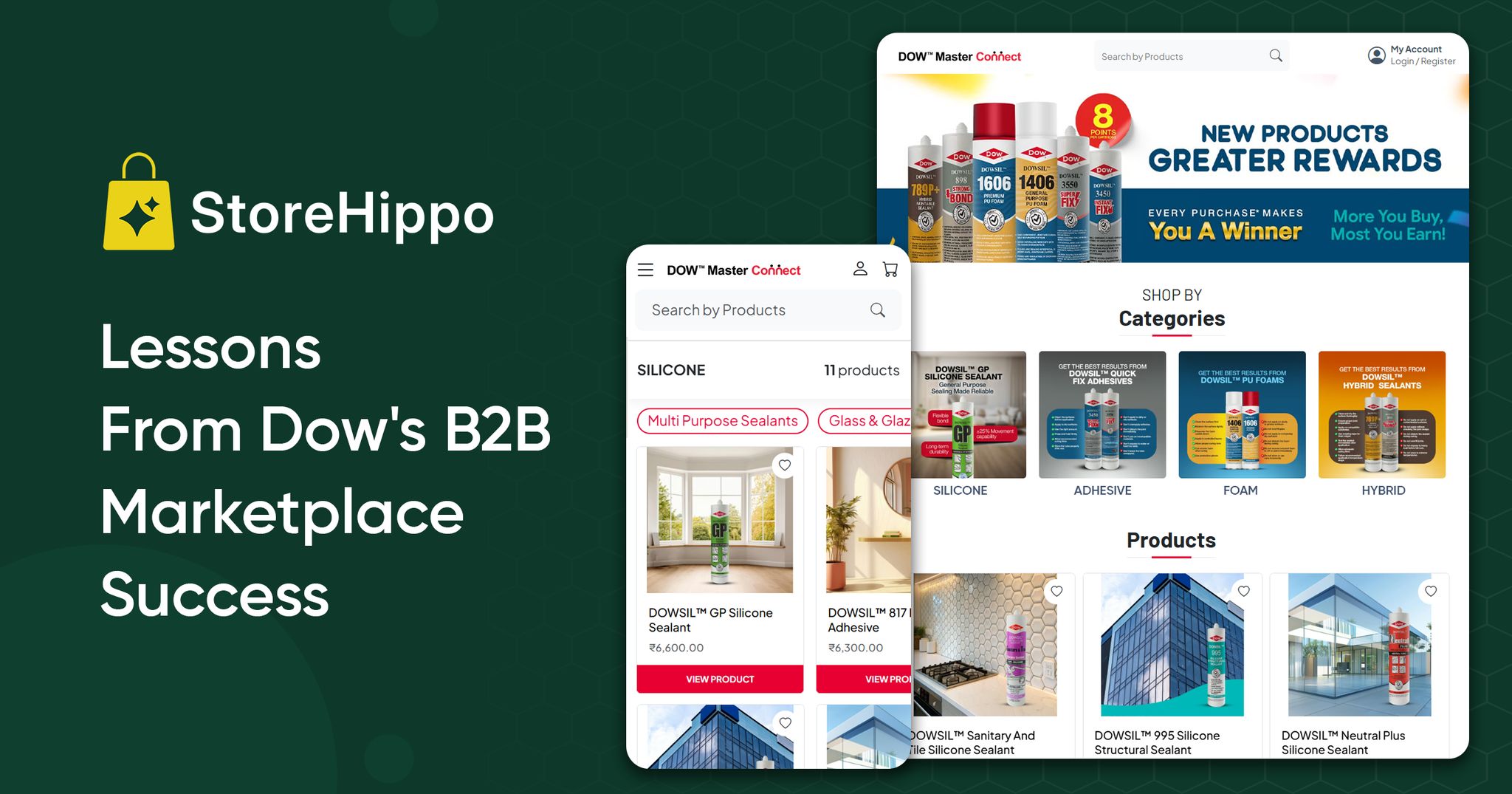
Dow, one of the world's largest chemical manufacturers with operations across 31 countries, faced a similar challenge as it expanded its digital commerce strategy in India. The company wanted a B2B marketplace that could bring distributors, dealers, and business buyers onto a single platform while supporting the flexibility needed for different markets. Working with StoreHippo, Dow built Dow Master Connect- a B2B+B2C hybrid marketplace designed around its distributor ecosystem and business workflows.
The impact was visible within the first three quarters of launch:
- 50%+ growth in orders
- 45+ distributor sub-stores
- 25+ sellers operating on a unified marketplace
This B2B marketplace case study explores how Dow approached its digital transformation, the challenges it solved, and the lessons enterprise manufacturers can apply when choosing an enterprise ecommerce platform for long-term growth.
Why Was Dow Looking For A New B2B Marketplace Platform?
Dow's Consumer Solutions business, covering sealants, adhesives, and construction materials, had built a strong offline distribution network across India. Distributors, dealers, retailers, affiliates, and field sales teams worked across multiple regions to serve different customer segments. But as the business expanded, managing this growing ecosystem through traditional sales processes alone became increasingly difficult. Limited visibility across the network, disconnected operations, and the challenge of coordinating multiple sales channels started slowing down growth.
These challenges aren’t unique to Dow. Many enterprise manufacturers are facing the same challenge. As distribution networks become more diversified and buyer expectations continue to evolve, traditional ecommerce platforms and conventional B2B marketplace platforms often fall short. Modern manufacturers need an enterprise commerce platform that can support distributor-led selling, buyer-specific experiences, multiple sales channels, and complex business workflows, all from a single, scalable system.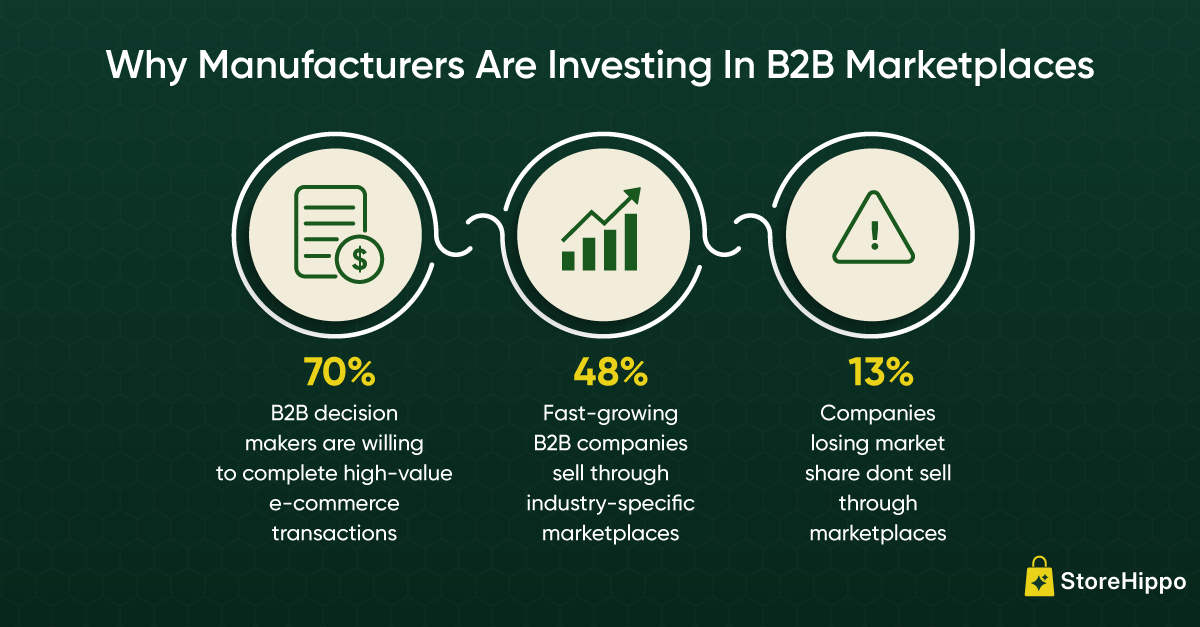
- B2B buying is now firmly omnichannel. McKinsey's latest B2B Pulse research shows buyers consistently expect a mix of digital self-service, remote, and in-person interactions throughout the buying journey, not one channel replacing another.
- Digital self-service is now expected, even for high-value purchases. Around 70% of B2B decision-makers are willing to complete ecommerce transactions worth up to $500,000, highlighting growing confidence in digital buying experiences.
- Marketplace-led commerce is becoming a competitive advantage. McKinsey found that 48% of B2B companies gaining market share sell through industry-specific marketplaces, compared with only 13% of companies losing share.
Retail-focused ecommerce platforms often fall short when manufacturers need distributor management, channel-partner workflows, buyer-specific pricing, approval processes, and different product catalogues for different audiences. Instead of reshaping business processes to fit the technology, businesses need an enterprise ecommerce platform that works around the way they already operate.
As Oh Lee Peng, Global Digital Marketing Operations Leader at Dow Consumer Solutions, recalls:
"We started working with Hippo Innovations when we were looking for a digital solution to grow our business and expand our reach."
For Dow, expanding its reach meant something specific: bringing wholesale and retail, offline and online, onto a single B2B marketplace without disrupting the distributor network it had spent years building.
How Did Dow Build A B2B Marketplace For Seven Different Buyer Groups?
Building a B2B marketplace was only part of the challenge. The bigger question was: how do you create one platform that works for everyone across a complex distribution ecosystem?
Dow's sales network included seven distinct buyer groups - distributors, dealers, retailers, affiliates, field sales officers, Dow employees, and end buyers. Each group had different responsibilities, pricing structures, permissions, and purchasing workflows. A one-size-fits-all buying experience simply wouldn't work.
To address this, StoreHippo built a hybrid B2B+B2C marketplace on its B2B marketplace platform, giving every user group a role-based experience within a single system. Distributors could manage their dealer network, dealers accessed region-specific catalogues and pricing, field sales teams placed orders on behalf of customers while on the move, and business buyers saw only the products, prices, and approval workflows relevant to them. Despite the complexity, everyone operated on the same platform, making the buying experience simpler while giving Dow complete visibility across its distribution network.
As Oh Lee Peng explains:
"Hippo Innovation team has a solution that allowed us and our distribution partners to customise our offer to different B2B profiles."
StoreHippo also built customised workflows for enquiry management, approvals, and order distribution to match Dow's existing business processes. Product catalogues, pricing, permissions, and approvals were managed centrally, making it easier to deliver personalised buying experiences without creating separate systems for different partners or regions.
The result was a B2B marketplace that served multiple buyer groups through one platform, giving customers the experience they needed while giving Dow a single system to manage its entire distribution ecosystem.
How Did Sub-Stores And A Master Catalogue Help Dow Manage Its Distributor Network?
As Dow's distributor network expanded, the challenge wasn't just onboarding more partners; it was giving each distributor the flexibility to run their business while maintaining central control over the entire ecosystem.
To make this possible, StoreHippo built Dow Master Connect on a multi-store architecture. Every distributor operates through a dedicated sub-store, but all of them remain connected to the same B2B marketplace platform.
Today, the marketplace powers more than 45 distributor sub-stores. Each distributor can independently manage its catalogue, orders, and customers, while Dow has complete visibility across the network from a single platform.
A central master catalogue ensures product information stays consistent across every sub-store, eliminating duplicate SKUs and reducing the effort needed to manage product data. Marketplace administrators can monitor distributor performance, oversee online and offline operations, and manage the entire distribution ecosystem from one dashboard. At the same time, role-based reports give distributors, field sales teams, affiliates, and management access to the insights they need, without exposing information that's not relevant to them.
The result is a scalable distributor marketplace where local teams have the freedom to serve their customers, while Dow retains the governance, consistency, and visibility needed to manage its business at enterprise scale.
How Did Mobile Apps And Integrations Extend The Marketplace?
Dow's distributor network isn't confined to offices. Orders are placed during customer visits, at dealer counters, and while field teams are on the move. To support these real-world workflows, Master Connect expanded beyond the web by adding mobile commerce capabilities.
Using StoreHippo's no-code mobile app builder, Dow launched Android and iOS marketplace apps that stay automatically synced with the B2B marketplace. Dealers, distributors, field sales teams, and business buyers all get the same seamless ordering experience across devices, without the need to build or maintain separate mobile applications.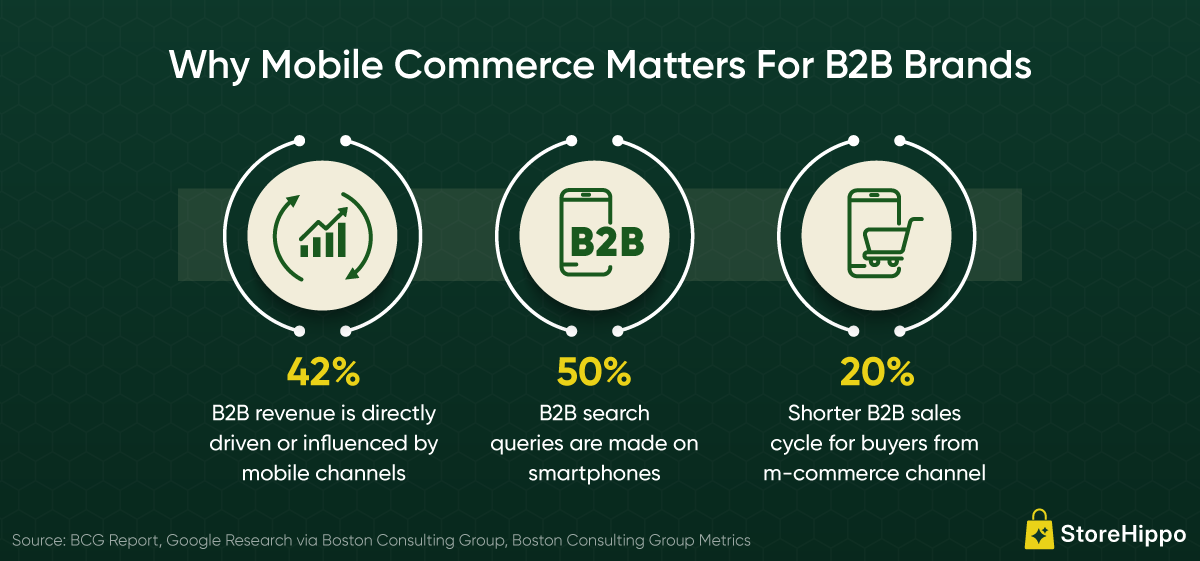
- 42% of B2B revenue is directly driven or significantly influenced by mobile channels among market leaders. (Source: BCG Report)
- 50% of B2B search queries are made directly on smartphones rather than desktop computers. (Source: Google Research via Boston Consulting Group)
- Using mobile capabilities shortens the traditional B2B sales cycle by roughly 20%, accelerating transaction timelines by enabling faster communication and quicker mobile approvals. (Source: Boston Consulting Group Metrics)
StoreHippo's API-first integration framework connected Master Connect with the business software Dow already relied on, including Tally for accounting, Dyrect for ledger automation and voucher-based marketing campaigns, and its campaign points system for partner incentives. Instead of working across disconnected tools and spreadsheets, sales tracking, ledger management, and distributor rewards became part of a single, connected B2B marketplace platform.
How Did The Marketplace Help Dow Expand Its Distribution Network?
For Dow, Master Connect became more than just another digital sales channel. It provided a scalable way to grow its distribution network, connect more distributors and business buyers, and do it without adding complexity to day-to-day operations.
The results were visible within the first three quarters of launch. Order volumes increased by more than 50%, the network expanded to 45+ distributor sub-stores, and 25+ sellers began operating through a single B2B marketplace platform.
As Oh Lee Peng shares:
"So with this solution from StoreHippo, we have been able to build a huge network of B2B buyers through the platform, allowing us to expand our reach to many areas."
As the distributor network continued to grow, onboarding new partners became far more efficient. Instead of deploying separate systems for every region or dealer, Dow could simply launch a dedicated sub-store for each new distributor while managing the entire ecosystem from the same B2B marketplace platform. This made it possible to scale its distributor marketplace without increasing operational complexity or sacrificing central visibility.
One of the biggest takeaways from this B2B marketplace case study is that technology delivers the most value when it's designed around the business model, not the other way around. By giving distributors, dealers, and channel partners the tools they needed within a single enterprise ecommerce platform, Dow expanded its reach, simplified partner onboarding, and kept its growing distribution ecosystem connected through one unified system.
What Can Enterprise Manufacturers Learn From Dow's B2B Marketplace Implementation?
Choosing the right enterprise ecommerce platform was only part of Dow's success. Just as important was building a solution around its distributor ecosystem, sales processes, and long-term business goals instead of trying to fit existing workflows into a standard platform.
As the business evolved, the B2B marketplace evolved with it. New distributors could be onboarded quickly, additional sub-stores could be launched without disrupting operations, and new workflows could be introduced without rebuilding the entire system.
As Oh Lee Peng recalls:
"Working with the Hippo team is a pleasant experience. The team is always there to listen to our challenges, identify our pain points, build user stories, and quickly develop solutions to meet our needs."
One of the biggest takeaways is that successful implementations don't end at launch. The right B2B marketplace platform should be backed by a team that understands enterprise workflows, translates business challenges into practical solutions, and continues to refine the platform as the business grows. After all, the requirements you launch with are rarely the same as the ones you need a year later.
That's the biggest takeaway for enterprise manufacturers from this B2B marketplace case study. Digital transformation isn't about launching another sales channel; it's about creating a scalable commerce ecosystem that adapts as your business grows. The right B2B marketplace platform should simplify distribution, support multiple buyer groups and sales channels, and give your teams the flexibility to scale without adding operational challenges. The reality is that the requirements of an enterprise brand at launch are rarely the same a year later. The platform needs to grow with the business, not hold it back.
Conclusion
Every B2B marketplace has its own challenges. Some manufacturers need to manage diverse distributor networks, while others require buyer-specific pricing, regional storefronts, or hybrid B2B+B2C marketplaces. What remains constant for every enterprise is the need for a platform that fits the business today and continues to support it as operations evolve.
Dow's B2B marketplace case study and implementation show that building a successful marketplace isn't about choosing the longest list of features. It's about selecting a B2B marketplace platform that can adapt to changing business requirements, support new workflows, and scale alongside your distribution network.
If you're evaluating an enterprise ecommerce platform, start by understanding your business model, sales processes, and long-term growth plans, not just the features you need today. The real question is whether your platform can support new partners, sales channels, and customer expectations as your business evolves.
If you're planning to build a B2B marketplace for your manufacturing or distribution business, StoreHippo's enterprise ecommerce platform helps you create scalable hybrid B2B+B2C marketplaces with custom workflows, distributor management, role-based buying experiences, and the flexibility to grow as your business expands. Schedule a demo to see how it can work for your business.
Frequently Asked Questions
1. What is a Hybrid B2B+B2C Marketplace?
A hybrid marketplace serves wholesale and retail buyers from one platform. Business buyers see negotiated pricing, credit terms, and approval workflows, while retail customers get a standard storefront experience. Catalogues, inventory, and permissions are managed centrally, allowing businesses to run one system instead of two.
2. How Do Sub-Stores Work in a Distributor Marketplace?
Each distributor or dealer gets a dedicated sub-store connected to the main marketplace. They manage their own catalogue, orders, and customers independently, while the brand retains central visibility and control through a master catalogue and unified admin dashboard.
3. How Long Does It Take to Build a Custom B2B Marketplace Platform?
A mid-complexity enterprise marketplace on StoreHippo typically goes live in 4-6 weeks. Highly customised implementations with role-based frontends and multiple buyer groups may take longer, but StoreHippo's low-code architecture enables faster iterations after launch.
4. Can a B2B Marketplace Platform Integrate with ERP and Accounting Systems?
Yes. A modern B2B marketplace platform can integrate with ERP, accounting, logistics, CRM, payment, and marketing systems through APIs. Dow Master Connect, for example, integrates with Tally for accounting and Dyrect for ledger automation and campaign management, helping teams work from a connected ecosystem.
5. Why Do Enterprise Manufacturers Need a B2B Marketplace Instead of a Retail Ecommerce Platform?
Retail ecommerce platforms are designed for a single storefront and a standard buying journey. Enterprise manufacturers need a B2B marketplace that supports distributors, dealers, negotiated pricing, regional catalogues, approval workflows, and role-based access, all from a single platform.
6. How can AI improve a B2B marketplace?
AI improves a B2B marketplace by automating catalog creation, product content generation, inventory updates, customer support, and routine operational tasks. This helps manufacturers reduce manual effort, improve data accuracy, and scale marketplace operations more efficiently. With platforms like StoreHippo, brands can also build custom Enterprise AI to automate and make their workflows more efficient.