


Enterprise commerce in 2026 is no longer built around a single business model. It’s built around how effectively you can serve different buyer segments at scale. That’s why the focus is no longer on choosing between B2B or B2C, but on how well you can run both together.
But scaling across both models on separate systems leads to disconnected data, inconsistent pricing, duplicated workflows, and limited visibility across operations. What should enable growth instead creates friction.
This is why enterprises are moving towards unified B2B+B2C marketplace platforms, where bulk buyers, end consumers, vendors, and partners can all operate within a single, connected ecosystem. These platforms are not just about adding another sales channel, they are designed to simplify operations, streamline workflows, and give you complete control across both business models.
But not every platform is built to support this efficiently. To make the right choice, we need to ask the right questions. In this blog, we will walk you through 10 must-ask FAQs to help you evaluate and choose the best B2B+B2C marketplace platform.
Table of Contents
- How B2B+B2C Marketplace Platform Drives Growth for Modern Enterprises
- 10 FAQs to Evaluate the Best Multi Vendor Marketplace Platform for B2B + B2C Models
- 1. What key capabilities should enterprises look for in multi vendor marketplace to run both B2B and B2C operations seamlessly?
- 2. How easy is it to create personalised buyer journeys for B2B and B2C audiences within the same multi vendor marketplace?
- 3. What should enterprises look for to ensure a multi vendor marketplace platform can efficiently handle separate B2B and B2C storefronts across global markets?
- 4. Why is it important to evaluate AI capabilities that improve product discovery, customer experience, and day-to-day ecommerce operations across B2B and B2C channels?
- 5. Why is it critical to choose a B2B+B2C marketplace platform with mobile first architecture?
- 6. Why it is important to have a unified backend for an enterprise ecommerce platform to manage pricing, discounts, and promotions across B2B+B2C channels?
- 7. What should businesses look for to ensure a marketplace platform can handle growth across both B2B and B2C operations?
- 8. Can a B2B marketplace balance complex B2B workflows like RFQs, credit limits, and approvals along with the seamless checkout experience B2C customers expect?
- 9. How to identify if an enterprise ecommerce platform offers integration flexibility to support B2B and B2C workflows without complex customisation?
- 10. Can the marketplace easily support different pricing models for different buyers, including bulk discounts, negotiated B2B rates, and standard retail pricing?
- Conclusion
How B2B+B2C Marketplace Platform Drives Growth for Modern Enterprises
The shift towards hybrid commerce is not just a trend but a strategic move driven by measurable growth outcomes. Enterprises adopting B2B+B2C marketplace platforms are seeing faster revenue expansion, broader market reach, and improved customer engagement. The following trends highlight how this model is reshaping enterprise commerce globally.
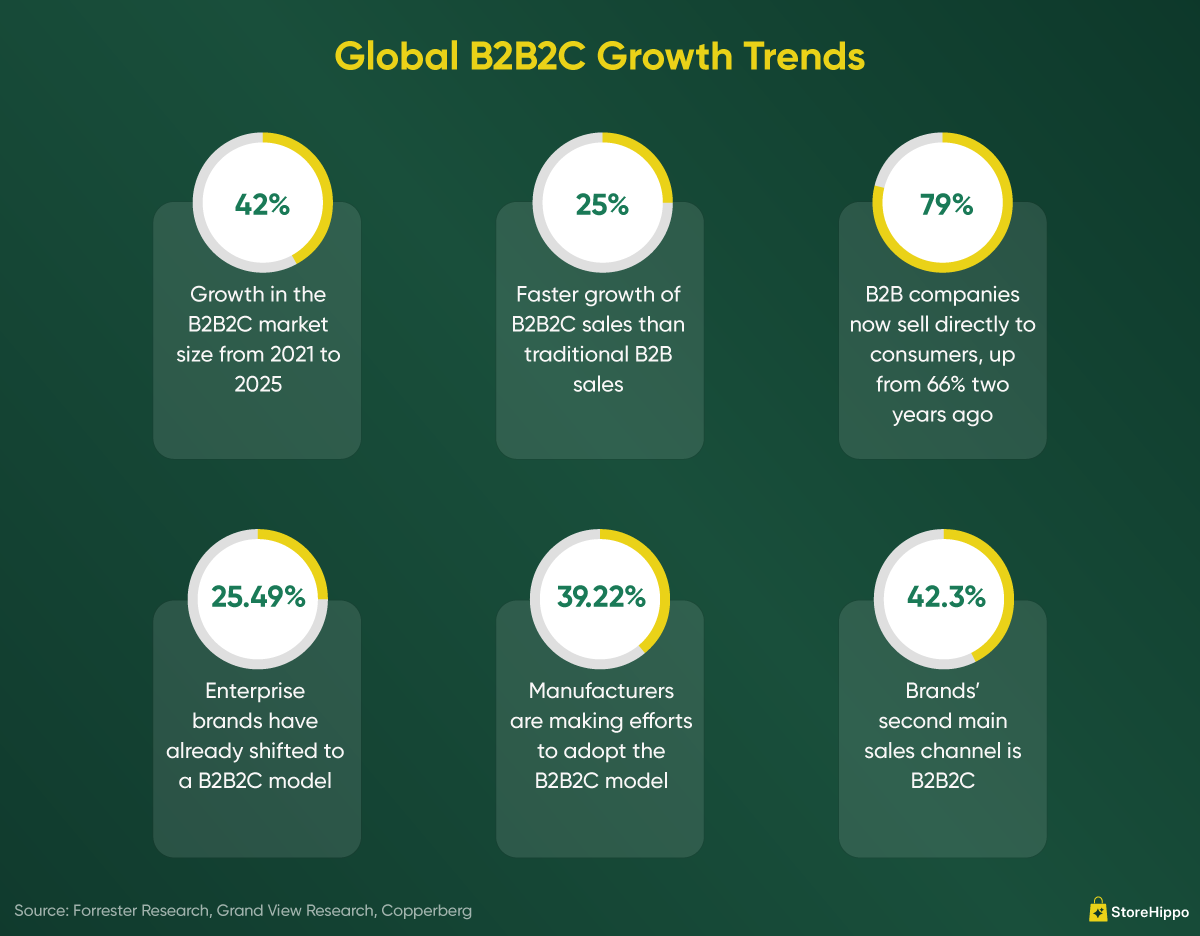
- 42% growth in the B2B2C market size from 2021 to 2025
- 25% faster growth of B2B2C sales than traditional B2B sales
- 79% of B2B companies now sell directly to consumers, up from 66% two years ago
- 25.49% of enterprise brands have already shifted to a B2B2C model
- 39.22% of manufacturers are making efforts to adopt the B2B2C model
- 42.3% of brands’ second main sales channel is B2B2C
Source: Forrester Research, Grand View Research, Copperberg
Now that the accelerating adoption of B2B2C models is clear, lets now understand how AI is driving this growth further by making these ecosystems smarter and more efficient.
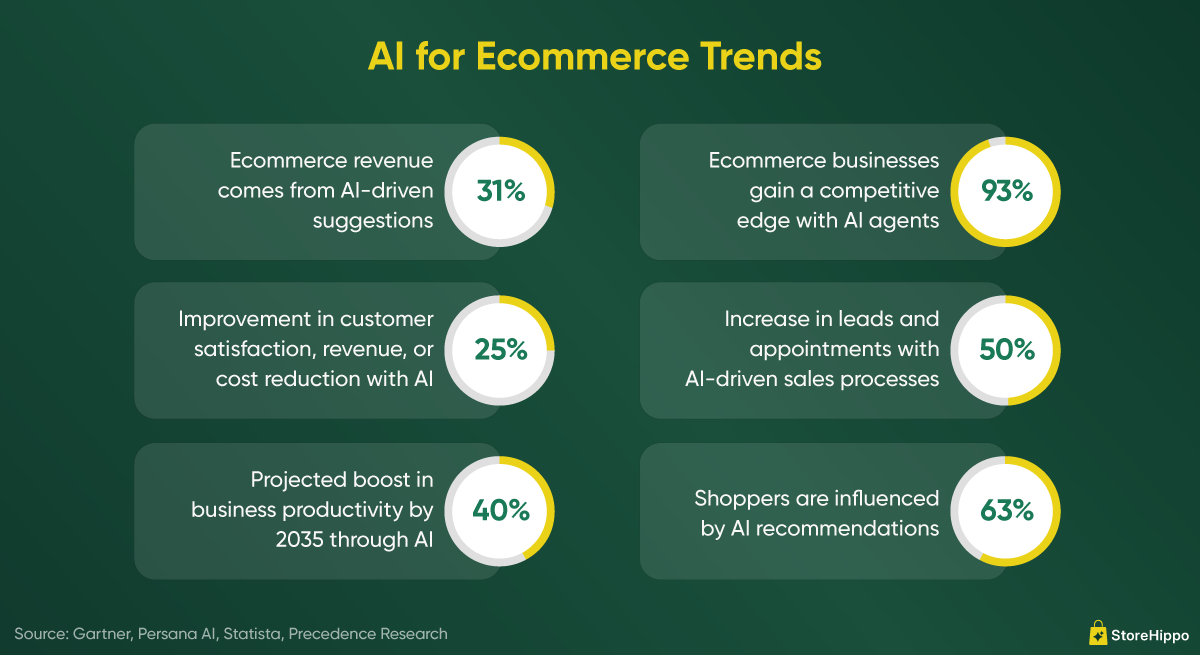
- 93% of ecommerce businesses gain a competitive edge with AI agents
- 50% increase in leads and appointments with AI-driven sales processes
- 63% of shoppers are influenced by AI recommendations
- 31% of ecommerce revenue comes from AI-driven suggestions
- 25% improvement in customer satisfaction, revenue, or cost reduction with AI
- 40% projected boost in business productivity by 2035 through AI
Source: Gartner, Persana AI, Statista, Precedence Research
The shift is clear - enterprises are no longer scaling just by adding channels, but by making those channels smarter with AI. B2B+B2C marketplaces bring reach and flexibility, while AI adds the intelligence needed to optimise every interaction, decision, and workflow. Together, they create a more responsive, efficient, and growth-ready commerce ecosystem that can adapt as fast as the market demands.
To turn these insights into action, enterprises need to evaluate the capabilities that truly define scalability, flexibility, and performance, starting with the right questions.
10 FAQs to Evaluate the Best Multi Vendor Marketplace Platform for B2B + B2C Models
Here are 10 FAQs enterprises need to ask to evaluate the best B2B+B2C marketplace platform
1. What key capabilities should enterprises look for in multi vendor marketplace to run both B2B and B2C operations seamlessly?
Enterprises should choose an enterprise ecommerce platform that natively supports both B2B and B2C business models from the same backend logic. This ensures consistent control over catalogues, pricing, vendors, and buyer journeys without operational inefficiencies and plugin requirements.
A true enterprise-grade B2B+B2C marketplace platform must enable businesses to manage multiple business models simultaneously while maintaining centralised governance and scalable workflows.
StoreHippo multivendor marketplace platform supports both B2B and B2C functionality on the same platform and enables same vendors to sell to both B2B and B2C customers from a single unified backend without operational silos. Brands can create separate stores tailored to their audience, with distinct catalogues, pricing, and buying journeys, while vendors operate through a unified dashboard to manage products, orders, invoicing, and shipping.
2. How easy is it to create personalised buyer journeys for B2B and B2C audiences within the same multi vendor marketplace?
A modern multi-vendor marketplace should make it easy to create separate buyer journeys for B2B and B2C audiences using built-in segmentation, role-based access, custom pricing, catalogue visibility, promotions, and workflows. This enables businesses to deliver personalised experiences for each audience while managing vendors, products, orders, and operations from a single platform.
Enterprises should evaluate if the platform offers separate workflows, catalogues, pricing structures, discounts, etc. for B2B and B2C and have a centralised dashboard to manage them seamlessly. This ensures consistency while catering to diverse buyer expectations. Enterprises should prioritise platforms that can deliver personalised experiences across both B2B and B2C journeys from a single system.
StoreHippo is the best B2B+B2C marketplace platform, which offers personalised buyer journeys with features like role-based access, multi-store feature, and AI-driven recommendations. Its intelligent discovery and personalised catalogues ensure that both B2B and B2C buyers get relevant experiences tailored to their needs, improving engagement and conversions across segments. StoreHippo offers dynamic pricing, personalised storefronts for diverse buyer segments, flexible payment options, and a powerful self-serve buyer portal.
3. What should enterprises look for to ensure a multi vendor marketplace platform can efficiently handle separate B2B and B2C storefronts across global markets?
Enterprises should look fora multi-vendor marketplace platform that supports multi-store architecture with built-in localisation capabilities to manage B2B and B2C operations across global markets. This enables businesses to scale internationally without creating operational complexity or relying on external plugins.
Enterprises should also evaluate go-global capabilities in a B2B+B2C marketplace platform, including multilingual support, multi-currency transactions, region-specific pricing, catalogues, and tax configurations. The platform should also offer pre-integrated international payment and logistics solutions, along with a unified dashboard to manage all stores, regions, and operations from a single system.
StoreHippo’s built-in multistore feature enables enterprises to create and run different B2B and B2C storefronts across regions without operational complexity. Enterprises can set up unique catalogues, pricing, and user experiences, while managing all region-specific sub-stores from a single admin dashboard. Enterprises can also create unique URLs, store designs, and languages tailored for each substore across the globe.
StoreHippo's built-in multilingual, multi-currency, and localisation capabilities enable enterprises to engage and convert both bulk buyers and end consumers across cross-border areas. In addition, StoreHippo’s built-in theme designer enables brands to customise and localise store themes for each region, ensuring that design elements, layouts, and user interfaces align with local preferences and cultural expectations, creating more relevant and engaging shopping experiences.
Additionally, it offers 150+ integrations with international payment gateways, logistics providers, and other service providers to support seamless checkouts and efficient order fulfilment.
With 300+ APIs, brands can connect their existing systems to build a fully integrated, scalable, and future-ready ecommerce ecosystem, enabling unified data flow and streamlined operations across both B2B and B2C business models.
4. Why is it important to evaluate AI capabilities that improve product discovery, customer experience, and day-to-day ecommerce operations across B2B and B2C channels?
Evaluating AI capabilities is essential because AI can improve far more than customer-facing experiences. The right enterprise ecommerce platform uses AI to optimise product catalogues, personalise buyer journeys, automate routine tasks, streamline order and inventory management, and support faster decision-making. This helps B2B and B2C businesses improve efficiency, customer satisfaction, and scalability.
AI should function as an operational layer within the platform, helping enterprises automate catalogue management, improve product discovery, and personalise buyer journeys. For hybrid marketplaces, AI can streamline processes like product tagging, intelligent recommendations, order routing tc, making operations more efficient across both B2B and B2C channels. Enterprises should prioritise platforms where AI acts as an operational layer, which helps taking smarter decisions and faster scaling across B2B and B2C workflows.
StoreHippo is a future-ready ecommerce platform with AI built into its core. It offers AI-powered cataloguing to automate catalogue creation by generating engaging product titles and descriptions, along with automatic tagging, categorisation, and attribute mapping.
Its advanced AI image editing tool, Magic Edit, transforms raw product images into high-quality, market-ready visuals by automatically removing backgrounds and optimising lighting for a polished, professional look.
StoreHippo also offers AI-powered semantic search that delivers intent-based and contextual results to customers. Its AI-driven recommendations analyse user behaviour, search history, and purchase patterns to suggest relevant products and improve discovery.
Additionally, StoreHippo enables enterprises to build custom AI chatbots for buyers, vendors and internal teams, ensuring faster query resolution, seamless interactions, and consistent support across all touchpoints.
5. Why is it critical to choose a B2B+B2C marketplace platform with mobile first architecture?
A mobile-first B2B+B2C marketplace platform enables buyers, sellers, distributors, and internal teams to access critical business functions from anywhere. It improves user experience, increases engagement and conversions, supports field sales and remote operations, and ensures consistent performance across devices. As mobile commerce continues to grow, mobile-first architecture becomes essential for scalability and business agility.
Today, nearly 80% of B2C sales happen on mobile devices. Business buyers are also increasingly becoming mobile-first, with 91% of B2B searches conducted on mobile and 65% of B2B companies already having a mobile app.
In this scenario, enterprises operating across both B2B and B2C models should prioritise a multi vendor marketplace platform that offers built-in mobile app capabilities. Building and maintaining mobile apps from scratch requires significant time, development effort, and ongoing costs, making it inefficient at scale.
The StoreHippo enterprise ecommerce platform offers built-in mobile app solutions for enterprises. It comes with a built-in mobile app builder to create Android and iOS apps. It also offers PWA capabilities, enabling enterprises to build Progressive Web App stores to easily reach and engage customers in low-connectivity areas.
Along with its mobile-first architecture, StoreHippo supports true omnichannel selling across web, mobile apps, WhatsApp, social channels, and chat interfaces. This ensures seamless and consistent buyer experiences across all devices and channels, while enabling businesses to manage everything from a single, intuitive interface.
6. Why it is important to have a unified backend for an enterprise ecommerce platform to manage pricing, discounts, and promotions across B2B+B2C channels?
A unified backend enables enterprises to manage pricing, discounts, promotions, and business rules consistently across B2B and B2C channels from a single system. This reduces operational complexity, prevents pricing inconsistencies, improves control and visibility, and allows businesses to launch targeted offers faster while delivering a seamless experience across all customer touchpoints.
Enterprises should be able to define rules based on customer segments, order volumes, geographies, or vendor-level agreements. This ensures that both B2B and B2C buyers receive relevant pricing without manual intervention. Enterprises should evaluate whether the platform supports multiple pricing strategies from a single system.
StoreHippo offers dynamic pricing overides and tiered pricing, which enables enterprises to manage diverse pricing strategies across B2B and B2C channels from a single backend, ensuring consistency and efficiency. It also offers built-in discount engine that enables enterprises to offer multi-level personalised discounts, region-specific campaigns, manage vendor-level offers, and execute localised marketing strategies across global storefronts, all from a single system.
7. What should businesses look for to ensure a marketplace platform can handle growth across both B2B and B2C operations?
Enterprises should evaluate whether the enterprise ecommerce platform is cloud-native and built on a microservices architecture to ensure it can scale smoothly as catalogues, vendors, and transaction volumes increase across both B2B and B2C models without any performance issues or system slowdowns. They should evaluate how well the B2B+B2C marketplace platform scales under growing demand and whether it can deliver consistent performance across both models without disruptions or slowdowns.
As businesses grow, scalability becomes a critical factor. Enterprises must ensure the platform can handle increasing traffic, vendors, and transactions across both B2B and B2C models without performance issues.
StoreHippo is built on a cloud-native, microservices-based architecture that ensures high scalability and consistent performance. Its decoupled, headless architecture enables enterprises to independently customise the frontend and backend as per their business needs.
With 300+ APIs, brands can easily integrate with new systems and software to extend capabilities and adapt to evolving workflows, without compromising speed or performance.
8. Can a B2B marketplace balance complex B2B workflows like RFQs, credit limits, and approvals along with the seamless checkout experience B2C customers expect?
A robust B2B + B2C marketplace platform built on a unified commerce architecture can seamlessly manage complex B2B workflows along with seamless B2C checkout. It offers advanced B2B buying processes like RFQs, approvals, and credit-based ordering, while ensuring fast and simple checkout for retail customers without compromising user experience.
StoreHippo offers built-in B2B features like RFQ, MOQ, credit management, and approval workflows, along with a seamless B2C checkout experience. This ensures smooth operations across both B2B and B2C without compromising user experience. B2B brands can further customise workflows to create B2C-like self-serve buying journeys, making complex purchasing faster and more intuitive for buyers. They can also launch custom AI shopping assistants for both B2B and B2C users, enabling guided, personalised, and efficient purchase experiences across segments.
9. How to identify if an enterprise ecommerce platform offers integration flexibility to support B2B and B2C workflows without complex customisation?
If an enterprise ecommerce platform is built on API-first architecture, it can enable enterprises to seamlessly integrate with ERP, CRM, accounting, payment, marketing, logistics and other business systems to support B2B and B2C workflows
They should also evaluate whether the platform offers pre-built integrations with commonly used services. This helps extend existing ecosystems without complex custom development, enabling faster implementation, lower costs, and smoother scalability.
StoreHippo is built on a MACH architecture, offering unmatched flexibility and scalability. It comes with 150+ pre-integrations across payment service providers, logistics partners, ERP, CRM, accounting, and other business tools, enabling enterprises to quickly connect and extend their existing ecosystem without complex development.
With 350+ APIs, enterprises can seamlessly integrate with critical business systems and adapt to evolving requirements, ensuring faster implementation and a unified ecosystem without heavy customisation.
10. Can the marketplace easily support different pricing models for different buyers, including bulk discounts, negotiated B2B rates, and standard retail pricing?
Yes, a robust B2B+B2C marketplace platform should support multiple pricing models from a single backend. This includes bulk and tiered pricing, customer-specific rates, negotiated contracts, MOQ-based pricing, volume discounts, and standard retail pricing. Such flexibility helps businesses serve different buyer segments effectively while maintaining pricing control and operational efficiency.
The platform should also enable easy configuration, real-time updates, and consistent application of pricing rules across different customer segments, channels, and geographies.
StoreHippo supports flexible pricing models, including bulk, negotiated, and retail pricing, from a single platform. This enables enterprises to cater to diverse customer segments efficiently while maintaining control and consistency across all channels.
StoreHippo supports flexible pricing structures, enabling enterprises to manage diverse pricing strategies efficiently from a single platform.
Conclusion
Choosing the right B2B+B2C marketplace platform is a strategic decision that directly impacts growth, scalability, and customer experience.
StoreHippo stands out as a powerful enterprise ecommerce platform designed to unify B2B and B2C operations, deliver AI-driven experiences, and scale seamlessly across global markets.
If your enterprise is looking to build a future-ready multi vendor marketplace, StoreHippo offers the flexibility, scalability, and innovation needed to grow without limits.
Book a demo today to explore how StoreHippo can power your next phase of growth.
Binny Joseph is a seasoned ecommerce and enterprise growth leader, serving as Senior Vice President of Sales & Alliances with extensive experience helping global brands adopt and scale modern commerce solutions. He writes about B2B, B2C, D2C, and global commerce, sharing practical insights that help businesses build, scale, and choose the right commerce platforms for growth.