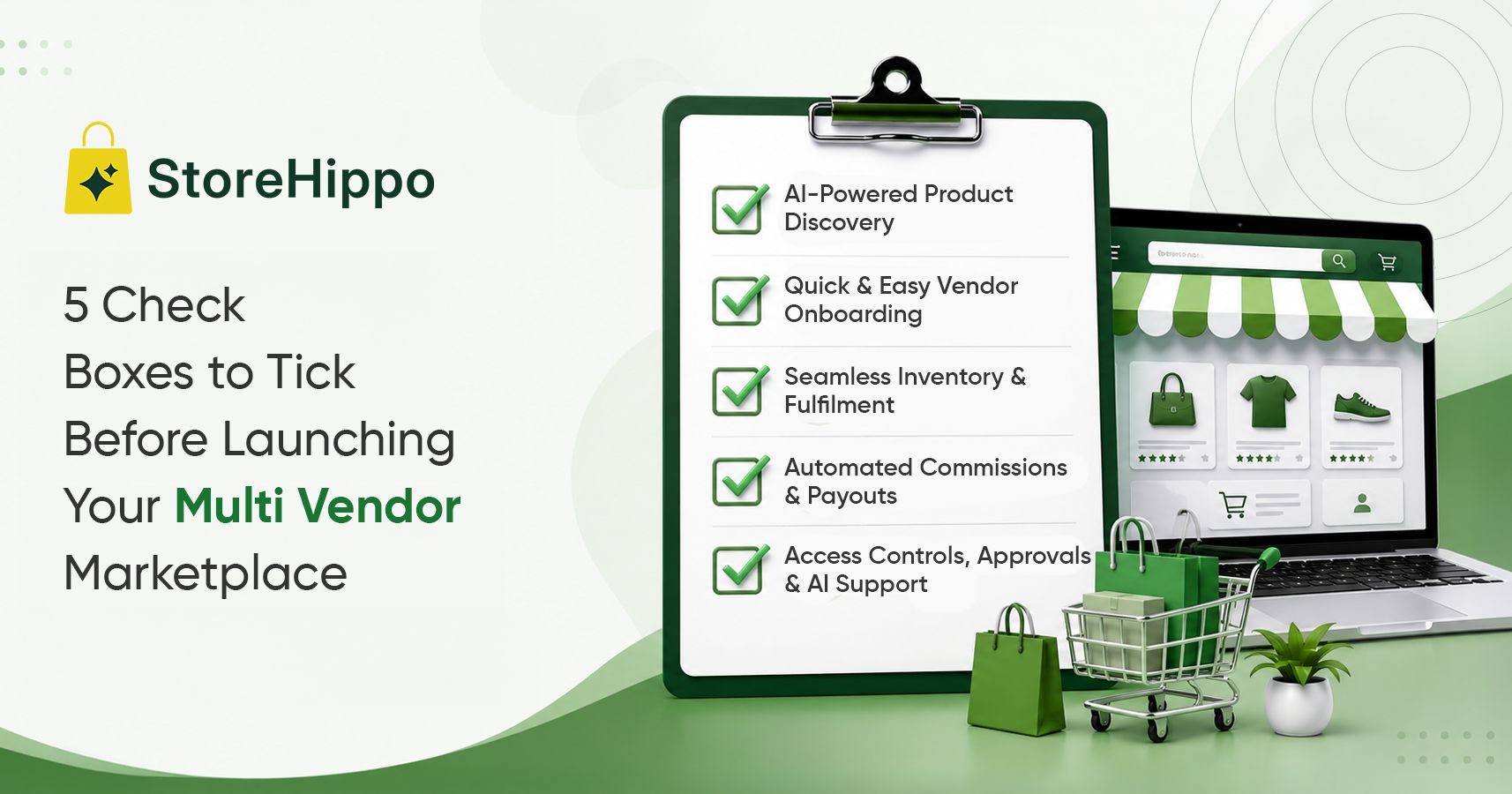



Most multi vendor marketplaces fail just after the launch, not because the idea is wrong, but because the marketplace isn't fully ready to handle key operational processes.
Vendors struggle to upload their products because the onboarding process doesn't support hundreds of sellers with different product data. As orders increase, shipping delays and fulfilment issues start to appear. Payment disputes arise when commission and payout rules aren't properly set up. And if buyers find it difficult to discover products or complete their purchase, many simply don't return.
These problems are common across online marketplaces of all sizes, industries and business models. Many businesses spend most of their time focusing on launching the platform rather than preparing the operations behind it. Getting your marketplace live is only the first step. Making sure it runs smoothly from day one is what sets successful marketplaces apart.
Ready to launch a marketplace that can scale smoothly?
Let’s explore the five key areas every business should streamline before going live.
Table of Contents
- 5 Things Every Business Should Streamline Before Launching a Multi Vendor Marketplace
- 1. How can you make product discovery easier for buyers on your multi vendor marketplace?
- 2. Is your vendor onboarding process ready to scale as your online marketplace grows?
- 3. Is your multi vendor marketplace ready to handle inventory, orders, taxes, and fulfilment before launch?
- 4. How will you manage commissions and vendor payouts on your multi vendor marketplace?
- 5. Do You Have Access Controls, Approval Workflows, and AI Support Live On Your Multi Vendor Marketplace Before Launch Day?
- Five Key Areas to Evaluate Before You Scale Your Multi Vendor Marketplace
- Conclusion
- FAQs
5 Things Every Business Should Streamline Before Launching a Multi Vendor Marketplace
Here are 5 critical questions every enterprise brand should ask to ensure their multi vendor marketplace is ready for growth:
1. How can you make product discovery easier for buyers on your multi vendor marketplace?
Product discovery should be simple, fast, and personalised to help buyers find the right products without spending too much time searching. Modern enterprises now use AI-powered search and recommendations to understand buyer intent, improve product visibility, and increase conversions. New-age buyers don't want to search endlessly to find the right product; instead, they want marketplaces to understand the intent behind their searches and show relevant products and recommendations instantly.
Lets see how the buyers' expectations evolved in this AI era:
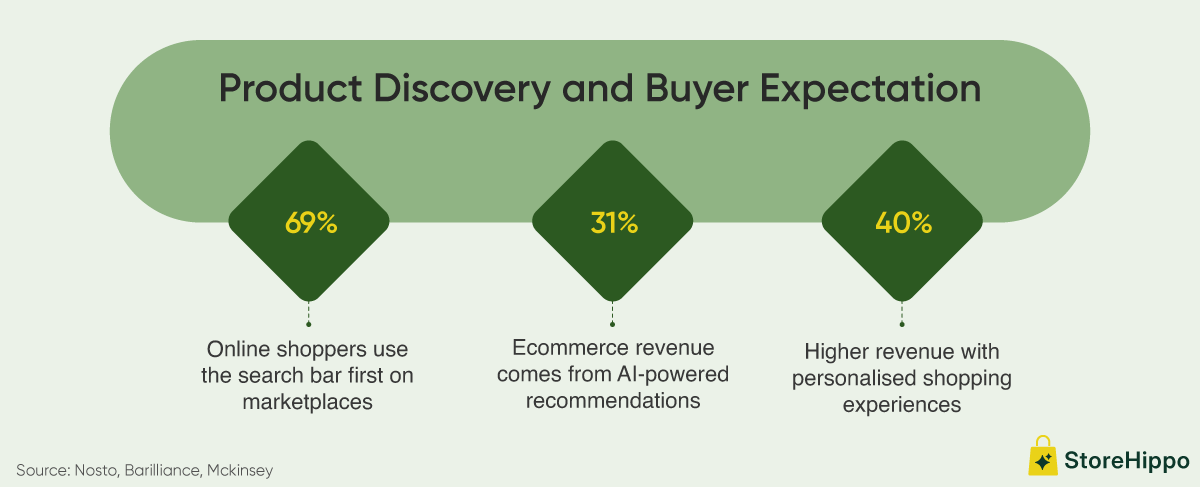
- 69% of online shoppers use the search bar first when they visit an online marketplace. If they can't quickly find relevant products, they may go to other websites to buy where they find their desired products easily and quickly.
- AI-powered product recommendations can generate up to 31% of ecommerce revenue, making personalised product discovery a key driver of conversions.
- Brands that deliver personalised shopping experiences can increase revenue by up to 40%, as buyers are more likely to engage and return.
Source Nosto, Barilliance, Mckinsey
It's clear that personalised shopping experiences have become an expected part of online buying journeys. However, delivering them becomes challenging, especially for multi vendor marketplaces where hundreds of sellers upload products with different titles, descriptions, images, and attributes. Without consistent product data and intelligent search, buyers may struggle to find relevant products.
For example, a fashion marketplace may have hundreds of sellers listing similar white sneakers with different product names and descriptions. A buyer searching for "running shoes" may not find the right products if the marketplace depends only on keyword matching. AI-powered search and recommendations help identify buyer intent and surface more relevant products.
To improve product discovery, marketplaces should use AI tools that understand buyer intent instead of relying only on exact keyword matches. Intelligent recommendations based on browsing behaviour and preferences can help buyers discover relevant products, while location-based storefronts with local language, currency, and content create a more personalised experience.
StoreHippo's AI-powered ecommerce platform helps multi-vendor marketplaces deliver personalised buying experiences by making product discovery faster, more relevant, and more engaging. Its AI-powered semantic search understands buyer intent to show more relevant results, while intelligent product recommendations help buyers discover products they are more likely to purchase. StoreHippo also enables businesses to build custom agentic AI assistants that guide buyers during their shopping journey, answer queries, and recommend products in real time. Since these capabilities are built into the core, businesses can deliver better buyer experiences without relying on multiple third-party tools.
2. Is your vendor onboarding process ready to scale as your online marketplace grows?
The success of a multi vendor marketplace depends on how quickly and easily new sellers can start selling. If onboarding requires manual reviews, repeated follow-ups, or frequent data corrections, it may work in the early stages of your online marketplace with a small number of vendors, but as your marketplace scales with a growing number of vendors, it quickly becomes difficult to manage.
To scale efficiently, enterprises should automate their vendor onboarding process with workflows that automate repetitive tasks like seller registration, document verification, catalogue creation, product approval, and vendor account setup. This reduces manual work, speeds up onboarding, and helps vendors start selling faster. As marketplaces grow, they may onboard different types of sellers with varying requirements, making flexible approval workflows and role-based access important.
For example, a marketplace onboarding hundreds of local artisans or home-based sellers can use automated workflows to help vendors complete registration, upload products, and start selling without delays.
Beyond onboarding sellers quickly, enterprises also need to ensure every vendor creates accurate and consistent product listings. Enterprises can use AI-powered tools to enhance images, simplify catalogue creation, and maintain consistent product listings.
Additionally, vendors must have the ability to manage their business from anywhere. A mobile-friendly seller dashboard allows them to upload products, manage inventory, process orders, and track payouts from their smartphones, making it easier to stay engaged with the marketplace.
StoreHippo is a future-ready multi vendor marketplace platform that simplifies vendor onboarding with built-in vendor management solutions, role-based seller dashboards, AI-powered cataloguing, AI image enhancement with Magic Edit, and a mobile-first seller portal. Businesses can create different approval processes and permission levels for different types of vendors while managing everything from a unified dashboard.
These capabilities help enterprises expand their seller network faster while maintaining catalogue quality and operational efficiency.
3. Is your multi vendor marketplace ready to handle inventory, orders, taxes, and fulfilment before launch?
Your multi-vendor marketplace should be ready to manage inventory, orders, taxes, and fulfilment workflows before launch. A well-planned operational system ensures accurate stock visibility, smoother order processing, correct tax calculations, and reliable deliveries as your marketplace scales.
The following data make clear how critical it is to optimise checkout and fulfilment processes to reduce cart abandonment and improve customer satisfaction.
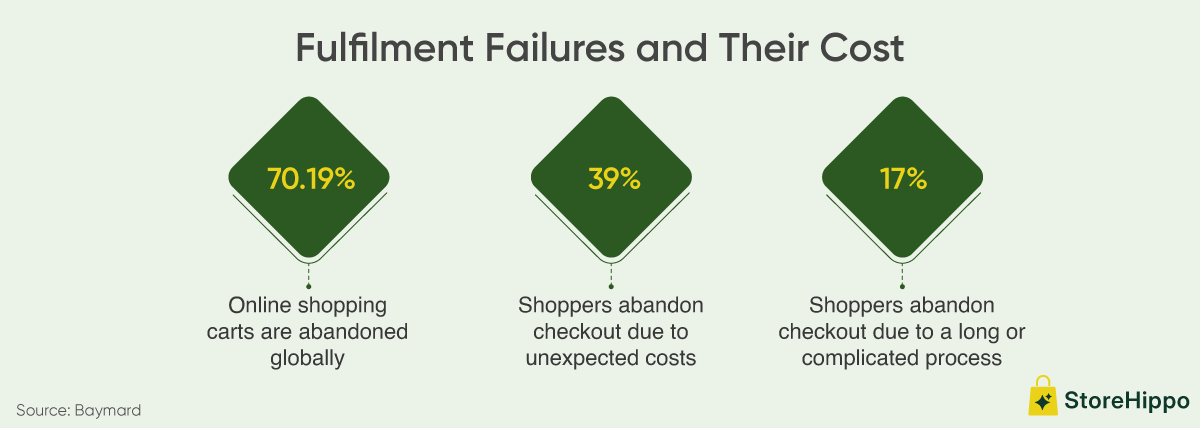
- 70.19% of online shopping carts are abandoned globally
- 39% of shoppers abandon checkout due to unexpected costs.
- 17% of shoppers abandon checkout due to a long or complicated process.
Source: Baymard
Launching a successful multi vendor marketplace requires more than connecting buyers and sellers. Inventory updates, order routing, tax calculations, and fulfilment workflows must work seamlessly from day one to avoid delays and poor customer experiences. Since every seller manages their own stock and fulfilment, real-time inventory syncing is essential to prevent overselling, cancelled orders, and inaccurate product availability.
Tax and fulfilment workflows also need to be accurate from the start. The ecommerce platform should apply the right tax rules and assign orders to the most suitable shipping partners based on seller location, delivery area, and service requirements. It should also provide accurate order tracking and smooth order fulfilment to ensure customers receive timely delivery updates.
For example, when a customer buys products from multiple vendors, the marketplace should calculate taxes correctly, assign deliveries to the right sellers, and provide clear updates throughout the fulfilment journey.
StoreHippo helps enterprises simplify complex marketplace operations by providing real-time inventory visibility, automated order routing through 30+ logistics partners, GST and tax automation, and enabling them to build custom AI-powered assistants that reduce manual effort for sellers.
These automated workflows also help sellers manage orders more efficiently without dealing with manual updates or fulfilment complexities.
4. How will you manage commissions and vendor payouts on your multi vendor marketplace?
A reliable commission and payout system helps online marketplaces build vendor trust and maintain smooth financial operations. Automating commission calculations, payment settlements, refunds, and transaction tracking ensures sellers receive accurate payouts while reducing manual effort for marketplace teams.
Every multi vendor marketplace has different commission rules. Rates may vary by vendor, product category, or promotions. Enterprises should choose the best marketplace builder that can automatically calculate commissions, split payments between vendors, process refunds correctly, and maintain a complete record of every transaction.
Flexible payout schedules can also improve vendor satisfaction. Some sellers may prefer weekly settlements, while others may work with different payment cycles. Giving businesses the flexibility to configure payout schedules helps improve vendor relationships and encourages long-term participation.
For example, a grocery marketplace may have both large suppliers and small local sellers. Large suppliers may prefer payments every two weeks, while local sellers may need weekly payments to manage their daily expenses. A flexible payout system helps both types of sellers receive payments according to their needs.
StoreHippo, the best marketplace builder, helps enterprises simplify commission and payout management with automated split payments through 60+ integrated payment gateways. Businesses can configure vendor-specific commissions, category-wise commission rules, and payout schedules from a single admin panel. Vendors also get dedicated dashboards to track sales, commissions, and payouts, reducing payment-related queries.
Testing commission calculations, refunds, payouts, and dispute scenarios before launch helps businesses build vendor confidence and create a smoother marketplace experience from the beginning.
5. Do You Have Access Controls, Approval Workflows, and AI Support Live On Your Multi Vendor Marketplace Before Launch Day?
A multi vendor marketplace should have access controls, approval workflows, and AI-powered support systems in place before launch to ensure secure operations, faster decision-making, and smoother experiences for buyers and sellers.
As a marketplace grows, different people manage different tasks every day. Admins, sellers, and support teams should have access only to the information they need. This prevents mistakes, keeps important data secure, and helps teams manage daily operations smoothly.
Approval processes are also important to maintain marketplace quality. Vendor registrations, product listings, pricing changes, and other updates should follow defined checks before going live. This helps businesses maintain accurate catalogues, follow marketplace rules, and avoid unnecessary manual follow-ups.
Customer and seller support should also be planned before launch. Buyers need quick answers about orders, deliveries, and returns, while sellers may need help with product uploads, payouts, and order management. To provide faster support and reduce the workload on support teams, enterprises should build AI-powered assistants that can handle common questions instantly, allowing support teams to spend more time on complex issues.
For example, a seller may need help uploading products while a buyer wants to check an order status. If enterprises build custom AI assistants, they can handle both queries instantly, while access controls ensure only authorised users can approve listings or make important changes. This keeps marketplace operations smooth from day one.
StoreHippo’s AI-powered multi vendor ecommerce platform provides role-based access, approval workflows, and enables enterprises to build their custom AI assistants for buyers, sellers, and internal teams. It also offers seamless integration with CRM, accounting, and other business tools to help enterprises manage queries and daily operations more efficiently.
Setting up these systems before launch helps businesses reduce errors, save time, protect important data, and create a better experience for buyers and sellers from the beginning.
Five Key Areas to Evaluate Before You Scale Your Multi Vendor Marketplace
These may not be essential on day one, but planning for them early can save significant time, cost, and effort as your marketplace grows.
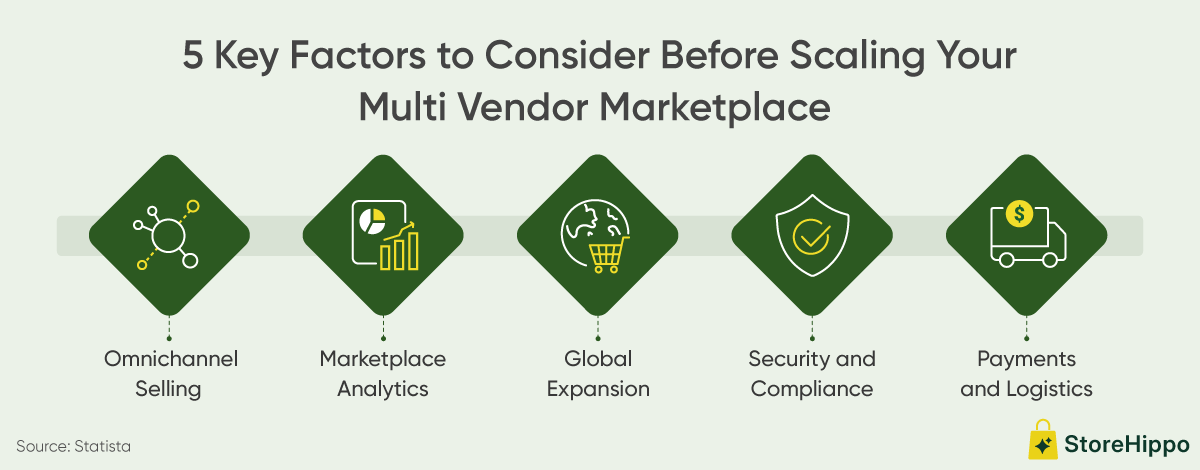
Let's explore the five areas that can help your marketplace scale smoothly as your business grows.
1. Omnichannel Selling
Your buyers should enjoy the same experience whether they shop on your marketplace website, mobile app, PWA, WhatsApp, conversation AI, or other sales channels. Managing every channel from a single platform helps keep pricing, inventory, orders, and product information consistent while giving customers a seamless shopping experience.
StoreHippo's omnichannel ecommerce platform lets businesses manage websites, mobile apps, marketplaces, and other sales channels from one backend, making it easier to deliver a consistent brand experience everywhere. It offers a unified dashboard that gives teams a single view of products, orders, customers, and conversations across every touchpoint, making it easier to monitor operations, respond faster, and deliver a consistent brand experience.
2. Marketplace Analytics
Good decisions depend on good data. Before launching your online marketplace, identify the business metrics you want to track, such as vendor performance, buyer acquisition, sales, order fulfilment, and cart abandonment. Having clear insights from the start helps you identify opportunities, improve operations, and make faster business decisions.
StoreHippo offers built-in analytics and integrates with tools like Google Analytics and Facebook Pixel, giving businesses deeper insights into marketplace performance.
3. Global Expansion
If you plan to build a marketplace website to expand into international markets in the future, choose the best marketplace builder that already supports multiple languages, currencies, taxes, and regional payment and shipping solutions.
This makes it much easier to launch country-specific storefronts without rebuilding your marketplace later.
StoreHippo natively supports multilingual commerce, multi-currency payments, regional tax rules, and localised storefronts, helping businesses expand into global markets from a single platform.
4. Security and Compliance
Protecting customer and vendor data should be a priority from the very beginning. You should choose the best marketplace builder that follows recognised security standards and compliance requirements so you can build trust and reduce business risk as your marketplace grows.
StoreHippo is a PCI DSS-compliant ecommerce platform that helps businesses process online payments securely and protect sensitive payment information. It is also certified with SOC and ISO certificates, ensuring strong data security, reliable platform operations, and the protection of customer and business information.
5. Payments and Logistics
The right integrations make multi vendor marketplace operations much easier. You should build a marketplace website on a platform that supports multiple payment gateways, shipping partners, automated order routing, and split payments. This gives buyers more payment choices, simplifies fulfilment, and helps vendors receive payments quickly.
StoreHippo comes with 60+ payment gateway integrations and 30+ logistics partners, along with built-in support for split payments, automated shipping, and regional payment methods, helping businesses launch and scale faster without custom integrations.
Conclusion
Launching a successful marketplace starts with putting the right systems in place from day one. A smooth onboarding process, reliable order fulfilment, accurate payouts, strong security, and responsive customer support help create a better experience for everyone using your multi vendor marketplace.
Fixing these areas before launch is much easier than solving problems after your online marketplace goes live. Taking the time to test your workflows, automate routine tasks, and prepare for real-world order volumes can help you avoid costly operational issues and build trust with both buyers and vendors.
Ready to build a marketplace website?
See how StoreHippo can help you launch faster and scale with confidence. Book your personalised demo now.
FAQs
Q1: How many vendors should a multi vendor marketplace have before it launches?
There is no fixed number of vendors a marketplace needs before launch. A marketplace with 20 active vendors offering high-quality products and reliable delivery will often perform better than one with hundreds of sellers who have incomplete catalogues or inconsistent service. Enterprises should focus on onboarding genuine and trusted vendors, building strong category coverage, and ensuring smooth fulfilment before expanding their seller base.
Q2: What is the most common operational mistake multi vendor marketplaces make at launch?
The most common mistake marketplaces make at launch is underestimating day-one operations. Buyers and vendors start raising questions as soon as the marketplace goes live, and without the right support systems, teams can quickly become overwhelmed. Another common mistake is relying on manual commission and payout processes, which often lead to payment errors, delays, and unhappy vendors.
Q3: How can multi vendor marketplaces handle returns and refunds across different vendors?
Multi vendor marketplaces can manage returns and refunds through a central system while allowing vendors to follow category- or seller-specific return policies. The platform automatically processes refunds, adjusts vendor payouts, and applies the correct tax rules. It should also handle partial returns from orders containing products from multiple vendors, reducing manual work and ensuring a smooth experience for buyers and sellers.
Q4: What does a vendor dashboard need to include at minimum for launch?
A vendor dashboard should give sellers everything they need to manage their business from one place. At a minimum, it should include order tracking, inventory management, product listing management, payout history with commission details, and basic sales performance reports. A mobile-friendly dashboard is equally important, allowing vendors to manage their business anytime, from any device.
Q5: How long does it take to configure commission and payout logic on a modern platform?
The time required to configure commission and payout logic depends on the ecommerce platform and the complexity of your commission structure. Modern platforms with built-in commission and payout management usually let businesses configure these settings within a few days. Businesses then need time to define commission rates, payout schedules, and test different scenarios, such as refunds and partial returns, before launching the marketplace.
Q6: What security certifications should a multi vendor marketplace platform have before launch?
A multi vendor marketplace platform should meet recognised security standards before launch. You should look for PCI DSS certification to secure online payments, SOC to ensure reliable and secure handling of customer data, and ISO for information security management. If you sell in international markets, you should also ensure your online marketplace complies with relevant regional data privacy and security regulations.
Pallavee Kumar brings over 20 years of hands-on ecommerce experience, helping enterprise brands scale through strong operations and clear storytelling.
She writes from hands-on experience, helping businesses understand what it takes to build, scale, and grow successful enterprise multi vendor marketplaces.