


Did you know that growing at an annual rate of 51%, the Indian Ecommerce revenue is highest in the world. Driven mainly by the popular multi vendor marketplaces, this growth also underlines the huge demand-supply gap.
While Amazon leads the race, many home-grown players are gradually growing their reach and solidifying their presence. The battle is undoubtedly fierce but ideal for the growth of indigenous brands that can capitalize on the gap in need and supply.
Despite the low internet penetration, with only 50% of the Indian population having internet access the Indian market size is huge. As the internet reaches more people the market would evolve and grow further.
With the Indian online shoppers already conditioned by their experiences on the popular ecommerce marketplaces, this business model is the one that will remain popular in years to come. No wonder why more and more purely ecommerce players as well as brick and mortar brands are opting for this business model.
Let’s explore the top 10 multi vendor marketplaces in India and see how they are shaping the future of online commerce.
Table of Contents
- India's Ecommerce Marketplace Growth at a Glance
- Top 10 Multi Vendor Marketplaces in India 2026 (B2B+B2C)
- What Makes Multi Vendor Marketplace The Best Model For Your Business
- How AI-Powered Multivendor Marketplaces Accelerate Growth
- Why Choose StoreHippo AI Powered Ecommerce Solutions to Build Your B2B or B2C Ecommerce Marketplace
- Conclusion
- FAQs
India's Ecommerce Marketplace Growth at a Glance
India's ecommerce ecosystem is expanding rapidly across both B2C and B2B segments, with multi vendor marketplaces leading this transformation. Rising internet penetration, increasing digital payments, growing MSME participation, and stronger logistics networks are encouraging more businesses to adopt marketplace models. At the same time, buyers are looking for greater product variety, competitive pricing, and seamless shopping experiences, making multi vendor marketplaces one of the fastest-growing ecommerce business models in the country.
Here are a few numbers that highlight this growth:
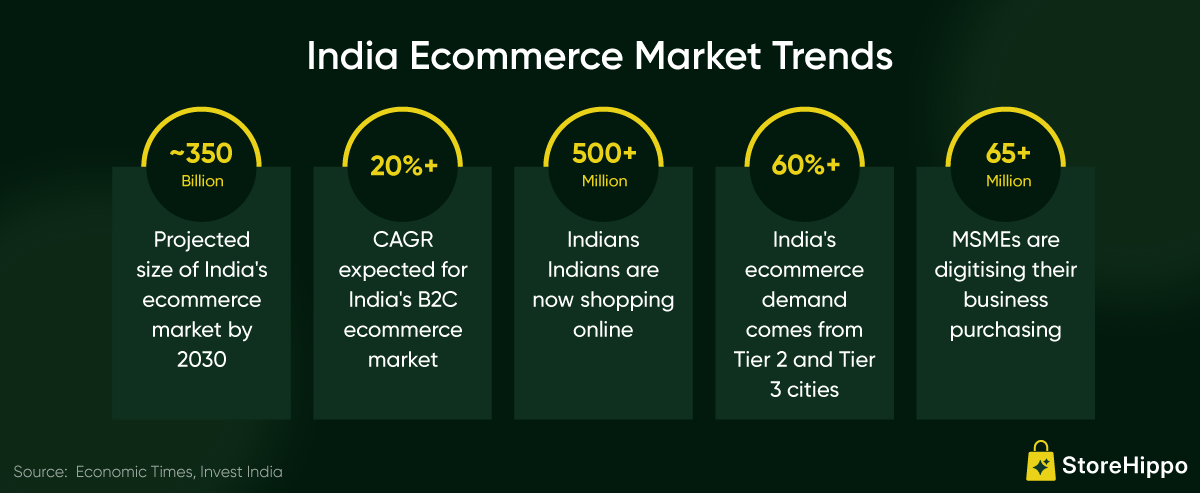
- $325–350 billion projected size of India's ecommerce market by 2030
- 20%+ CAGR expected for India's B2C ecommerce market
- 500+ million Indians Indians are now shopping online
- 60%+ of India's ecommerce demand comes from Tier 2 and Tier 3 cities
- 65+ million MSMEs are digitising their business purchasing
Source Economic Times, Invest India
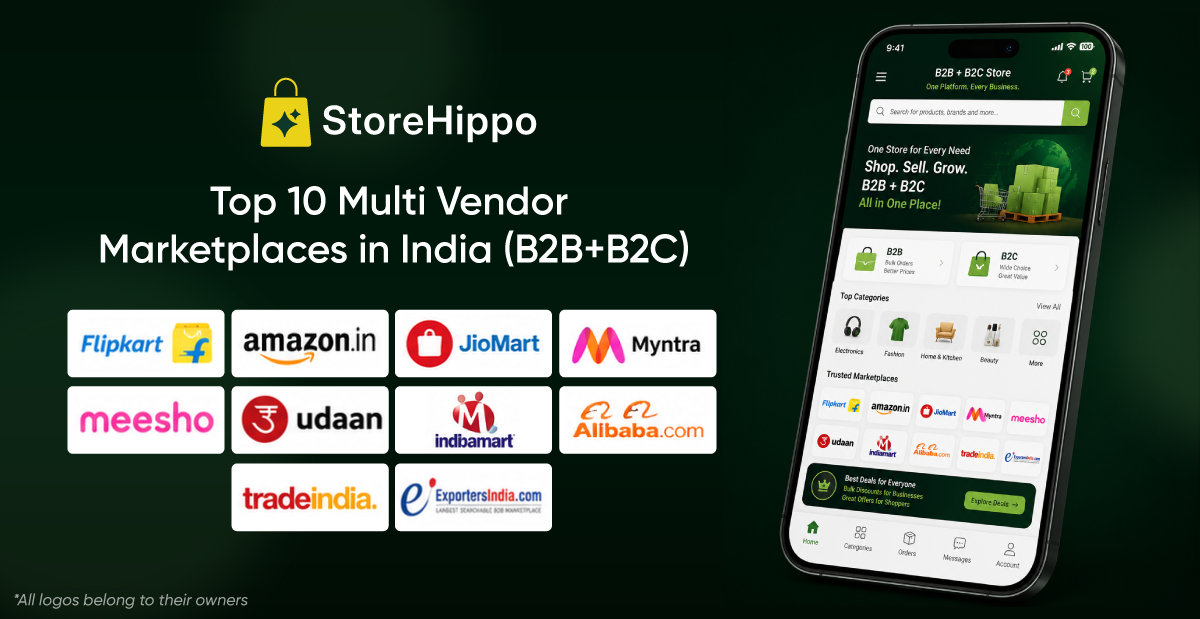
Top 10 Multi Vendor Marketplaces in India 2026 (B2B+B2C)
So without further ado let's first check out the top 10 online marketplaces in India.
Top 5 B2C Ecommerce Marketplaces In India In 2026
Since the B2C multi seller model is known to everyone, lets first check the top 5 marketplaces in this segment:
1. Flipkart
Flipkart is India's largest B2C marketplace by revenue. What started as a bookselling portal online is now a powerful multi-vendor marketplace that offers products in almost all categories, including electronics, fashion, furniture, appliances, toys, books, etc. With 1.4 million active sellers, 180-200 million monthly active users, and 148-198 million monthly visits, Flipkart continues to lead India's ecommerce market.
Flipkart Growth Stats
- 500 million+ registered users
- 500 million+ products across 150+ categories
- ₹20,493 crore revenue reported by Flipkart Internet in FY25
- 1.4 billion+ customer visits during The Big Billion Days 2024
- 606 million visits in the first 48 hours of The Big Billion Days 2025
Source Wikipedia, Economic Times, Fortune India
2. Amazon India
Amazon is one of the world's largest ecommerce marketplaces and remains a leading online shopping platform in India. It offers millions of products across categories such as electronics, fashion, groceries, home essentials, and more. Along with its marketplace, Amazon also offers services like Amazon Prime, Amazon Pay, Alexa, Echo devices, and streaming through Prime Video, making it a comprehensive digital commerce ecosystem.
Amazon Growth Stats
- ₹30,139 crore operational revenue reported by Amazon India in FY25
- 1.6 million+ sellers selling across Amazon India
- 12.5 crore+ products available across the marketplace
- 70% of new Prime members during Prime Day 2025 came from Tier II and Tier III cities
- 52% of online shoppers start their product search on Amazon
Source: Economic Times, Reuters, Amazon News
3. Jio Mart
JioMart has become one of India's leading ecommerce platforms. It started with groceries and daily essentials but now offers products across many categories, including fashion, electronics, home, and beauty. Backed by Reliance's large retail network, JioMart connects online shopping with nearby stores to make deliveries faster and more convenient. Affordable prices, a growing product range, and reliable delivery have made it a popular choice for shoppers across metro, tier 2, and tier 3 cities.
JioMart Growth Stats
- 378 million+ registered customers
- 360%+ year-on-year increase in average daily orders
- 200 million+ monthly visitors navigating the marketplace
- 5,000+ pin codes across 1,000+ cities served
Source: YourStory, FinTechBizNews / Reliance Investor Disclosures
4. Myntra
Myntra is one of India's leading fashion and lifestyle ecommerce platforms. It offers a wide range of fashion, beauty, footwear, accessories, and home products from thousands of national and international brands. As part of the Flipkart Group, Myntra continues to be a preferred destination for online fashion shopping. It also offers M-Now, its quick commerce service, delivering fashion, beauty, and lifestyle products in minutes across select cities, making shopping faster and more convenient.
- ₹6,043 crore revenue from operations in FY25
- 70 million+ monthly active users
- 3.8 million+ styles from 9,700+ brands
- 30% growth in first-time shoppers during EORS 2026
Source Money Control, Economic Times
5. Meesho
Meesho is one of fastest-growing B2C ecommerce platforms in India, making online shopping affordable and accessible for millions of customers. It offers a wide range of products across fashion, home, kitchen, beauty, electronics, and everyday essentials at competitive prices. With a strong presence in tier 2, tier 3, and smaller cities, Meesho has expanded ecommerce access beyond major metros. Its value-driven pricing, wide product selection, and easy shopping experience have made it a popular choice for budget-conscious shoppers across India.
- ~190 million monthly active users
- ₹9,389 crore revenue in FY25
- ₹1,032 crore in free cash flow generated in FY25
- 80% of total shoppers from Tier-2 to Tier-4 cities
- 70% repeat purchase rate
Source: Wikipedia, Entrackr, Business Model Canvas Insights
Top 5 B2B Multi Vendor Marketplaces In India In 2026
Now that we’ve covered B2C marketplaces, let’s move on to the top 5 B2B multi vendor platforms driving wholesale commerce in India.
6. Udaan
Founded in 2016, Udaan is India’s largest eB2B platform, with nearly 70% market share. It connects retailers with thousands of suppliers and leading brands across categories such as FMCG, staples, fresh produce, electronics and pharma, enabling efficient, technology-driven B2B sales.
Through udaanCapital, the platform also offers working capital and financial solutions to help small businesses manage cash flow and scale faster.
Udaan Growth Stats
- 70% of B2B market share
- ₹4,561.4 crore revenue from operations reported in FY25
- $114 million raised in Series G funding
Source: ET Retail, Economic Times
7. IndiaMART
IndiaMART is one of India’s most popular B2B multi-vendor marketplaces, enabling growth opportunities for large enterprises, SMEs, and individual sellers alike.
Powered by a vast business ecosystem, IndiaMART simplifies B2B trade by providing businesses with wider market access, digital tools, and growth-enabling solutions, making buying and selling more efficient at scale.
IndiaMART Growth Trends
- 8.7 million supplier storefronts listed on the platform
- 220,000+ paying suppliers subscribed to premium business plans
- 27-28 million business enquiries generated every quarter
- ₹3,280 crore cash and investment reserves as of early 2026
Source: IndiaMART Investor Relations, Angel One
8. Alibaba
Alibaba not only connects Indian suppliers and businesses domestically but also opens up the platform for exporters, importers, and suppliers who wish to connect with global businesses. Indian buyers can buy products from global sellers and also sell their products globally through Alibaba’s B2B multi vendor marketplace.
Alibaba Growth Stats
- 40–50 million business buyers across 200+ countries and regions
- $100 billion+ annual cross-border transaction volume
- 47% year-on-year growth across global marketplace operations
- 200,000+ merchant partners using its cross-border logistics network
Source: Alibaba Group Global Financial Disclosures, Wall Street Journal
9. TradeIndia
TradeIndia is one of India's leading B2B marketplaces, helping manufacturers, exporters, importers, wholesalers, and SMEs connect with buyers across domestic and international markets. The platform offers millions of product listings across industrial and commercial categories while providing digital catalogues, verified business profiles, and lead generation tools. Its strong focus on helping Indian businesses expand globally has made it a preferred marketplace for businesses looking to grow beyond traditional trade channels.
TradeIndia Growth Stats
- 10 million+ registered business users
- 3 million+ product listings across multiple industries
- $15–20 billion in trade transactions facilitated annually
- 35% year-on-year growth in trade volume
- 1.3 million SME listings on the platform
Source: Tracxn Platform Insights, Scribd TradeIndia Case Files
10. ExportersIndia
ExportsIndia is an exclusive ecommerce marketplace to help Indian Indian manufacturers and sellers reach foreign markets while also selling in the domestic markets. By enabling businesses to go online and access global buyers, the platform helps brands reach new markets that were previously difficult or impossible to access, driving growth beyond traditional trade boundaries.
ExportersIndia Growth Stats
- 20 lakh+ suppliers listed across the marketplace
- 50 lakh+ verified buyers connected through the platform
- 12 lakh+ verified companies registered across industries
- 75,000+ product and service categories available on the marketplace
- 6 lakh+ business enquiries generated every month
Source: ExportersIndia Live Trade Index, Trustpilot Corporate Registry
So, here we have the top 10 multi seller websites in India. Now that we know their business model and area of operation, let’s understand why this is the most sought after business model by brands as well as individual players.
What Makes Multi Vendor Marketplace The Best Model For Your Business
The multi-vendor marketplace model continues to be the preferred choice for new and established businesses alike and for good reason. It offers a faster path to scale, diversified revenue streams, and strong buyer trust from day one.
Key factors that make the multi seller model ideal include:
- Availability of turnkey solutions that make it easy to launch the business
- Lots of existing examples to help you frame your business model
- The willingness of vendors and sellers to sell on online marketplaces
- Easy to scale to new markets or product lines by adding new vendors
- Multiple ways to generate revenue along with commissions on orders
- Customers willingness and trust in marketplace brands
It’s no surprise that new marketplaces are launching at a rapid pace. However, success depends not just on the business model but on the technology foundation behind it. A robust, flexible marketplace builder is essential to efficiently connect sellers and buyers, automate operations, and support long-term growth.
However, as competition intensifies and buyer expectations evolve, traditional marketplace models alone are no longer enough. This is where AI-powered online marketplaces step in, transforming how platforms attract buyers, engage sellers, and accelerate growth at scale.
How AI-Powered Multivendor Marketplaces Accelerate Growth
AI has revolutionised how ecommerce marketplaces operate. What was once a nice-to-have add-on has now become an essential growth driver for B2B and B2C marketplaces. By embedding AI across every stage of the buyer’s journey, AI-powered online marketplaces can generate better leads, boost engagement, and increase conversions.
Still skeptical? The data speaks for itself.
How AI in Ecommerce is Reshaping Online Marketplaces
- 4X increase in conversion rates with AI-powered chat
- 67% increase in sales through custom retail chatbots
- 10% to 15% e-commerce customer retention achieved through AI
- 47% faster ecommerce purchases when assisted by AI ( reduces friction and choice paralysis)
- 10%-30% of retailers' ecommerce revenue comes from suggestive selling through agentic AI engines
Source: McKinsey Global Survey, Barilliance survey, Capital One Shopping, Rep AI
Clearly, AI is no longer optional, it’s the engine that powers growth and strengthens connections with your buyers.
By adding AI into your B2C or B2B marketplace, your brand can deliver smarter product discovery, automate complex operations seamlessly, and create highly personalised experiences that drive loyalty, boost engagement, and maximise conversions.
With AI evolving from simple automation to intelligent decision-making, modern multi-vendor marketplaces are becoming smarter, faster, and more customer-centric. Advanced AI capabilities such as AI-powered product discovery, personalised recommendations, automated catalogue creation, intelligent search, and agentic AI assistants are transforming marketplace experiences by improving customer engagement and simplifying business operations. To fully leverage these capabilities and build a scalable B2B or B2C marketplace, choosing the right AI-powered platform like StoreHippo becomes crucial. StoreHippo’s AI-native commerce platform combines commerce intelligence, automation, and scalable architecture while enabling enterprises to build AI agents that assist buyers, sellers, and internal teams in completing tasks seamlessly, driving smarter operations, better engagement, and sustainable growth.
Why Choose StoreHippo AI Powered Ecommerce Solutions to Build Your B2B or B2C Ecommerce Marketplace
StoreHippo offers a turnkey,mobile-ready, scalable and customisable multi-seller ecommerce solution to build B2C as well as B2B multi vendor portals. The fully hosted and managed platform comes with 300+ inbuilt features that take care of your end to end business requirements. It gives you customisable themes to build the most engaging and customer friendly portal.
Designed to make it easy for the business owners as well as the vendors to run the everyday business, StoreHippo offers an intuitive admin panel that brings everything together in one place. From managing your vendors to their products, commissions and payouts, you have it all in one place. You can also see the complete order history, best-selling products, shipping and payment details etc.
StoreHippo takes your marketplace to the next level with AI-driven capabilities that improve product discovery, personalised recommendations, catalogue optimisation, and guided checkout experiences, all designed to boost engagement, conversions, and operational efficiency. Additionally, custom agentic AI assistants can be built to support buyers, sellers, and internal teams with operational queries, onboarding, and daily workflows. With a unified AI-powered dashboard, enterprises can manage marketplace operations, monitor performance insights, streamline workflows, and make data-driven decisions from a single platform, ensuring smooth and intelligent marketplace management.
Alongside AI, you get a comprehensive set of B2B ecommerce solutions like minimum order quantity, request a quote, custom forms, customised invoice, wholesale and retail pricing, location-based pricing, white labelling etc. to take care of the B2B requirements. Integrations with custom ERP and other software is also easy. You can also set up your multi-store portal or explore global markets with a multilingual, multicurrency online marketplace.
StoreHippo also offers 60+ payment gateways, integrated logistics solutions and inbuilt marketing tools. Built on the mobile-first principle StoreHippo helps you in tapping the m-ecommerce market with PWA stores that work like apps when opened in a browser. You can also build your Android and iOS apps right from your dashboard at no additional cost.
In nutshell, StoreHippo has everything you need to build, run and grow your B2B+B2C multi vendor marketplace.
Conclusion
Inspired by the success of the top 10 Indian multi vendor marketplaces?
Ready to build your own marketplace website? Have a custom or complex model in mind? With StoreHippo’s AI-powered online marketplace, has all the features and customisations to take care of your unique business requirements, whether B2B, B2C, or hybrid. Leverage AI-driven tools, automation, and personalisation to enhance engagement, boost conversions, and build long-term buyer loyalty.
Want to know more about StoreHippo multi vendor features and how they can give wings to your idea?
Explore the 300+ inbuilt features of StoreHippo along with the ecommerce marketplace solutions. Book your free demo today.
FAQs
1. What features should enterprises look for in a multi vendor marketplace platform?
Enterprises should look for features like built in vendor management solutions, separate seller dashboards, product and inventory management, order and payout management, integrated payments and logistics, AI-powered automation, marketing tools, mobile commerce, enterprise security, and the ability to scale as your marketplace grows. These capabilities help businesses manage sellers efficiently, deliver a better buyer experience, and grow their marketplace without operational bottlenecks.
2. How can enterprises build a fully customisable ecommerce marketplace?
Enterprises can build a fully customisable ecommerce marketplace by choosing a platform with a headless, API-first architecture, flexible design tools, custom workflows, and easy third-party integrations. This allows businesses to tailor every aspect of the marketplace, adapt quickly to changing needs, and scale without rebuilding their technology stack.
3. How can AI help multi vendor marketplace grow?
AI can help a multi vendor marketplace grow by automating routine operations, personalising shopping experiences, improving product discovery, streamlining vendor management, and providing actionable business insights. This helps enterprises increase conversions, improve operational efficiency, enhance customer satisfaction, and scale their marketplace faster.
4. Can one ecommerce marketplace platform support both B2B and B2C business models?
Yes. A single ecommerce marketplace platform can support both B2B and B2C business models if it offers built-in capabilities like flexible pricing, bulk ordering, RFQs, flexible catalogues, multiple storefronts, and role-based access. This allows enterprises to serve different customer segments while managing all operations from one platform.
5.How Can enterprises integrate my ERP, CRM, and logistics software with my multi vendor marketplace platform?
Enterprises can integrate ERP, CRM, and logistics software with a multi vendor marketplace platform by choosing an API-first solution with pre-built integrations and flexible connectors. This enables seamless data flow across business systems, automates inventory and order updates, streamlines fulfilment, and keeps marketplace operations synchronised in real time.
6. How long does it take to launch a multi vendor marketplace?
The time required to launch a multi vendor marketplace depends on the platform, customisation needs, and business complexity. With a platform that offers built-in multi-vendor features, ready integrations, and no-code or low-code tools, enterprises can launch much faster than building a marketplace from scratch.
7. Can ecommerce marketplace platform support national and global expansion?
Yes. An ecommerce marketplace platform can support both national and global expansion if it offers multilingual and multi-currency capabilities, flexible tax management, local and international payment options, logistics integrations, and multi-location inventory management. These features help enterprises expand into new markets while managing operations from a single platform.
8. What integrations should an enterprise ecommerce marketplace platform support?
An enterprise ecommerce marketplace platform should support integrations with ERP, CRM, payment gateways, logistics providers, accounting software, marketing tools, customer support systems, and third-party business applications. These integrations automate workflows, improve data accuracy, and create a connected ecosystem that scales with business growth.
Binny Joseph is a seasoned ecommerce and enterprise growth leader, serving as Senior Vice President of Sales & Alliances with deep experience helping global brands adopt modern commerce solutions.
He combines strategic expertise with practical experience to help B2B and B2C enterprises modernise their commerce operations through AI-powered innovation, and scalable digital solutions.