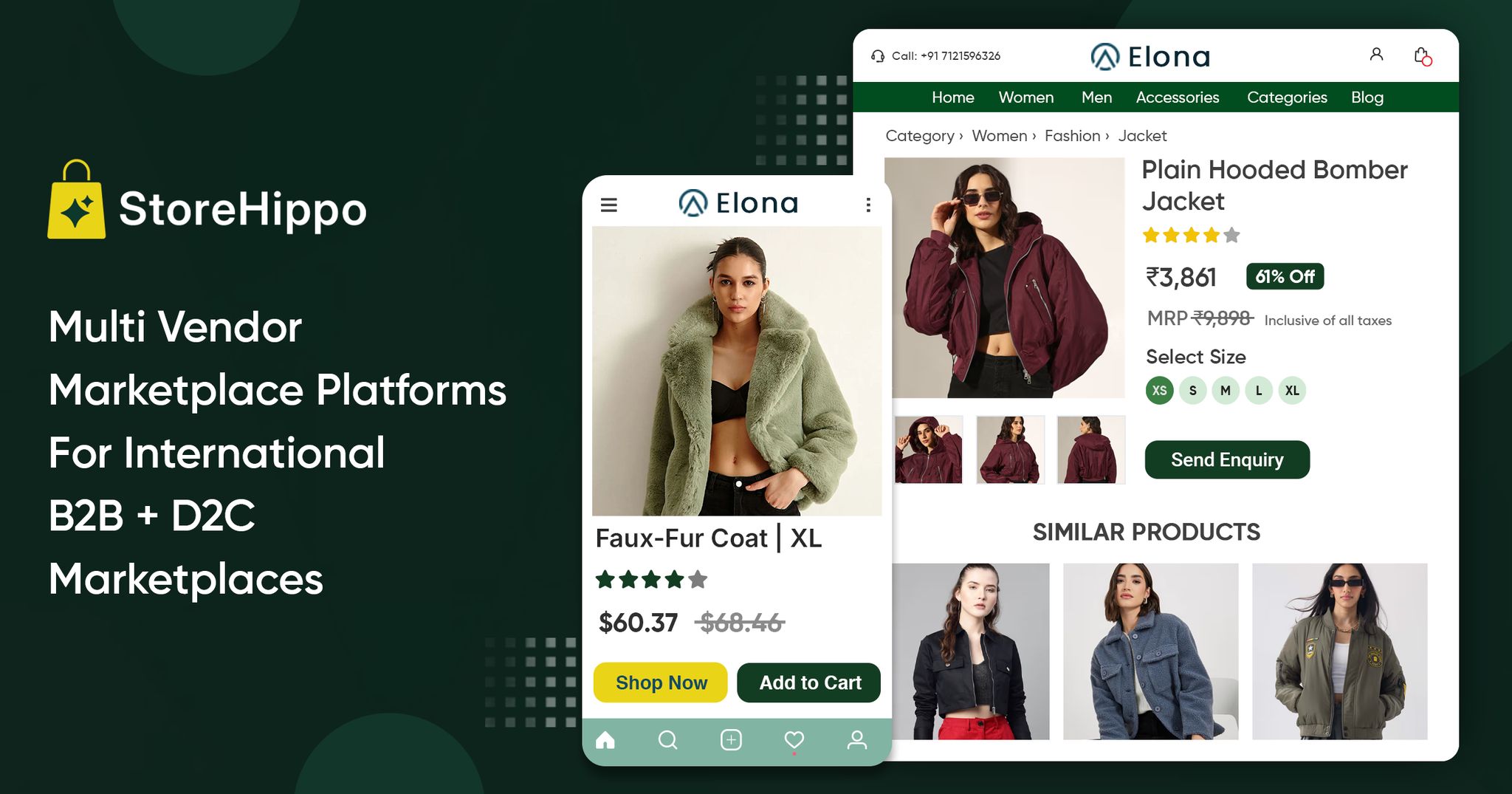



If you’re currently evaluating multi vendor marketplace platforms, chances are this thought has crossed your mind more than once: our business is no longer just B2B or just D2C, so why are our systems still built that way?
Across industries, enterprises are finding themselves serving distributors, partners, and end customers simultaneously. Buyers discover products on marketplaces, negotiate like B2B customers, and expect the speed of D2C commerce, often in the same journey. This shift is quietly changing how modern commerce ecosystems need to be built. A single storefront or a patchwork of tools is no longer enough to support the scale and complexity of today enterprise brand’s hybrid business models.
That’s why more organisations are exploring a unified enterprise marketplace approach, one that can bring B2B, B2C, and partner-led selling together without creating operational chaos. The goal isn’t just to launch a marketplace, but to create a flexible multi vendor marketplace software foundation that can handle new regions, new seller networks, and new customer expectations without forcing another rebuild two years down the line.
Table of Contents
- Why Global Enterprises Are Building Hybrid B2B+D2C Multi Vendor Marketplaces
- Top 10 B2B + D2C Multi Vendor Marketplace Platforms for Hybrid Global Enterprises
- 1. StoreHippo - Enterprise Marketplace Platform for Scalable B2B + D2C Ecosystems
- 2. Shopify Plus
- 3. Adobe Commerce (Magento)
- 4. BigCommerce
- 5. Salesforce Commerce Cloud
- 6. commercetools
- 7. SAP Commerce Cloud
- 8. BigCommerce Enterprise
- 9. Spryker
- 10. OroCommerce
- Quick Comparison Of Top B2B + D2C Multi-Vendor Marketplace Platforms
- Conclusion
- FAQs
Why Global Enterprises Are Building Hybrid B2B+D2C Multi Vendor Marketplaces
Before evaluating platforms or architecture, it helps to step back and look at where global commerce itself is heading. Is the market actually pushing enterprises toward unified, hybrid marketplace models?
The data below reveals why more global brands are restructuring around marketplace-led ecosystems and what this shift means for the future of enterprise commerce.
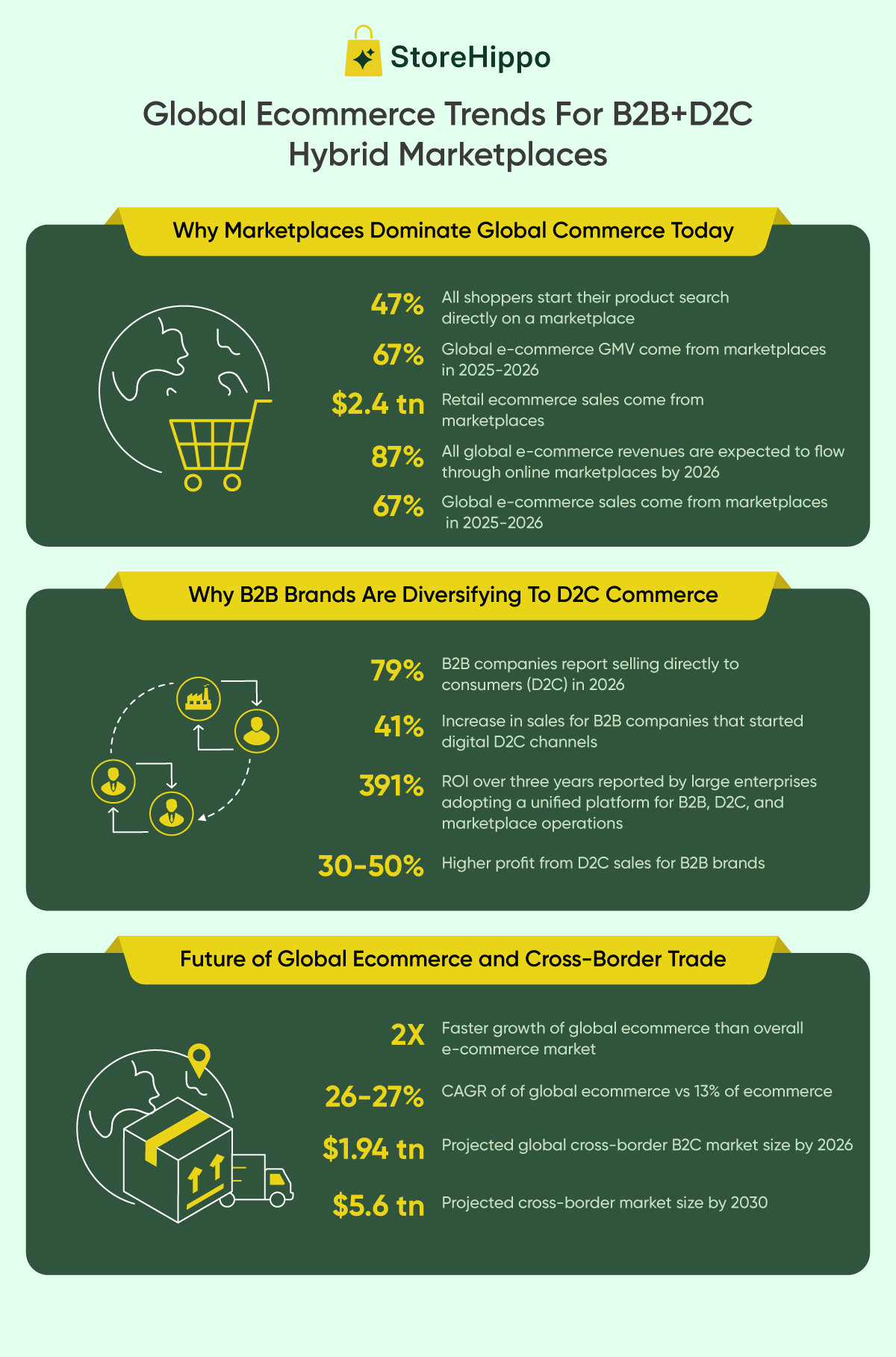
Why Marketplaces Dominate Global Commerce Today
- 47% of all shoppers start their product search directly on a marketplace
- 67% of global e-commerce GMV come from marketplaces in 2025-2026
- $2.4 trillion retail ecommerce sales come from marketplaces
- 87% of all global e-commerce revenues are expected to flow through online marketplaces by 2026
- 67% of global e-commerce sales come from marketplaces in 2025-2026
Why B2B Brands Are Diversifying To D2C Commerce
- 79% of B2B companies report selling directly to consumers (D2C) in 2026
- 41% increase in sales for B2B companies that started digital D2C channels
- 30–50% higher profit from D2C sales for B2B brands
- 391% ROI over three years reported by large enterprises adopting a unified platform for B2B, D2C, and marketplace operations
Future of Global Ecommerce and Cross-Border Trade
- 2X faster growth of global ecommerce than overall e-commerce market
- 26-27% CAGR of of global ecommerce vs 13% of ecommerce
- $1.94 trillion is the projected global cross-border B2C market size by 2026
- $5.6 trillion is the projected cross-border market size by 2030
Source:Gartner, Forrester, McKinsey,FedEx, Business Research Insights, ECDB / E-commerce Germany
Taken together, these trends point to a clear shift: globally expanding enterprises are increasingly adopting B2B + D2C hybrid marketplace ecosystems to accelerate growth by bringing multiple buyer and seller journeys onto one unified platform.
For enterprises, this shift is less about launching another sales channel and more about choosing a multi-vendor marketplace platform that can support scale, global expansion, and evolving business models without constant rework.
Top 10 B2B + D2C Multi Vendor Marketplace Platforms for Hybrid Global Enterprises
Choosing the right foundation becomes critical once the decision to build a hybrid marketplace is made. Not every platform designed for ecommerce can support the complexity of running B2B, D2C, distributor, and partner-led operations together at global scale.
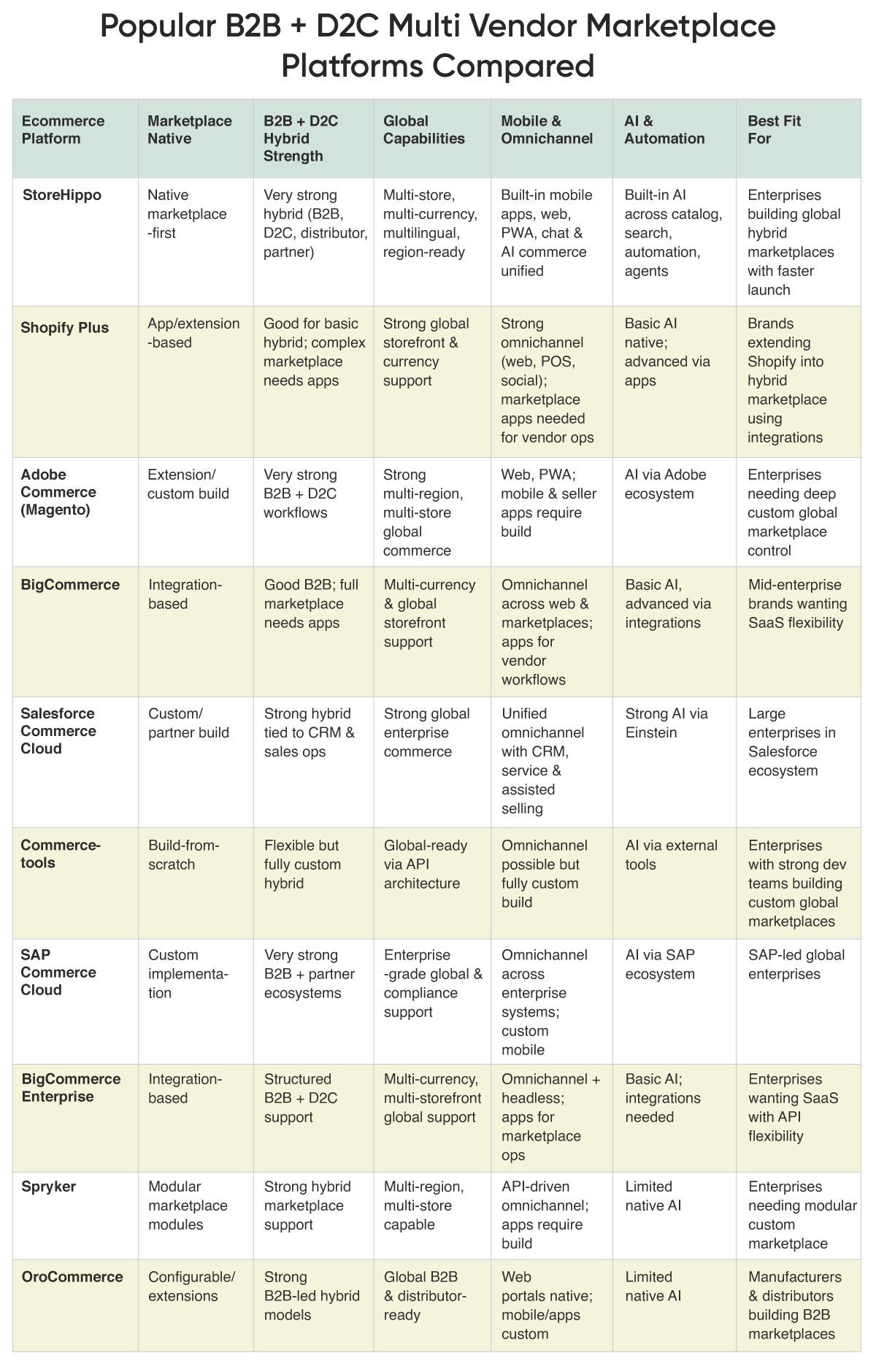
Image: Detailed Comparison of 10 Enterprise Multi Vendor Marketplace Platforms For B2B+D2C Brands
To help decision-makers evaluate the right fit, here’s a curated list of multi-vendor marketplace platforms that enable enterprises to build and scale unified B2B + D2C hybrid marketplaces across regions and business models.
1. StoreHippo - Enterprise Marketplace Platform for Scalable B2B + D2C Ecosystems

StoreHippo is an AI-powered enterprise marketplace platform designed for businesses building large-scale B2B + D2C ecosystems across regions and customer segments. Built as a marketplace-first system rather than a storefront extension, it enables brands to run distributor networks, wholesale channels, and direct sales together from a single backend. For organisations evaluating multi vendor marketplace platforms that can support complex operations without constant rebuilds, StoreHippo offers a scalable foundation to launch and grow a fully branded enterprise marketplace with complete operational control.
Core Features
Multi-Vendor Marketplace Solution
StoreHippo is built as a true multi vendor marketplace software with end-to-end native features for seller onboarding, vendor dashboards, master catalog, commissions, payouts and catalogue ownership. Businesses can manage large seller ecosystems without relying on external marketplace plugins or custom development.
B2B + D2C Hybrid Marketplace Support
Supports wholesale, retail, distributor and direct-to-customer selling from one unified system. Custom pricing, approval workflows, RFQs, tiered pricing, segment specific catalogues and role-based access make it suitable for running a hybrid marketplace at enterprise scale.
Omnichannel Marketplace
Unified backend across web stores, mobile apps, PWAs, chat-based buying and assisted AI commerce channels. Ensures consistent data, pricing and workflows across all buyer and seller touchpoints.
AI Built Into Core Platform
AI-powered catalog creation, image editing, intelligent search, built-in ecommerce journeys, recommendations, workflow automation, and the ability to create custom AI agents are embedded into the platform to enhance product discovery, improve conversions, and drive operational efficiency at scale.
Mobile App Builder
Built-in mobile app builder for launching Android and iOS buyer apps with built-in seller and admin apps that eliminate external development need. Enables faster rollout of mobile-first marketplace experiences across regions.
Global Commerce Readiness
Built-in multi-store, multi-currency and multilingual capabilities along with powerful tax-engine support global expansion. Businesses can operate region-specific storefronts and pricing while managing everything from a central backend.
Vendor And Distributor Management
Advanced tools to manage sellers, dealers and distributors including commission rules, catalog control,seller storefronts, pricing logic and payout automation for large enterprise marketplace ecosystems.
Customisation And Extensibility
API-first, headless architecture with low-code workflow customisation. Businesses can tailor checkout flows, pricing rules, logistics and integrations without heavy redevelopment.
Enterprise Integrations
Pre-integrated with leading ERP, CRM, payment and logistics systems. 350+ APIs endpoints allow seamless connection with preferred software and service providers.
Scalability And Infrastructure
Cloud-based infrastructure designed to support large catalogues, high order volumes and multi-country marketplace operations with consistent performance and security.
Pros
- Native marketplace solution built for complex B2B + D2C and hybrid ecosystems, no plugins needed
- 300+ native features and 150+ pre-integrated solutions
- Built-in AI, mobile apps builder and omnichannel capabilities
- Global-ready with multi-store, multilingual and multi-currency support.
Cons
- Advanced enterprise automation and workflow capabilities are available in higher-tier plans
- Teams transitioning from plugin-heavy platforms may need time to explore and fully utilise the extensive built-in feature set
Pricing
Enterprise pricing typically starts from around $499/month with custom plans based on scale, integrations and advanced requirements.
Best For
Enterprises and fast-scaling brands looking for a future-ready enterprise marketplace platform to build global B2B + D2C or hybrid marketplace ecosystems with strong vendor management, automation and long-term scalability.
2. Shopify Plus
Shopify Plus is popular ecommerce platform used by global brands looking to run unified digital commerce operations across retail and wholesale channels. While primarily built for single-brand ecommerce, it is often evaluated by businesses exploring multi vendor marketplace platforms for B2B + D2C use cases. With strong storefront flexibility and a large partner ecosystem, Shopify Plus can be extended into an enterprise marketplace through integrations and custom development, making it suitable for brands experimenting with hybrid marketplace models.
Core Features
Multi-Vendor Marketplace Solution
Shopify is not a native multi vendor marketplace software. Vendor onboarding, commissions, seller dashboards and payouts typically require third-party marketplace apps or custom builds, which can add complexity as seller count grows.
B2B + D2C Hybrid Marketplace Support
Shopify Plus includes wholesale capabilities such as company accounts, custom pricing and bulk ordering. However, running a full hybrid marketplace with multiple sellers, distributors and regions usually requires additional apps and custom logic.
Omnichannel Marketplace
Strong omnichannel presence across web, POS, social commerce and integrations. Enables brands to sell across channels, though unified vendor-level omnichannel workflows require external tools.
AI And Automation Capabilities
Includes basic AI features such as recommendations, search enhancements and automation. Advanced AI-driven marketplace automation typically depends on third-party integrations.
Mobile And App Ecosystem
Mobile-responsive storefronts and PWA support are available. Dedicated buyer, seller, or admin marketplace apps require separate development or third-party solutions.
Global Commerce Readiness
Supports multi-currency, localisation and global storefronts. Managing complex multi-region pricing and vendor-level operations across countries may require additional integrations.
Vendor And Distributor Management
Vendor management capabilities depend heavily on marketplace apps. Commission logic, catalog ownership and payouts often require third-party tools or custom development.
Customisation And Extensibility
Extensive app marketplace and APIs enable high storefront customisation. Deeper workflow changes for enterprise marketplace operations may require multiple apps and developer support.
Enterprise Integrations
Integrates with a wide range of ERP, CRM, logistics and marketing tools through apps and APIs. Integration depth and stability depend on the selected app stack.
Scalability And Infrastructure
Cloud-based infrastructure supports high traffic and global brands. Large enterprise marketplace builds may require careful app and architecture planning to maintain performance and cost efficiency.
Pros
- Strong global ecosystem and partner network
- Robust storefront customisation and UX flexibility
- Large integration and app marketplace
- Suitable for launching hybrid B2B + D2C commerce quickly
- Reliable infrastructure for scaling digital commerce operations
Cons
- Not a native enterprise marketplace platform for multi-vendor operations
- Heavy reliance on third-party apps for marketplace functionality
- Costs can rise significantly with apps, integrations and transaction fees
- Limited control over deep marketplace workflows at scale
Pricing
Shopify Plus pricing typically starts around $2,000/month, with additional costs for marketplace apps, integrations and custom development depending on complexity.
Best For
Brands and mid-to-large businesses looking to extend an existing Shopify ecosystem into a B2B + D2C or hybrid marketplace model and willing to use integrations and customisation to build multi-vendor capabilities.
3. Adobe Commerce (Magento)

Adobe Commerce (formerly Magento) is a highly flexible commerce platform used by enterprises that require deep architectural control and advanced workflow customisation. While not marketplace-native, it is often evaluated among multi vendor marketplace platforms by organisations planning complex B2B + D2C ecosystems.
For enterprises building a large-scale hybrid marketplace, Adobe Commerce offers strong B2B capabilities and global flexibility but marketplace functionality typically requires extensions or custom development to evolve into a full enterprise marketplace model.
Core Features
Multi-Vendor Marketplace Solution
Adobe Commerce does not include native multi-vendor functionality. Vendor onboarding, commissions, dashboards, and payout management require marketplace extensions or custom development to function as full multi vendor marketplace software.
B2B + D2C Hybrid Marketplace Support
Strong native B2B capabilities including company hierarchies, contract pricing, shared catalogues, RFQs, approval workflows, and bulk ordering. Well-suited for enterprises running wholesale and D2C together within a structured hybrid marketplace model.
Omnichannel Marketplace
Supports web storefronts, PWAs, and integrations with mobile and third-party channels. Omnichannel consistency depends on integration architecture and implementation quality.
AI And Automation Capabilities
AI-driven search, recommendations, and personalisation available through Adobe Sensei and Adobe Experience Cloud integrations. Advanced automation requires ecosystem modules.
Mobile And Headless Readiness
Mobile-responsive storefronts and PWA support are available. Dedicated buyer, seller, or admin marketplace apps require separate development or third-party solutions.
Global Commerce Readiness
Multi-store, multilingual, and multi-currency capabilities enable international expansion. Suitable for enterprises operating across regions with varied compliance and pricing requirements.
Vendor And Distributor Management
Vendor control and distributor workflows must be configured using extensions. Large seller ecosystems require careful architectural planning.
Customisation And Extensibility
Highly developer-friendly and deeply customisable. Ideal for enterprises needing tailored pricing logic, checkout workflows, and operational rules.
Enterprise Integrations
Extensive integration ecosystem covering ERP, CRM, PIM, payments, logistics, and analytics. Integration depth depends on implementation quality.
Scalability And Infrastructure
Capable of handling large catalogues and global traffic. Performance and scalability depend heavily on hosting setup, optimisation, and DevOps maturity.
Pros
- Strong B2B commerce capabilities for complex enterprise workflows
- Deep architectural flexibility and customisation control
- Global commerce support across multiple regions
- Full data ownership and backend control
- Large ecosystem of extensions and partners
Cons
- Not a marketplace-first enterprise marketplace platform
- Multi-vendor functionality requires extensions or custom builds
- Higher development and maintenance overhead
- Advanced AI and automation depend on additional Adobe tools
- Longer implementation timelines compared to SaaS-native marketplace systems
Pricing
- Enterprise licensing based on GMV and deployment scale.
- Additional costs include hosting, marketplace extensions, development, and ongoing maintenance, which can increase total investment significantly.
Best For
Large enterprises with strong technical teams seeking deep customisation and full control while building a structured B2B + D2C hybrid marketplace, and willing to invest in development to create a scalable marketplace ecosystem.
4. BigCommerce
BigCommerce is a SaaS commerce platform used by growing and mid-to-large enterprises looking for scalability without managing infrastructure. While originally designed for single-brand ecommerce, it is often evaluated among multi vendor marketplace platforms by organisations exploring B2B + D2C models.
For enterprises building a structured hybrid marketplace, BigCommerce provides a flexible SaaS foundation. However, most marketplace capabilities require integrations or third-party tools to evolve into a fully functional enterprise marketplace environment.
Core Features
Multi-Vendor Marketplace Solution
BigCommerce does not include built-in multi-vendor functionality. Vendor onboarding, commissions, seller dashboards, and payout management require third-party marketplace solutions or custom integrations to operate as scalable multi vendor marketplace software.
B2B + D2C Hybrid Marketplace Support
Includes built-in B2B features such as company accounts, customer groups, price lists, bulk pricing, and purchase ordering. Running a fully integrated hybrid marketplace across distributors and D2C channels typically requires additional configuration and integrations.
Omnichannel Marketplace
Supports omnichannel selling across web, social platforms, and marketplaces. Unified catalogue and order management are available, though vendor-level omnichannel workflows depend on integration architecture.
AI Built Into Core Platform
Offers basic AI-driven merchandising insights, search optimisation, and product recommendations. Advanced AI automation and marketplace intelligence typically require external tools.
Mobile And App Ecosystem
Provides mobile-responsive storefronts and headless capabilities. Dedicated buyer, seller, or admin marketplace apps are not native and require third-party solutions or custom development.
Global Commerce Readiness
Supports multi-currency, multi-storefront, and international tax configurations. Suitable for enterprises expanding into global markets, though complex multi-region vendor logic may require integrations.
Vendor And Distributor Management
Vendor management capabilities depend heavily on marketplace integrations. Commission logic, catalogue ownership, and payout workflows require ecosystem tools.
Customisation And Extensibility
API-first and headless-ready architecture enables frontend and backend flexibility. Workflow-level marketplace customisation may require development and partner support.
Enterprise Integrations
Extensive integration ecosystem covering ERP, CRM, payments, logistics, and marketing tools. Marketplace-specific functionality relies on partner applications.
Scalability And Infrastructure
Cloud-native SaaS infrastructure supports growing catalogues and high transaction volumes. Performance remains stable with scale, though integration complexity can increase operational overhead.
Pros
- SaaS deployment with minimal infrastructure management
- Strong API-first and headless flexibility
- Built-in B2B features for wholesale operations
- Reliable performance and global scalability
- Large ecosystem of integrations and partners
Cons
- Not a marketplace-first enterprise marketplace platform
- Multi-vendor functionality requires third-party solutions
- Advanced AI and automation depend on integrations
- Operational complexity can grow with app dependencies
- Custom distributor workflows may require development support
Pricing
- Subscription-based SaaS pricing depending on plan and scale.
- Additional costs apply for marketplace integrations, apps, and custom development, which can increase total investment for large marketplace deployments.
Best For
Mid-market to enterprise businesses seeking a flexible SaaS foundation to extend into a B2B + D2C hybrid marketplace, and willing to use integrations to build marketplace-specific capabilities.
5. Salesforce Commerce Cloud
Salesforce Commerce Cloud is an enterprise-grade commerce platform designed to unify commerce, customer data, sales, and service within a single ecosystem. Large organisations evaluating multi vendor marketplace platforms for B2B + D2C operations often consider Salesforce when they want their commerce environment deeply connected with CRM, service, and marketing workflows.
While not built as a native marketplace-first system, Salesforce Commerce Cloud can be extended into a scalable enterprise marketplace using Experience Cloud, partner tools, and custom architecture. It is typically chosen by enterprises building a structured hybrid marketplace connected to customer and revenue operations.
Core Features
Multi-Vendor Marketplace Solution
Salesforce Commerce Cloud does not include native multi-vendor functionality. Vendor onboarding, commissions, seller dashboards, and payout workflows must be implemented through Experience Cloud or custom development to function as multi vendor marketplace software.
B2B + D2C Hybrid Marketplace Support
Strong support for B2B + D2C commerce with account-based pricing, contract pricing, approval workflows, bulk ordering, and customer-specific catalogues. Suitable for enterprises operating complex hybrid marketplace models across distributors, partners, and direct customers.
Omnichannel Marketplace
Unified omnichannel capabilities across web, mobile, assisted sales, and service channels. Integration with Salesforce CRM enables consistent customer, order, and interaction data across the enterprise marketplace ecosystem.
AI Built Into Core Platform
Salesforce Einstein AI powers product recommendations, predictive search, demand insights, and workflow automation. Advanced AI capabilities strengthen when integrated with Salesforce Data Cloud and analytics tools.
Mobile And App Ecosystem
Mobile-responsive storefronts and app-ready frameworks supported. Dedicated marketplace-specific buyer, seller, or admin apps typically require custom development or partner solutions.
Global Commerce Readiness
Supports multi-currency, localisation, and global customer management. Suitable for enterprises running multi-region commerce and expanding across international markets.
Vendor And Distributor Management
Vendor and partner management capabilities must be configured through custom workflows or ecosystem tools. Suitable for structured distributor-led and partner marketplace environments with proper implementation.
Customisation And Extensibility
Highly extensible through APIs, low-code tools, and developer frameworks. Enterprises can customise workflows, pricing logic, integrations, and marketplace experiences to match operational requirements.
Enterprise Integrations
Deep integration across Salesforce CRM, service, marketing automation, and analytics platforms. Extensive partner ecosystem supports ERP, payments, logistics, and data integrations.
Scalability And Infrastructure
Enterprise-grade global infrastructure designed for high transaction volumes, large catalogues, and multi-region operations. Scales well for large enterprise marketplace ecosystems with proper architecture planning.
Pros
- Strong AI and customer intelligence through Salesforce Einstein
- Deep integration across sales, service, and marketing ecosystem
- Scalable infrastructure for global marketplace operations
- Powerful B2B + B2C commerce capabilities
- Highly customisable with APIs and low-code tools
Cons
- Not a native marketplace-first platform
- Multi-vendor functionality requires custom development
- High total cost when multiple Salesforce products are used
- Implementation requires specialised Salesforce expertise
- Longer deployment timelines compared to SaaS marketplace-native platforms
Pricing
Enterprise SaaS pricing based on GMV, usage, and Salesforce ecosystem modules.
Total investment varies depending on integrations, AI tools, and custom marketplace development requirements.
Best For
Large enterprises already using Salesforce and looking to build a deeply connected enterprise marketplace or global hybrid marketplace integrated with CRM, customer data, and service operations.
6. commercetools
commercetools is a headless, API-first commerce platform designed for enterprises that want maximum flexibility in building customised commerce and marketplace ecosystems. It’s one of the preferred multi vendor marketplace platforms for organisations that want to construct their own hybrid marketplace experiences from modular services rather than using a ready-made marketplace product.
Rather than offering marketplace features out of the box, commercetools provides the building blocks to create a tailored enterprise marketplace, ideal for enterprises with strong internal teams or partners capable of architecting custom marketplace workflows.
Core Features
Multi-Vendor Marketplace Solution
commercetools does not include native multi-vendor marketplace features. Seller onboarding, commissions, payouts, and dashboards must be built using custom services or third-party modules to operate as a scalable multi vendor marketplace software.
B2B + D2C Hybrid Marketplace Support
Flexible data models support complex B2B pricing, custom catalogues, and customer hierarchies alongside consumer commerce. Enterprises can use these models as the basis for their own hybrid marketplace flows with custom development.
Omnichannel Marketplace
API-first architecture enables omnichannel experiences across web, mobile apps, IoT, and future channels. Every touchpoint must be architected using frontend frameworks and integrated services.
AI Built Into Core Platform
Limited native AI. Enterprises typically integrate external AI tools for search intelligence, recommendations, personalisation, and automation to support large marketplace operations.
Mobile And App Ecosystem
The headless approach allows complete control over frontend channels including web, native mobile, and progressive interfaces. Dedicated marketplace buyer/seller/admin apps are built separately using APIs and custom UIs, not provided natively.
Global Commerce Readiness
Built for global commerce with multi-currency, localisation, and multi-region support through API-driven services. Global readiness depends on how services are configured and orchestrated.
Vendor And Distributor Management
Vendor and distributor workflows are not built in. These must be created using custom modules or partner services to support catalogue control, role-based access, pricing tiers, and commissions.
Customisation And Extensibility
Highly extensible and developer-centric. APIs allow full control over marketplace logic, integrations, pricing rules, and frontend experiences, making it suitable for enterprises with sophisticated custom requirements.
Enterprise Integrations
Strong ecosystem of technology partners for search, payments, PIM, ERP, and analytics. Designed for composable commerce where multiple services work together to power marketplace operations.
Scalability And Infrastructure
Cloud-native microservices architecture supports high traffic, large catalogues, and complex workflows. Scalability is achieved through service orchestration and infrastructure design.
Pros
- Maximum flexibility to build custom marketplace ecosystems
- API-first composable architecture suited for large enterprise scale
- Full control over frontend and backend logic
- Integrates well with specialised services and partners
- Scales for global, complex commerce scenarios
Cons
- Not a ready-to-launch marketplace platform
- Multi-vendor marketplace features must be built from scratch
- Limited native AI and automation capabilities
- Requires significant engineering investment
- Longer time to market compared to marketplace-native solutions
Pricing
Enterprise pricing is based on usage, API consumption, and services deployed.
Overall cost depends on external services, development investment, and infrastructure components included.
Best For
Large enterprises with strong engineering teams or partners looking to build a fully customised enterprise marketplace or hybrid marketplace ecosystems using composable architecture and bespoke marketplace logic.
7. SAP Commerce Cloud
SAP Commerce Cloud is an enterprise-grade commerce platform used by large organisations managing complex B2B and B2C operations across regions. Among global multi vendor marketplace platforms, it is often evaluated by enterprises that want their enterprise marketplace deeply connected with ERP, supply chain, finance, and customer data systems.
While not a marketplace-native system, SAP Commerce Cloud can be extended into a scalable hybrid marketplace through custom implementation and ecosystem modules. It is typically chosen by SAP-centric enterprises building large global commerce and partner ecosystems that require strong backend integration and governance.
Core Features
Multi-Vendor Marketplace Solution
SAP Commerce Cloud does not include native multi-vendor functionality. Vendor onboarding, commissions, seller dashboards, and payouts must be built via custom development or partner solutions to operate as a structured multi vendor marketplace software.
B2B + D2C Hybrid Marketplace Support
Strong native B2B capabilities, including company hierarchies, contract pricing, RFQs, approval workflows, and bulk ordering. These features support enterprises building a complex hybrid marketplace that runs distributor, partner, and D2C operations together.
Omnichannel Marketplace Enablement
Supports omnichannel commerce across web, mobile, assisted sales, and partner channels. Unified SAP product, pricing, and customer data enable consistent experiences across multiple buyer and seller touchpoints.
AI Built Into Core Platform
AI-driven recommendations, personalisation, and analytics available through SAP AI and Customer Data Cloud. Advanced automation and predictive capabilities depend on integration with broader SAP ecosystem tools.
Mobile And App Ecosystem
Mobile-responsive storefronts and SAP-integrated digital experiences are supported. Dedicated marketplace buyer, seller, or admin apps typically require custom development or partner frameworks.
Global Commerce Readiness
Built for global commerce with multi-currency, multilingual, taxation, and regional compliance support. Enables enterprises to run multi-country marketplace operations from a unified backend.
Vendor And Distributor Management
Vendor and distributor management capabilities require configuration or custom modules. Commission structures, pricing control, and catalogue governance can be implemented for large enterprise marketplace ecosystems with partner networks.
Customisation And Extensibility
Highly customisable through SAP implementation partners and developer frameworks. Pricing logic, workflows, and integrations can be tailored to enterprise-specific marketplace requirements.
Enterprise Integrations
Deep integration with SAP ERP, CRM, finance, and supply chain systems. Works best for organisations already using SAP infrastructure and looking to build a unified commerce and operations layer.
Scalability And Infrastructure
Enterprise-grade infrastructure capable of supporting large catalogues, high transaction volumes, and multi-region commerce. Designed for global organisations with complex operational requirements.
Pros
- Strong B2B and enterprise commerce capabilities
- Deep integration with SAP ERP and backend systems
- Scalable infrastructure for global operations
- Robust governance, compliance, and security features
- Suitable for complex distributor and partner ecosystems
Cons
- Not a native marketplace-first platform
- Multi-vendor marketplace features require custom build
- Higher implementation and maintenance costs
- Longer deployment timelines
- Best suited for SAP-centric organisations
Pricing
Enterprise licensing based on modules, usage, and SAP ecosystem integrations.
Implementation and maintenance costs vary significantly depending on scale, customisation, and integration scope.
Best For
Large global enterprises already using SAP and looking to build a deeply integrated enterprise marketplace or hybrid marketplace connected to ERP, supply chain, and finance systems using extensible multi vendor marketplace software architecture.
8. BigCommerce Enterprise
BigCommerce Enterprise is a SaaS-based commerce platform used by growing and mid-to-large brands to run unified digital commerce operations across regions and customer segments. It is one of the global multi vendor marketplace platforms best suited for businesses looking for faster deployment, strong APIs, and SaaS convenience while building a scalable enterprise marketplace.
While primarily designed for single-brand ecommerce, BigCommerce can be extended into a hybrid marketplace using marketplace integrations and custom workflows. It is typically chosen by enterprises that want flexible storefront control with the ability to scale into multi-seller and multi-region marketplace models over time.
Core Features
Multi-Vendor Marketplace Solution
BigCommerce does not include native multi-vendor functionality. Vendor onboarding, commissions, seller dashboards, and payouts are enabled through third-party marketplace integrations or custom builds to operate as full multi vendor marketplace software.
B2B + D2C Hybrid Marketplace Support
Includes built-in B2B features such as company accounts, price lists, bulk ordering, and customer groups. Running a complex hybrid marketplace across distributors, partners, and D2C channels usually requires integrations and custom logic.
Omnichannel Marketplace Enablement
Supports omnichannel selling across web, social commerce, marketplaces, and integrations. Unified catalogue and order data enable consistent customer experiences across channels.
AI Built Into Core Platform
Provides basic AI-driven recommendations, merchandising insights, and search optimisation. Advanced AI-driven automation and marketplace intelligence typically require third-party integrations.
Mobile And App Ecosystem
Mobile-responsive storefronts and headless commerce capabilities enable integration with mobile apps and custom interfaces. Dedicated marketplace buyer or seller apps require external development or partner tools.
Global Commerce Readiness
Supports multi-currency, localisation, and multi-storefront management. Suitable for enterprises expanding into international markets with region-specific pricing and catalogues.
Vendor And Distributor Management
Vendor management capabilities depend on marketplace integrations. Commission logic, catalogue ownership, and payout workflows typically require third-party solutions for full marketplace operations.
Customisation And Extensibility
API-first and headless-ready architecture allows extensive customisation of storefronts and integrations. Deeper workflow-level customisation for a large enterprise marketplace may require development support.
Enterprise Integrations
Extensive integration ecosystem covering ERP, CRM, payments, logistics, and marketing tools. Marketplace-specific integrations are often managed through partners or middleware.
Scalability And Infrastructure
Cloud-native SaaS infrastructure supports high traffic, large catalogues, and growing transaction volumes. Suitable for mid-sized to enterprise marketplaces scaling across regions.
Pros
- SaaS-based deployment with faster implementation timelines
- Strong API-first and headless commerce flexibility
- Good B2B commerce capabilities for growing enterprises
- Extensive global integrations ecosystem
- Reliable infrastructure for scaling digital commerce
Cons
- Not a native marketplace-first platform
- Multi-vendor marketplace functionality requires integrations
- Advanced AI and automation depend on external tools
- Operational complexity can increase with scale and integrations
- Custom workflows may require development support
Pricing
Enterprise SaaS pricing based on usage and feature requirements.
Additional costs apply for marketplace integrations, apps, and custom development depending on scale.
Best For
Mid-sized to enterprise brands looking for flexible multi vendor marketplace platforms to build a scalable hybrid marketplace with SaaS convenience, strong APIs, and global commerce readiness for a growing enterprise marketplace.
9. Spryker
Spryker is a modular commerce platform designed for enterprises building complex digital commerce ecosystems across B2B, B2C, and marketplace models. Among advanced multi vendor marketplace platforms, Spryker is typically chosen by organisations that want deep architectural control and the flexibility to build highly customised marketplace environments.
Unlike plug-and-play systems, Spryker provides a composable foundation for creating a scalable enterprise marketplace with dedicated marketplace modules. Businesses planning a large hybrid marketplace spanning distributors, partners, and direct customers often evaluate Spryker for its flexibility and ability to support tailored multi-region commerce ecosystems.
Core Features
Multi-Vendor Marketplace Solution
Spryker offers dedicated marketplace modules for vendor onboarding, merchant portals, commissions, product management, and order handling. Designed to support structured multi vendor marketplace software operations at scale.
B2B + D2C Hybrid Marketplace Support
Strong support for running B2B and B2C together. Includes contract pricing, company accounts, bulk ordering, and workflow customisation suited for a scalable hybrid marketplace model.
Omnichannel Marketplace Enablement
API-driven architecture supports web, mobile, IoT, and assisted commerce channels. Enables unified operations across buyer and seller touchpoints within a growing enterprise marketplace ecosystem.
AI Built Into Core Platform
Limited native AI capabilities. Businesses typically integrate external AI tools for search, recommendations, automation, and analytics to optimise marketplace operations and growth.
Mobile And App Ecosystem
Headless architecture enables integration with custom mobile apps and frontend experiences. Dedicated buyer, seller, or admin apps must be built or integrated separately.
Global Commerce Readiness
Supports multi-store, multi-currency, multilingual, and multi-region commerce. Suitable for enterprises expanding across geographies with complex pricing and regional requirements.
Vendor And Distributor Management
Marketplace modules enable merchant management, commissions, catalogue control, and partner workflows. Designed for enterprises managing structured vendor and distributor ecosystems.
Customisation And Extensibility
Highly composable and modular architecture. Enables deep customisation of workflows, integrations, pricing logic, and marketplace structures across global operations.
Enterprise Integrations
Strong integration capabilities with ERP, CRM, PIM, payments, and logistics systems. Built to work within composable enterprise technology stacks.
Scalability And Infrastructure
Enterprise-grade performance designed to support large catalogues, high transaction volumes, and global operations across multiple regions and seller networks.
Pros
- Marketplace-focused modular architecture
- Strong support for B2B + B2C hybrid commerce models
- Highly customisable composable ecosystem
- Suitable for complex global marketplace operations
- Flexible integration capabilities across enterprise systems
Cons
- Implementation requires strong development resources
- Limited native AI and automation capabilities
- Higher setup and maintenance effort
- Longer time to launch compared to SaaS marketplace-native platforms
- Total cost depends on custom build scope
Pricing
Custom enterprise pricing based on modules, implementation scope, and usage.
Total cost depends on development, integrations, and infrastructure requirements.
Best For
Large enterprises with strong technical teams looking to build a fully customised enterprise marketplace or hybrid marketplace using composable multi vendor marketplace software tailored to complex global commerce and partner ecosystems.
10. OroCommerce
OroCommerce is a B2B-focused commerce platform built for manufacturers, distributors, and wholesalers managing complex sales ecosystems. Among structured multi vendor marketplace platforms, OroCommerce is often evaluated by enterprises that want strong backend control over pricing, accounts, and distributor workflows.
While not marketplace-native out of the box, it can be configured and extended into a scalable enterprise marketplace. Businesses planning a B2B-led hybrid marketplace that combines dealer networks, partner sales, and D2C channels often consider OroCommerce for its deep B2B foundation and operational flexibility.
Core Features
Multi-Vendor Marketplace Solution
Multi-vendor functionality is enabled through configuration and extensions rather than native marketplace modules. Vendor onboarding, pricing control, and role-based access can be structured to support multi vendor marketplace software requirements.
B2B + D2C Hybrid Marketplace Support
Strong B2B-first capabilities including account hierarchies, custom price lists, RFQs, contract pricing, and approval workflows. Can operate alongside B2C and partner-led models within a growing hybrid marketplace structure.
Omnichannel Marketplace Enablement
Supports web portals, account dashboards, and assisted sales. API-first architecture allows integration with mobile apps and external channels for unified operations across the enterprise marketplace.
AI Built Into Core Platform
Limited native AI functionality. Advanced search, recommendations, and automation typically require third-party AI integrations or custom analytics layers.
Mobile And App Ecosystem
Responsive web experiences are included. Dedicated buyer, seller, or admin mobile apps require custom development or external frameworks.
Global Commerce Readiness
Supports multi-currency, multilingual storefronts, and regional tax configurations. Suitable for enterprises expanding distributor and B2B operations across global markets.
Vendor And Distributor Management
Designed for structured B2B operations. Enables role-based access, catalogue control, contract-based pricing, and distributor workflows suited for B2B-led marketplace ecosystems.
Customisation And Extensibility
Open-source architecture allows deep customisation of workflows, pricing logic, checkout flows, and integrations. Suitable for enterprises requiring tailored marketplace processes.
Enterprise Integrations
Strong integration capabilities with ERP, CRM, PIM, and backend systems. Designed to connect commerce with supply chain, finance, and operational infrastructure.
Scalability And Infrastructure
Built to manage large product catalogues, complex B2B pricing structures, and high transaction volumes across regions.
Pros
- Strong B2B foundation for complex pricing and workflows
- Flexible for building a structured enterprise marketplace
- Open architecture with deep customisation capability
- Strong backend integration support
- Suitable for distributor-led and dealer ecosystems
Cons
- Not a native multi-vendor marketplace-first platform
- Limited built-in AI and automation
- Marketplace features require configuration or extensions
- Implementation requires development resources
- Deployment timelines can be longer compared to SaaS-native systems
Pricing
Custom enterprise pricing based on deployment model, features, and integrations.
Implementation and maintenance costs vary depending on complexity and scale.
Best For
Manufacturers, distributors, and B2B enterprises building a structured hybrid marketplace using flexible multi vendor marketplace software integrated deeply with ERP and backend business systems.
Quick Comparison Of Top B2B + D2C Multi-Vendor Marketplace Platforms
Here is a quick view of the non-negotiable capabilities a hybrid marketplace software should have:
Conclusion
Choosing the right multi vendor marketplace platforms for building global hybrid marketplace ecosystems becomes much easier when you can evaluate all leading options side by side. The real decision comes down to long-term operational control and scalability. Most enterprises outgrow surface-level marketplace features quickly; what matters is choosing an enterprise marketplace foundation that can handle complex vendor networks, multiple business models, and global expansion without repeated replatforming.
From an expert standpoint, the strongest multi vendor marketplace software is not just the one that launches fastest, but the one that continues to support growth as seller ecosystems, geographies, and transaction volumes scale.
Before making a final decision, it’s always wise to explore and experience these platforms in action. Start your evaluation from the top of the list with StoreHippo to understand how a marketplace-first, AI-powered enterprise platform can support your hybrid B2B + D2C vision. Explore the capabilities, and then compare with other platforms to choose the foundation that truly fits your enterprise marketplace journey. Book your StoreHippo demo now.
FAQs
1. What are the non-negotiables in a multi vendor marketplace platform for running a global B2B + D2C hybrid business?
The platform must offer native multi-vendor management, flexible B2B pricing and approvals, multi-currency and multi-region readiness, strong integrations, and full data ownership. Just as important is the ability to run distributors, retailers, and direct customers from one unified backend without relying heavily on plugins or fragmented tools.
2. How critical is B2B + D2C support when selecting an enterprise marketplace platform for long-term growth?
It is extremely critical. Most enterprise marketplaces eventually operate hybrid models where distributors, partners, and direct customers transact together. Choosing a platform that supports both B2B and D2C from the start prevents future system fragmentation and avoids costly replatforming as the business expands.
3. Can a single multi vendor marketplace software handle B2B, D2C, and distributor-based operations from one backend without operational complexity?
Yes, but only if the platform is built for hybrid marketplace operations. A strong system should support custom pricing, catalogue segmentation, approval workflows, and role-based access so each buyer type sees the right products, pricing, and processes without creating parallel systems.
4. Which capabilities should a hybrid marketplace platform offer to scale smoothly across distributors, partners, and new global regions?
Look for multi-store and multi-currency support, region-wise catalogue and pricing control, automated vendor onboarding and payouts, integration with ERP/logistics systems, and strong reporting. These ensure you can add new sellers, regions, and customer segments without rebuilding operations each time.
5. What level of automation and AI should a modern enterprise marketplace include to reduce manual operations at scale?
At minimum, AI should support catalog creation, intelligent search, recommendations, workflow automation, and analytics. Automation should extend to vendor onboarding, order routing, payouts, and support queries. When these are built into the core platform rather than added via plugins, teams can scale marketplace operations without proportionally increasing manual effort.