


Running a multi vendor marketplace today isn’t just about adding more sellers or expanding your catalog. Most platforms can do that. The real challenge is staying ahead when everything from buyer expectations, fulfilment speed, and competition is moving faster than ever.
At scale, small gaps start to show. Vendor coordination gets harder, experiences become inconsistent, and growth begins to slow under operational complexity. What separates leading marketplace websites is not just what they offer, but how smoothly everything works together, across vendors, channels, and customer touchpoints.
The focus now is simple: reduce friction, move faster, and deliver more relevant experiences without increasing effort.
Table of Contents
- 7 Ways to Keep Your Marketplace Website Ahead of Your Competitors
- 1. Make Vendor Onboarding Your Competitive Edge
- 2. Use AI Personalisation Across the Buyer Journey
- 3. Go Mobile-First, Not Just Mobile-Friendly
- 4. Build Loyalty and Repeat Purchase Systems
- 5. Enable Hyperlocal and Fast Delivery
- 6. Use Data and Analytics to Make Strategies
- 7. Choose a Scalable, Future-Ready Platform
- Conclusion
- FAQs
7 Ways to Keep Your Marketplace Website Ahead of Your Competitors
Competitors can copy features of your marketplace website, but they can’t match execution. Success depends on how quickly you adapt and improve your marketplace by continuously refining user experience, optimising operations, and responding to changing buyer and seller needs faster than competitors.
These seven ways focus on simple, practical actions that can help you improve performance, grow faster, and stay competitive:
1. Make Vendor Onboarding Your Competitive Edge
Most enterprises with a multi vendor marketplace focus mainly on buyer experiences and often neglect their vendors. In the long term, this can become a major challenge, as vendors on your marketplace are the core growth driver and directly impact catalogue growth, pricing competitiveness, and overall buyer satisfaction.
In a multi vendor ecosystem where catalogue expansion and vendor quality define marketplace success, onboarding and managing vendors can become major competitive differentiators.
These numbers clearly show why enterprises can no longer treat vendor onboarding as just an operational task.
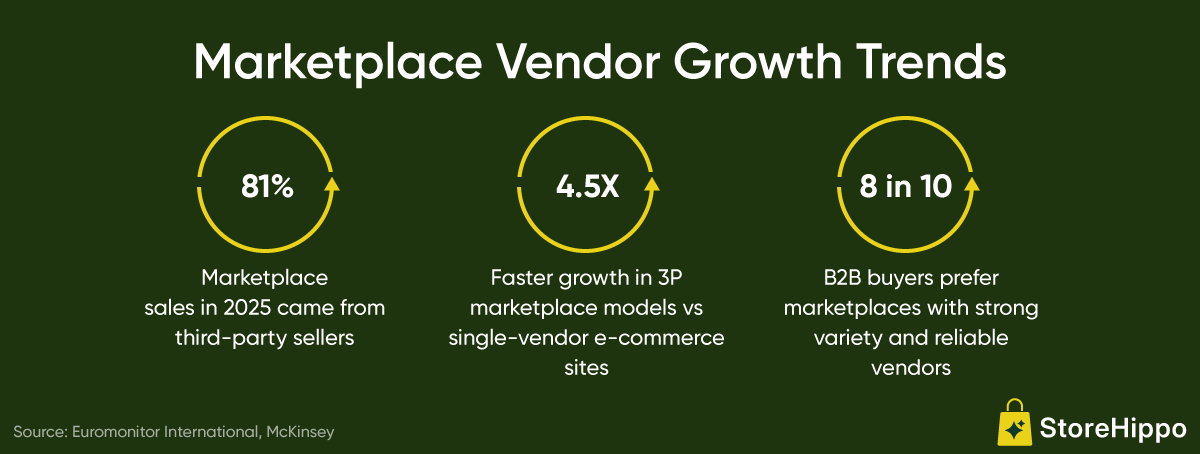
- 81% of marketplace sales in 2025 came from third-party sellers, highlighting the growing importance of strong vendor ecosystems
- 4.5x faster growth in marketplace models utilising 3P sellers vs single-vendor e-commerce sites
- 8 in 10 B2B buyers prefer marketplaces with strong product variety and reliable vendors
Source: Euromonitor International, McKinsey
If vendor onboarding on your online marketplace is slow or operationally complex, sellers quickly move to other multi vendor marketplaces that make onboarding easier and help them start selling faster.
What StoreHippo Offers:
- Native multi-vendor management solutions to manage vendors, catalogues, inventories, orders, and payouts from a single unified platform without relying on third-party plugins
- Dedicated vendor dashboard to enable vendors to independently manage products, inventory, pricing, and orders
- Intuitive Admin dashboards to give admins complete visibility and control over vendor operations, approvals, performance, etc
- AI-powered cataloguing tool to enable vendors to easily upload catalogues by automatically generating product titles and descrition from product images.
- Supports multiple business models to enable vendors catering to different client types to manage each business from a single dashboard
2. Use AI Personalisation Across the Buyer Journey
Today’s buyers don't see personalisation as a premium experience. They expect marketplaces to understand their preferences, show relevant products instantly, and simplify buying decisions at every stage of the journey. In such a scenario, where personalisation is the core expectation, if you fail to deliver relevant discovery and engagement on your multi vendor marketplace, buyers' experience quickly becomes frustrating, disconnected, and easy to abandon.
These trends clearly show why AI-driven personalisation is becoming essential for marketplace growth and buyer retention.
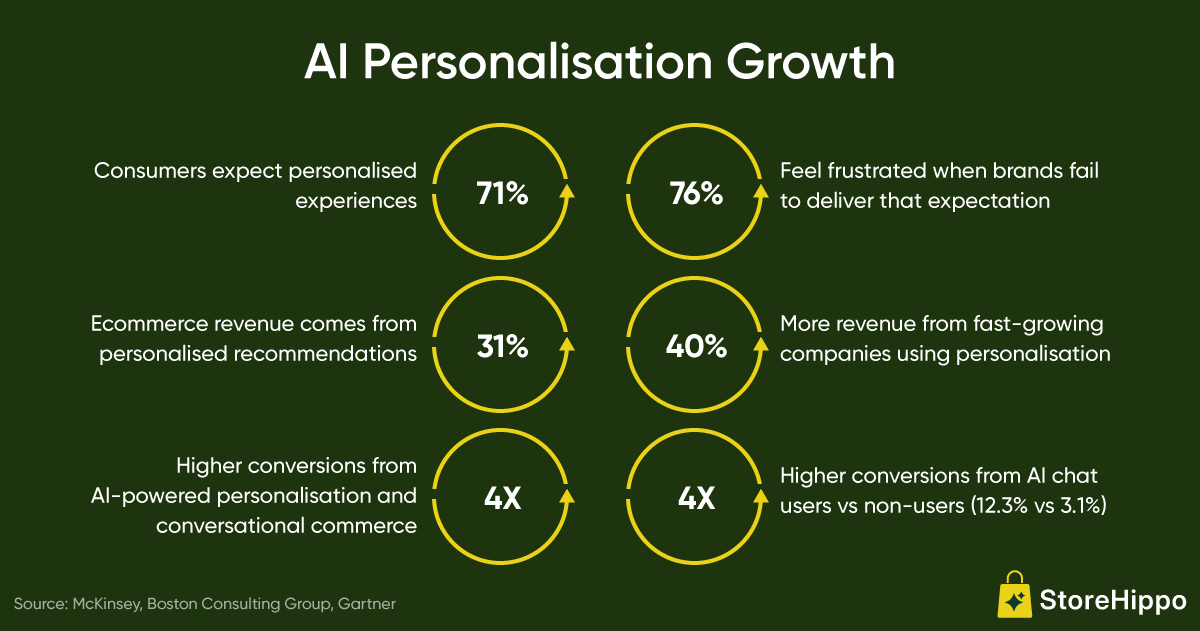
- 71% of consumers expect personalised experiences
- 76% feel frustrated when brands fail to deliver that expectation
- 31% of ecommerce revenues come from personalised recommendations.
- 40% more revenue is generated by fast-growing companies through personalisation
- 4x higher conversions through AI-powered personalisation and conversational commerce.
- 4x higher conversions from AI chat users compared to non-users (12.3% vs 3.1%)
Source: McKinsey, Boston Consulting Group, Gartner
In a highly competitive multi vendor ecosystem, AI-powered personalisation has become a major factor influencing buyer engagement, conversions, repeat purchases, and customer retention. To deliver personalised buying experiences at scale, you need the best multi vendor platform with built-in AI capabilities that can offer contextual recommendations and conversational buying journeys on your marketplace website in real time. This helps you improve customer satisfaction, increase conversions, and drive higher revenue growth.
What StoreHippo Offers:
- Built-in AI tools to automate and optimise buyer journeys across discovery, engagement, and conversions
- AI-powered semantic search to help buyers discover relevant products faster through intent-based search experiences
- AI-driven product recommendations to deliver personalised product suggestions based on buyer behaviour and preferences
- Custom agentic AI shopping assistants to enable multilingual conversational buying journeys and assist customers throughout the purchase process
3. Go Mobile-First, Not Just Mobile-Friendly
Today, mobile is not just an additional channel; it's the primary shopping channel for new-age customers. In this mobile-first commerce ecosystem, simply having a mobile-optimised website is not enough. Buyers now expect fast-loading storefronts, app-like browsing experiences, seamless mobile checkouts, and instant engagement across every touchpoint.
The trends below clearly show why mobile-first commerce has become essential to marketplace growth and customer engagement.
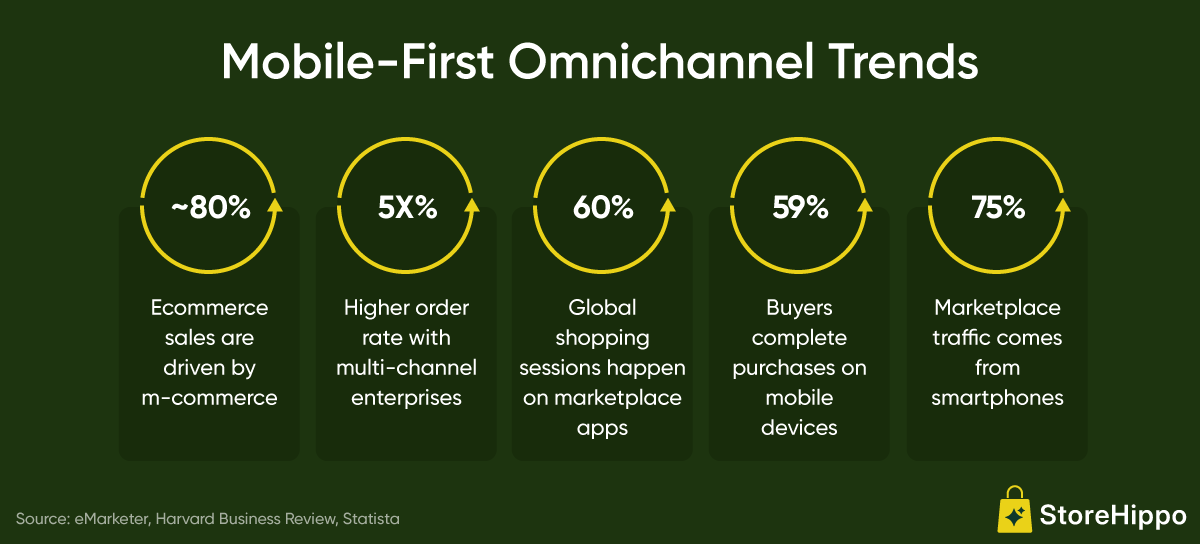
- ~80% of total ecommerce sales is driven by m-commerce
- 5X increase in order rate for enterprises using multiple channels
- 60% of global shopping sessions come from marketplace apps
- 59% of online buyers now complete their marketplace purchases on a mobile device
- 75% of all marketplace web traffic is generated through mobile smartphones
Source: eMarketer, Harvard Business Review, Statista
Mobile-first commerce has become a major factor influencing buyer engagement, conversions, and customer retention. To deliver seamless mobile buying experiences at scale, your multivendor marketplace should be built on mobile first architecture. Powering your business with the best multi vendor platform with built-in mobile commerce capabilities helps you create faster, smoother, and more engaging buying journeys across devices and channels.
What StoreHippo Offers:
- Mobile-first omnichannel commerce solutions to deliver seamless buying experiences across mobile, social, and other channels
- Mobile-responsive storefronts that work smoothly across different mobile devices and screen sizes
- No-code built-in mobile app builder to help enterprises quickly launch Android and iOS apps without coding
- PWA-based storefronts to deliver fast, app-like experiences to engage customers in tier 3+ areas
- Unified commerce capabilities across web, apps, PWAs, social platforms, and AI-powered conversational channels
4. Build Loyalty and Repeat Purchase Systems
Multi-vendor ecommerce has become highly competitive, as every business targets the same customers. In such a scenario, competing only on pricing is not a sustainable growth strategy. While discounts can help bring first-time buyers, long-term marketplace growth depends on how well you retain customers and turn occasional buyers into loyal repeat customers.
Today’s buyers actively look for deals, personalised offers, and engaging shopping experiences. If your multi vendor marketplace relies only on common discounts without a strong loyalty and engagement strategy, it can lead to lower profits, weaker brand loyalty, and poor long-term customer retention.
The numbers below show why personalised engagement is essential for improving repeat purchases and customer retention.
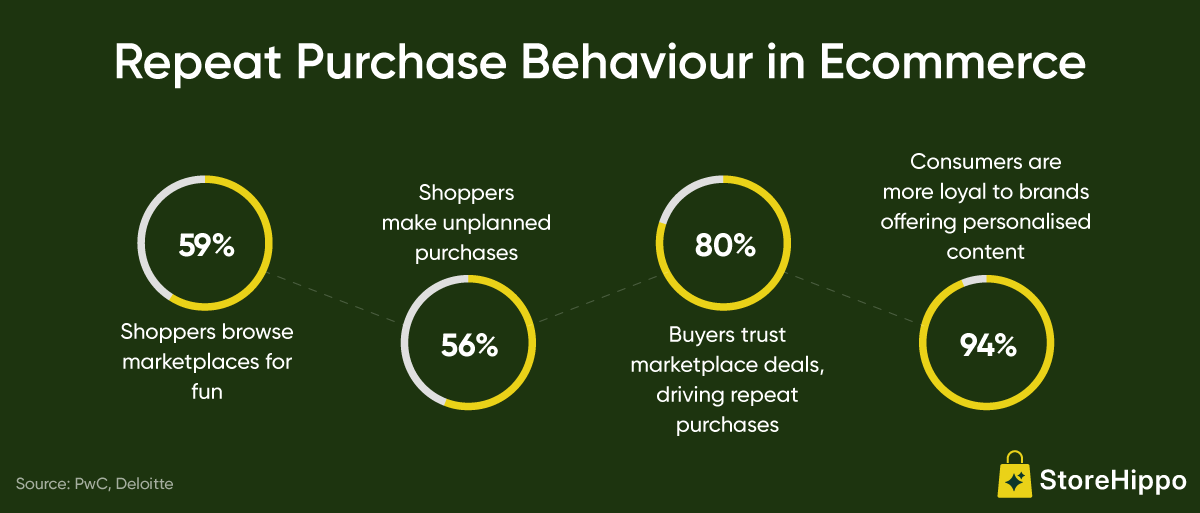
- 59% of shoppers browse marketplaces for fun
- 56% of shoppers make unplanned purchases
- 80% of buyers trust marketplace deals, driving repeat purchases
- 94% of consumers are more loyal to brands offering personalised content
Source: PwC, Deloitte
Enterprises need a flexible discount and loyalty engine that can deliver targeted offers, personalised promotions, and contextual buying incentives. A robust multi vendor marketplace platform with built-in discount and loyalty management capabilities helps you improve repeat purchases, strengthen customer loyalty, and drive long-term marketplace growth.
What StoreHippo Offers:
- Native discount engine to create rule-based, cart-level, product-level, seller-specific, and customer-segment discounts from a single platform.
- Time-based and flash sale discount capabilities to run festive campaigns, limited-period offers, and promotional events with ease.
- Built-in coupon and loyalty/store wallets to offer reward points, store credits, personalised offers, and loyalty-driven promotions.
- Personalised promotional campaigns across mobile, email, SMS, and push notifications to improve engagement and drive repeat purchases.
- Unique QR code generation for products, brand pages, and seller pages to simplify sharing, improve discovery, and drive faster customer engagement.
5. Enable Hyperlocal and Fast Delivery
The fastest-growing online marketplaces in 2027 and beyond will not be the ones serving the most areas, but the ones delivering to customers the fastest. Hyperlocal commerce, powered by local dealers and nearby delivery networks, is the key trend today that reshapes how marketplaces stay competitive.
Today’s buyers don’t want to wait days for delivery. If shipping is slow, they often drop off and switch to another option within seconds.
These trends clearly show why hyperlocal fulfilment and fast delivery are competitive advantages for modern marketplaces.
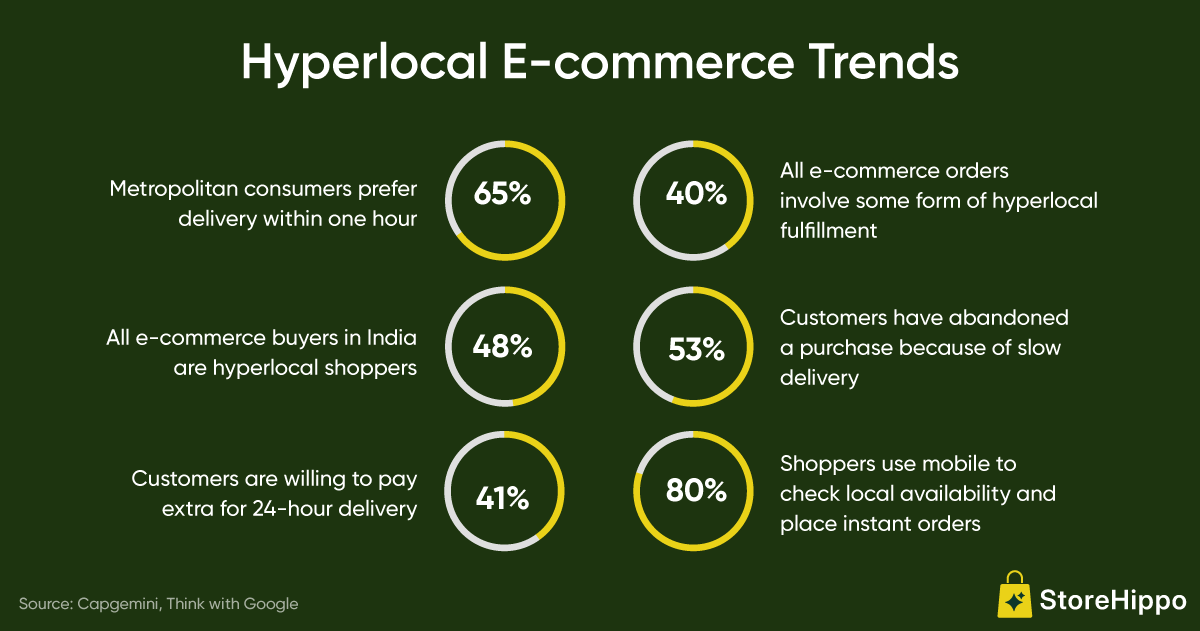
- 65% of metropolitan consumers prefer delivery within one hour
- 40% of all e-commerce orders involve some form of hyperlocal fulfillment
- 48% of all e-commerce buyers in India are hyperlocal shoppers
- 53% of customers have abandoned a purchase because of slow delivery
- 41% customers are willing to pay extra for 24-hour delivery
- 80% shoppers use mobile to check local availability and place instant orders
Source: Capgemini, Think with Google
Speed of delivery, local availability, and real-time fulfilment are no longer optional; they directly influence conversions, repeat purchases, and customer loyalty.
To stay competitive and deliver better buying experiences, enterprises need to build a strong hyperlocal network on their multi vendor marketplace.
What StoreHippo Offers:
- Native hyperlocal ecommerce solutions to manage end-to-end hyperlocal operations, including location-based storefronts, inventory, pricing, fulfilment, etc
- Dealer-powered quick commerce solutions to enable faster, proximity-based fulfilment by connecting local dealers with nearby customers
- Multi-store feature to create multiple geo-based storefronts with unique URLs, layouts, themes, pricing, languages, etc., for different geo locations
- Pre-integrated hyperlocal and intercity logistics network for seamless shipping across regions with ready delivery partners and easy integrations
- Intelligent order routing that assigns orders to the nearest dealer or store for faster delivery and efficient fulfilment
6. Use Data and Analytics to Make Strategies
In a crowded multi vendor marketplace, the winners are those who can make strategic data-driven decisions for growth. Enterprises must implement different pricing strategies, like volume-based pricing, login-based pricing, etc. They should have access to check vendors' performance, best-selling products, etc.
These data trends show that multivendor marketplaces using advanced analytics are making faster, smarter, and more profitable business decisions.
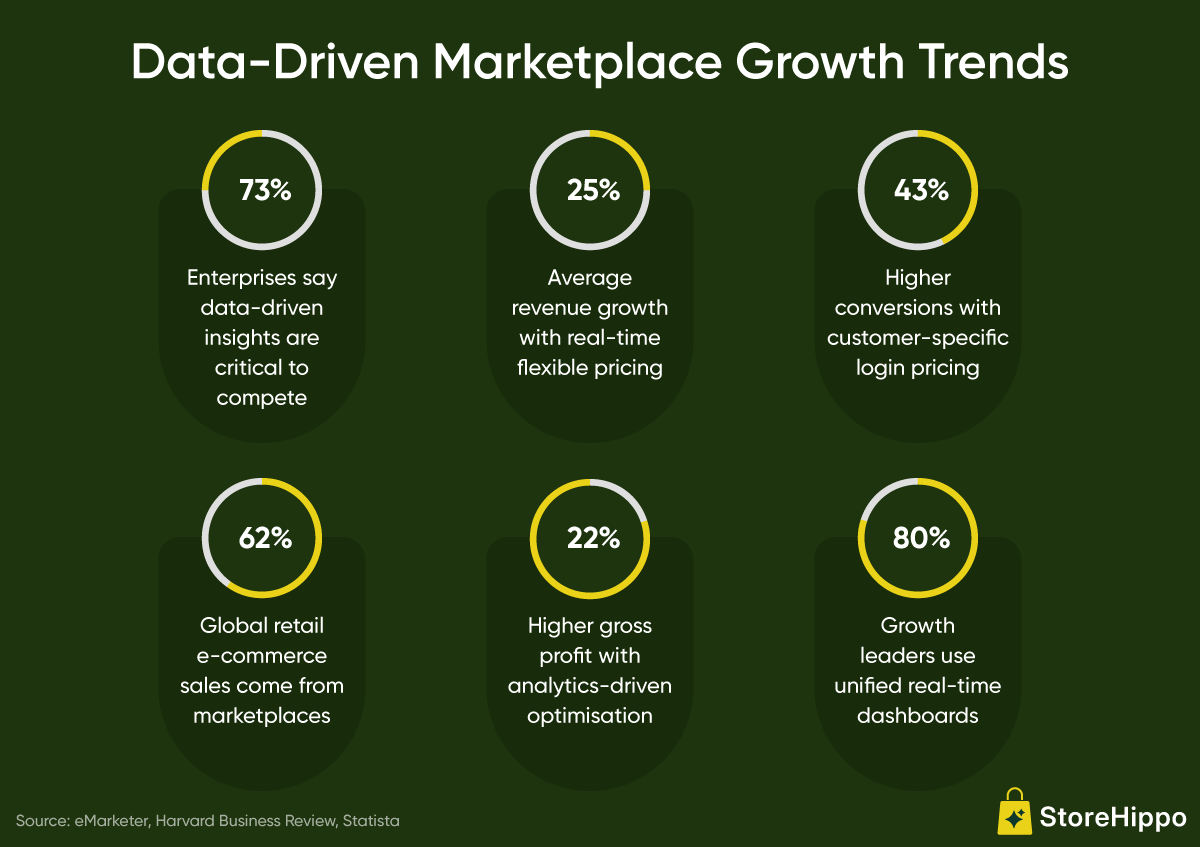
- 73% of enterprises say data-driven insights are critical to competing in digital markets
- 25% average revenue growth with real-time flexible pricing strategies
- 43% increase in conversions using customer-specific login-based pricing
- 62% of global retail e-commerce sales come via multi-vendor marketplaces
- 22% boost in gross profit through advanced analytics-driven optimisation
- 80% of growth leaders use unified dashboards for real-time insights
Source: Onramp Funds, Salesforce
The best multi vendor marketplace platform built for large-scale businesses enables enterprises to implement dynamic pricing models such as volume-based pricing and login-based pricing, while also tracking vendor performance, best-selling products, and category trends in real time. With the right platform, you can use marketplace data more effectively to improve margins, increase conversions, and identify new revenue opportunities faster than competitors.
What StoreHippo Offers:
- Unified vendor and marketplace data to create connected, consistent operations across the platform
- Advanced pricing flexibility with volume-based pricing, login-based pricing, and other rule-based pricing strategies
- Real-time visibility into vendor performance, catalogue performance, and best-selling products for better decision-making
- Seamless integration with analytics and marketing tools to enable data-driven growth strategies across the marketplace
7. Choose a Scalable, Future-Ready Platform
One of the biggest reasons many multi vendor marketplaces struggle to scale is not competition or marketing, but the limitations of the ecommerce platform they rely on.
As the business grows, most traditional ecommerce systems start showing cracks in performance, flexibility, and scalability.
These trends highlight the need for scalable and future-ready commerce architecture for long-term marketplace growth.
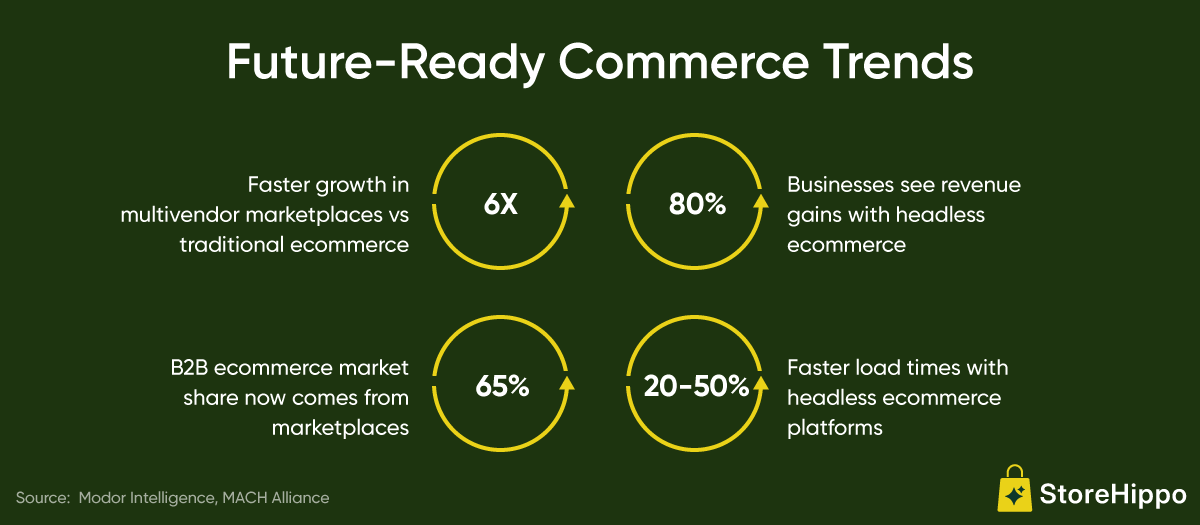
- 6x faster growth of marketplaces vs traditional ecommerce shows linear platforms can’t keep up
- 65% of the B2B ecommerce market share now comes from marketplace channels
- 80% of businesses report revenue gains with headless ecommerce platforms
- 20-50% faster load times for websites built on headless ecommerce platforms
Source: Modor Intelligence, MACH Alliance
To stay competitive, your online marketplace needs more than just features. It needs the best multivendor platform built on a scalable, future-ready architecture that supports speed, flexibility, and different business models without creating technical hurdles.
What StoreHippo Offers:
- MACH architecture to support flexible, scalable, and future-ready commerce operations
- API-first architecture to extend capabilities by connecting with external tools and softwares
- 300+ native features to reduce dependency on external tools and integrations
- No-plugin design to ensure faster performance, lower complexity, and easier scalability
- Multi-model support to run B2B, B2C, D2C, and hybrid marketplace models from a single platform
- AI-native core to enable intelligent automation, personalised buyer journeys, and scalable marketplace growth.
Conclusion
The future of ecommerce is not a linear graph. To stay on top of the ecommerce trends and keep your marketplace ahead of the competitors, you need the best multi vendor platform that helps adapt to market disruptions. As you plan to carve a niche for your enterprise brand in the ecommerce market, you need a robust ecommerce platform that comes with futuristic ecommerce solutions.
Storehippo AI powered enterprise ecommerce platform is built on MACH architecture and comes with 300+ built-in features and tools to help you create a tailored marketplace website for your customers. With StoreHippo’s future-ready cutting-edge technology, you can implement desired features and flows on your multi-vendor marketplace and stay ahead of the curve.
Are you ready to build a future-ready multi vendor marketplace with StoreHippo? Explore the wide range of enterprise-grade features by booking yourfree demo now.
FAQs
1. What makes a multi vendor marketplace website competitive in 2027 and beyond?
A competitive multi vendor marketplace needs fast vendor onboarding, AI-driven personalisation, mobile-first experiences, hyperlocal delivery, and scalable architecture. These capabilities help enterprises to improve buyer engagement, vendor retention, and long-term growth on their marketplace website.
2. How does AI improve multi vendor marketplace performance?
AI-powered tools can improve product discovery, personalised recommendations, conversational buying, and catalogue management across the multi vendor marketplace. It helps enterprises increase conversions, improve customer experiences, and automate marketplace operations at scale.
3. How does mobile commerce impact multivendor marketplace strategy?
Mobile commerce helps marketplaces improve engagement and sales through fast-loading storefronts, mobile apps, PWAs, WhatsApp, and seamless buying experiences. A mobile-first strategy also helps enterprises reach customers across tier 2 and tier 3 markets more effectively.
4. How does hyperlocal commerce give a multi-vendor marketplace a competitive edge?
Hyperlocal commerce enables faster deliveries, location-based fulfilment, and better customer experiences by connecting nearby sellers with local buyers. It also helps marketplaces improve repeat purchases, reduce delivery time, and strengthen customer loyalty.
5. What multi vendor platform features does a scalable marketplace needs?
A scalable multi vendor marketplace platform should be built on MACH and mobile-first architecture. It should offer built-in AI tools, multi-vendor management, omnichannel, flexible pricing, analytics, and multi-business model support. These features help enterprises scale operations faster without facing performance or flexibility limitations.