


Over the past few years, I've had conversations with a growing number of pharma companies, healthcare distributors, pharmacy chains, and healthcare brands looking to strengthen their digital presence by building an online pharmacy marketplace. Some wanted to bring their existing B2B pharma operations online. Others were exploring how to build a complete healthcare ecosystem that could combine medicine delivery, diagnostics, consultations, and patient engagement on a single platform.
The timing couldn't be better. With the Indian digital health market continuing to grow at a healthy pace and the e-pharmacy segment projected to expand at nearly 16% CAGR, customer behaviour has shifted significantly. Ordering medicines, booking lab tests, and consulting doctors online has become a normal part of healthcare for millions of Indians.
For businesses evaluating this space today, the bigger question is no longer whether healthcare commerce will move online. It is understanding what the market leaders did right, how they scaled, and what lessons can be applied when building the next generation of digital healthcare multi vendor marketplace platforms.
In this blog, we'll look at the current state of the market, answer some of the common questions we hear from pharmaceutical and healthcare businesses planning their digital journey, and analyse what India's top online pharmacy platforms got right as they scaled.
But first, a look at where the market actually stands.
Table of Contents
- Why More Pharma Brands Are Building Online Pharmacy Marketplaces
- Benefits of Building a Multi Vendor Marketplace for Medicines in India
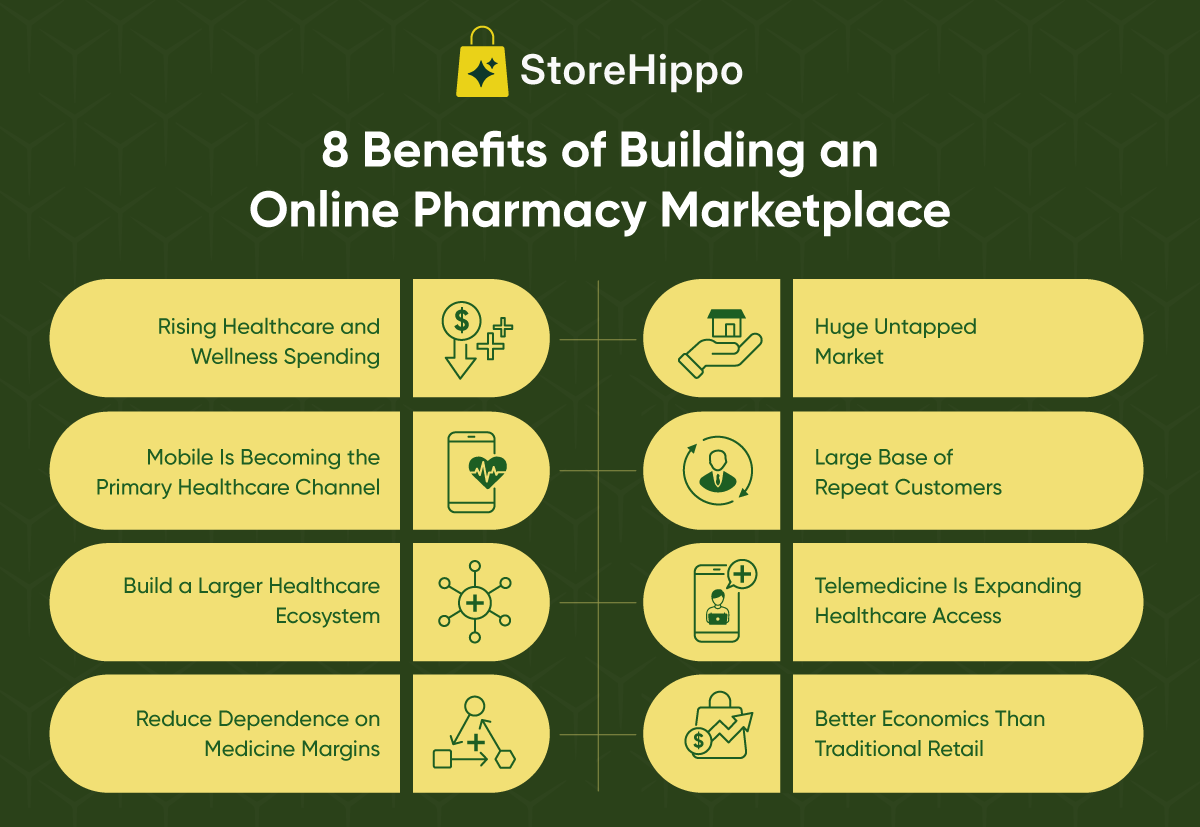
- 1. Huge Untapped Market
- 2. Large Base of Repeat Customers
- 3. Telemedicine Is Expanding Healthcare Access
- 4. Better Economics Than Traditional Retail
- 5. Rising Healthcare and Wellness Spending
- 6. Mobile Is Becoming the Primary Healthcare Channel
- 7. Build a Larger Healthcare Ecosystem
- 8. Reduce Dependence on Medicine Margins
- Top 5 Online Pharmacy Marketplaces in India and What Makes Them Work
- Building an Online Pharmacy Marketplace: A Practical 10-Step Framework
- 1. Start With the Right Business Model
- 2. Build Compliance Into the Foundation
- 3. Choose a Platform That Can Scale With You
- 4. Create a Unified Medicine Catalogue
- 5. Make Product Discovery Effortless
- 6. Design Robust Prescription Workflows
- 7. Prioritise Mobile From Day One
- 8. Build for Hyperlocal Fulfilment
- 9. Think Beyond Medicines
- 10. Measure, Optimise, and Expand
- Key Takeaway
- How StoreHippo Helps You Build a Scalable Online Pharmacy Marketplace
- 1. Build Around Your Existing Distribution Network
- 2. Support B2B and D2C From One Platform
- 3. Build a Connected Pharmacy Ecosystem
- 4. Use AI Where It Creates Real Value
- 5. Make Mobile the Centre of Your Strategy
- 6. Bring Pharmacy Commerce to WhatsApp
- 7. Run Omnichannel Healthcare Commerce From a Single Platform
- 8. Deliver Faster With Hyperlocal Fulfilment
- 9. Localise, Market, and Scale
- 10. Work With the Systems You Already Use
- 11. Bringing It All Together
- Conclusion
- FAQ
Why More Pharma Brands Are Building Online Pharmacy Marketplaces
Before we dive deeper into the whys and hows of building an online medicine delivery marketplace, let us check the current state of the Indian online pharma market.
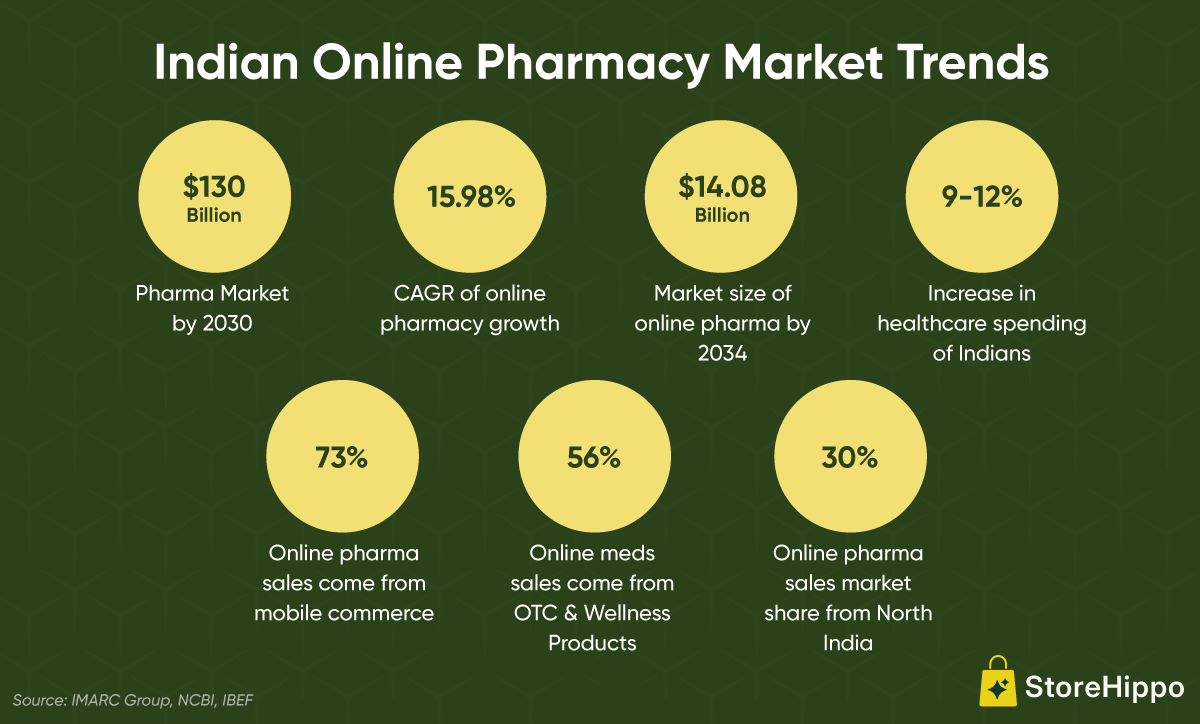
Source: IMARC Group, NCBI, IBEF
- Indian pharmaceutical landscape is projected to reach USD 130 billion by 2030
- India's online pharmacy market was valued at USD 3.71 billion in 2025 and is projected to reach USD 14.08 billion by 2034, growing at 15.98% CAGR , a consistent, structural growth curve, not a pandemic spike
- 9% to 12% increase in overall spending allocations on healthcare treatments and medications in India
- Mobile channel accounts for 73% of the market as of 2025 proving pharmacy app development is the primary channel, not a support layer
- OTC products make up 56% of sales, driven by self-medication, wellness supplements, and preventive care, a high-repeat, low-barrier segment any platform should be building around
- North India leads with 30% market share, but tier II and tier III cities represent the biggest growth frontier as logistics networks extend and smartphone penetration deepens
Source: IMARC Group, NCBI, IBEF
India's online pharmacy market hit USD 3.71 billion in 2025. It is heading to USD 14 billion by 2034. That is not a pandemic-era number running on borrowed tailwinds. It is a current projection grounded in chronic disease rates, smartphone penetration, and 1.4 billion people who are still largely underserved by physical pharmacies.
Looking at these trends, it's clear where the market is headed. While the early leaders have established strong positions, the opportunity is far from saturated. Large parts of the market remain underserved, especially across emerging cities, specialised healthcare segments, and integrated digital health services. That's one of the key reasons we're seeing growing interest from pharma companies, healthcare brands, distributors, and pharmacy chains. The customer behaviour shift has already happened. The real opportunity now lies in building an online pharmacy marketplace that can meet evolving healthcare needs at scale.
Benefits of Building a Multi Vendor Marketplace for Medicines in India
What I find quite paradoxical is that while India is known as the "Pharmacy of the World" and supplies medicines to more than 200 countries, access to medicines and healthcare services is still a challenge for 50-60% of the population within the country, especially outside major urban centres (Source: NIH).
This gap is exactly what makes a multi vendor marketplace model so compelling. By bringing together multiple pharmacies, diagnostic providers, and healthcare services on a single platform, businesses can extend their reach far beyond what a standalone pharmacy can achieve. In many ways, an online pharmacy marketplace is not just about selling medicines online. It's about making healthcare more accessible, convenient, and available to customers wherever they are.
1. Huge Untapped Market
One thing that stands out when I look at this market is how much room there is still to grow. While the major cities are reasonably well served, large parts of Tier II, Tier III, and rural India still have limited access to organised healthcare and medicine delivery. As internet access and digital payments continue to expand, these regions represent some of the biggest opportunities for a new online pharmacy marketplace.
2. Large Base of Repeat Customers
Unlike many ecommerce categories, medicines are often not one-time purchases. Patients managing diabetes, hypertension, heart conditions, and other chronic illnesses need regular refills month after month. In my experience, businesses that make online medicine delivery simple, affordable, and reliable can build long-term customer relationships and highly predictable revenue streams.
3. Telemedicine Is Expanding Healthcare Access
What I find particularly interesting is that while many digital habits faded after the pandemic, telemedicine moved in the opposite direction. It has become a mainstream part of healthcare, changing how people access doctors, prescriptions, and ongoing care. More people are consulting doctors online, monitoring health conditions digitally, and actively searching for healthcare services on the internet. An e-pharmacy platform naturally fits into this journey by helping customers move seamlessly from consultation to medicine fulfilment.
4. Better Economics Than Traditional Retail
When I speak with healthcare businesses evaluating digital commerce, the economics of the marketplace model are often what get their attention first. It allows pharmacies and distributor networks to manage their own inventory while the parent umbrella platform focuses on customer acquisition, transactions, and supply chain. This makes it possible to offer a wider catalogue without the costs associated with owning and managing large inventories.
5. Rising Healthcare and Wellness Spending
Another trend I'm seeing across the healthcare sector is the steady increase in spending on medicines, supplements, wellness products, and preventive care. Consumers are becoming more proactive about their health, creating opportunities that extend well beyond prescription medicines. For businesses building an online pharmacy marketplace, this opens up multiple revenue streams across healthcare categories.
6. Mobile Is Becoming the Primary Healthcare Channel
Healthcare consumers are increasingly mobile-first. Today, most medicine searches, consultations, and healthcare transactions begin on a smartphone. That's why I see pharmacy app development as a strategic investment rather than an optional add-on. Businesses that offer a seamless online pharmacy app India experience are often the ones best positioned to capture growing demand and build lasting customer relationships.
7. Build a Larger Healthcare Ecosystem
One thing I've noticed when studying the market leaders is that the most successful platforms rarely stop at medicine delivery. They gradually add diagnostics, consultations, wellness products, insurance services, or healthcare partners to create a more complete customer experience. A multi vendor marketplace makes this expansion much easier because new sellers and service providers can be added without rebuilding the business from scratch. Over time, the platform becomes more valuable to both customers and partners.
8. Reduce Dependence on Medicine Margins
Another advantage that often gets overlooked is diversification. Healthcare marketplaces are not limited to earning revenue from medicine sales alone. Seller commissions, subscription plans, featured listings, diagnostics, consultations, wellness products, and healthcare partnerships can all contribute to revenue. This creates a more balanced business model and reduces dependence on a single category or margin source.
What stands out to me is that the biggest opportunities in this market go well beyond online medicine delivery. The brands creating long-term value are the ones building complete healthcare ecosystems around medicines, diagnostics, consultations, and patient engagement rather than operating as standalone pharmacy businesses.
That's exactly what India's leading pharmacy platforms have done. While each followed a different path, their journeys offer valuable lessons for any business looking to build and scale a successful digital healthcare marketplace.
Top 5 Online Pharmacy Marketplaces in India and What Makes Them Work
If there is one lesson from India's digital healthcare sector, it is that success doesn't come from following a single playbook. Some companies built trust through healthcare services and consultations. Others focused on fulfilment, accessibility, or leveraging strong offline networks. Each found a different way to solve a real customer problem.
That is precisely why these platforms are worth studying. Beyond their scale, they offer practical lessons on building trust, expanding services, improving customer retention, and growing sustainably in a highly competitive market.
Whether you are exploring pharmacy app development, evaluating the online pharmacy marketplace opportunity, or planning to launch your own healthcare platform, these are the businesses that show what it takes to build and scale successfully in this space.
1. Tata 1mg
Tata 1mg is India's largest online pharmacy today. The platform covers medicines, health supplements, lab tests, and doctor consultations under one roof. It reported revenue of Rs 2,392 crore in FY25, a 22% jump year on year, and overtook PharmEasy as the market leader in 2023, a position it has held since.
Success Mantra of Tata 1mg
What They Got Right
Instead of positioning itself as just an online medicine delivery platform, Tata 1mg built a complete healthcare ecosystem. Customers can buy medicines, book lab tests, access health information, and manage prescriptions from a single platform.
Why It Worked
- Multiple healthcare services create more reasons for customers to return.
- Prescription uploads and refill reminders make repeat purchases easier.
- Detailed medicine information helps build trust and improve decision-making.
- Strong health content attracts users searching for medicine information, side effects, and treatment options.
- The broader healthcare experience reduces dependence on discounts alone for customer retention.
Key Takeaway
The biggest lesson from Tata 1mg is that successful healthcare platforms solve more than one customer need. An online pharmacy marketplace that combines medicine delivery, diagnostics, consultations, and trusted health information can increase customer engagement, improve retention, and capture a larger share of healthcare spending.
2. Apollo 24|7
Apollo 24|7 entered the market with a major advantage: the trust and reach of one of India's largest healthcare networks. Over the years, it has grown beyond a medicine ordering platform into a digital healthcare ecosystem serving 25 million+ users . Today, the platform handles around 75,000 daily orders across medicines, diagnostic tests, and doctor consultations. Its growing scale is also translating into business success, with Apollo HealthCo, the company behind Apollo 24|7, reporting a profit of Rs 32 crore profit in Q3 FY25, a significant milestone for India's e-pharmacy industry.
Success Mantra of Apollo 24|7
What They Got Right
Apollo 24|7 successfully connected its hospital, pharmacy, and digital healthcare ecosystem into a single customer journey. Patients can move from doctor consultation to prescription fulfilment and medicine ordering without leaving the platform.
Why It Worked
- The connection between hospitals, doctors, pharmacies, and digital services creates a seamless healthcare experience.
- Customers can easily order medicines after consultations, reducing friction in the buying journey.
- Condition-specific programmes for diabetes, heart care, and respiratory health encourage long-term engagement.
- A large offline pharmacy network strengthens convenience and accessibility.
- Years of trust built through Apollo's healthcare services carry over naturally to its digital platform.
Key Takeaway
Apollo 24|7 shows that trust remains one of the biggest advantages in healthcare commerce. Businesses with physical stores, clinics, hospitals, or pharmacy networks can strengthen their online pharmacy marketplace by connecting offline and online experiences. An omnichannel approach not only improves convenience but also helps build stronger customer relationships and repeat usage over time.
3. PharmEasy
PharmEasy helped make online medicine delivery a mainstream habit for millions of Indian consumers across 19,000+ pincodes. Starting as a digital-first healthcare platform, it expanded rapidly by building a strong delivery network and making medicines, diagnostic tests, and healthcare services accessible through a single app. Today, the platform serves customers across thousands of cities, towns, and pincodes, making healthcare more convenient for people who may not have easy access to physical pharmacies or diagnostic centres. Its focus on wide availability, affordable pricing, and doorstep convenience helped it become one of the most recognised names in India's e-pharmacy market.
Success Mantra of PharmEasy
What They Got Right
PharmEasy focused on solving one of the biggest challenges in healthcare commerce: accessibility. By building a large delivery network and expanding beyond medicines into diagnostics and healthcare services, it created a convenient, one-stop healthcare platform for customers across the country.
Why It Worked
- A wide delivery network helped make medicines available to customers across urban and emerging markets.
- The addition of diagnostic services created a more complete healthcare ecosystem.
- Competitive pricing and convenience encouraged customers to try online medicine delivery for the first time.
- Multiple healthcare services increased customer engagement beyond medicine purchases alone.
- A strong focus on fulfilment and reach helped the platform scale rapidly across India.
Key Takeaway
PharmEasy demonstrates that convenience and accessibility can be powerful growth drivers for an online pharmacy marketplace. Building a reliable delivery network, expanding into complementary healthcare services, and making healthcare easier to access can create lasting customer value. However, long-term success comes from balancing growth with sustainable operations and a strong customer experience.
4. Netmeds ( Now Backed by Reliance Retail)
Netmeds was among the first ( founded 2025) companies to bring online medicine delivery to Indian consumers at scale. Since its launch, the platform has built a strong presence in the country's growing e-pharmacy market by offering medicines, wellness products, and healthcare essentials through a convenient digital experience. Its growth received a major boost after becoming part of the Reliance Retail ecosystem, giving it access to one of India's largest retail and digital commerce networks while continuing to operate under the trusted Netmeds brand.
Success Mantra of Netmeds
What They Got Right
Netmeds successfully combined digital convenience with the strength of a large retail ecosystem. By leveraging offline stores, delivery infrastructure, and a broad customer network, it created a more connected healthcare shopping experience for customers.
Why It Worked
- A strong retail network helps support faster and more flexible order fulfilment.
- Customers can choose between home delivery and store-based convenience depending on their needs.
- The combination of online and offline touchpoints improves accessibility and customer trust.
- Access to a larger commerce ecosystem helps increase reach and customer acquisition.
- An omnichannel approach creates a smoother experience across digital and physical channels.
Key Takeaway
Netmeds highlights the value of combining digital commerce with physical infrastructure. For businesses building an online pharmacy marketplace, a strong network of stores, pharmacies, fulfilment partners, or healthcare providers can become a significant competitive advantage. Faster delivery, better accessibility, and a seamless omnichannel experience often matter as much as product selection or pricing.
5. MediBuddy
MediBuddy has built its presence by focusing on healthcare as a complete service rather than a standalone online medicine delivery business. The platform brings together doctor consultations, diagnostic tests, medicine ordering, surgical care, and health benefits under a single digital experience. While many healthcare platforms primarily target individual consumers, MediBuddy has also established a strong presence in the corporate wellness and employee healthcare space, helping organisations provide accessible healthcare services to their workforce. This broader approach has helped it become one of India's most recognised digital healthcare platforms. It reported revenue of Rs 724.6 crore in FY25, a 12.3% year-on-year increase, and narrowed losses by 37%.
Success Mantra of MediBuddy
What They Got Right
MediBuddy expanded beyond direct-to-consumer healthcare by building strong partnerships with businesses and employers. This allowed the platform to reach large groups of users through workplace healthcare programmes while continuing to offer a wide range of healthcare services to individual customers.
Why It Worked
- Corporate partnerships bring a steady stream of users onto the platform.
- Employees can access multiple healthcare services from a single platform, increasing engagement and repeat usage.
- A broad network of pharmacies, doctors, and diagnostic centres improves accessibility across different regions.
- Offering consultations, diagnostics, medicines, and healthcare support in one place creates a more complete customer experience.
- The combination of B2B and B2C channels helps diversify growth opportunities.
Key Takeaway
MediBuddy demonstrates the value of serving both businesses and consumers. For companies building an online pharmacy marketplace or broader healthcare platform, partnerships with employers, hospitals, clinics, insurers, or healthcare providers can become a powerful growth channel. Expanding beyond direct consumer acquisition can help increase reach, strengthen customer retention, and create a more sustainable healthcare ecosystem.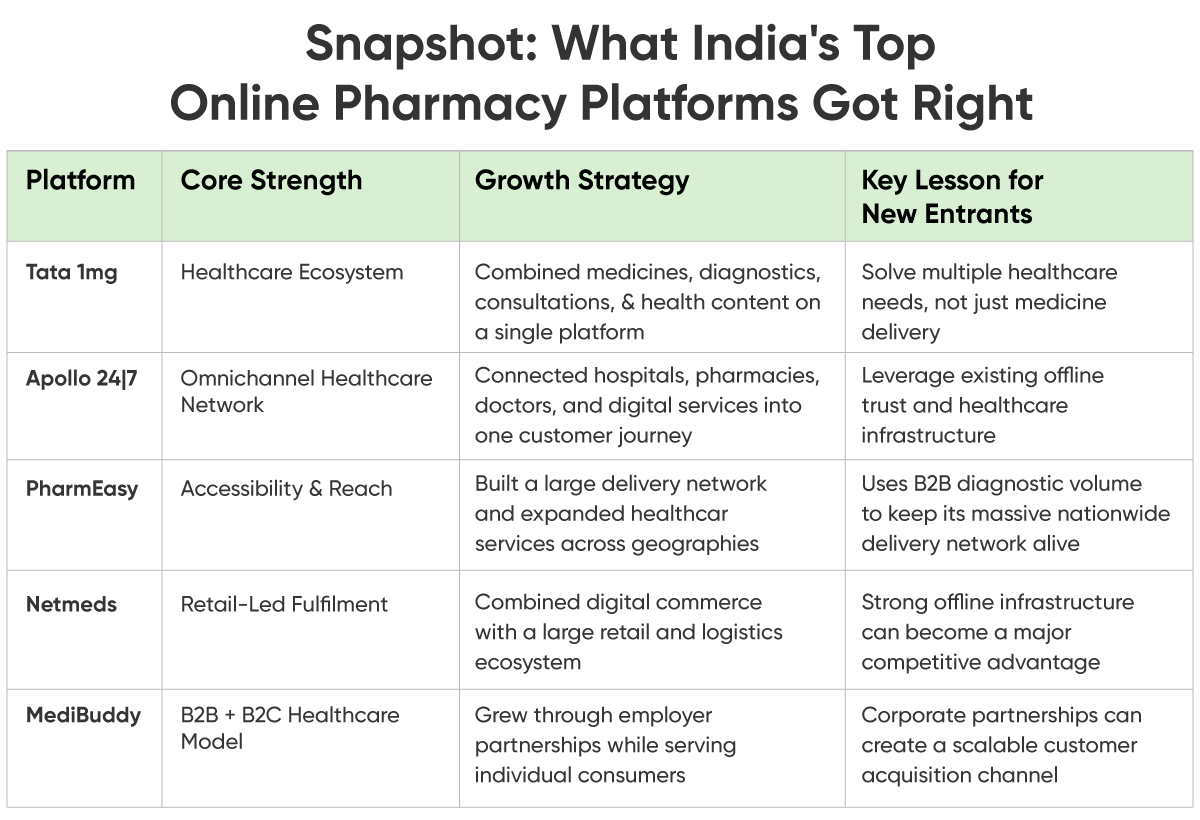
Looking across these five platforms, one thing becomes clear. While their growth strategies differed, they all invested in the same fundamentals: trust, accessibility, operational scale, customer retention, and a seamless healthcare experience.
The good news is that businesses entering the market today don't have to build these capabilities from scratch. The technology, infrastructure, and marketplace models have matured significantly. The next question is how to bring all these moving parts together and build a scalable online pharmacy marketplace of your own.
Building an Online Pharmacy Marketplace: A Practical 10-Step Framework
In conversations with pharma companies, distributors, and healthcare brands, I often find that the biggest challenge isn't identifying the opportunity. It's understanding what it actually takes to launch and scale a successful healthcare marketplace.
Based on what we've seen work across the industry, here are the ten building blocks every online pharmacy marketplace should get right from day one.
1. Start With the Right Business Model
Before investing in technology, decide how your business will operate. Will you run your own inventory, onboard independent pharmacies, or combine both models? Many successful e-pharmacy businesses use a marketplace approach because it expands product availability without requiring massive inventory investments.
2. Build Compliance Into the Foundation
Healthcare is not a category where compliance can be added later. Prescription validation, pharmacist approvals, medicine classification, seller verification, and customer data protection should be built into the operating model from day one. Trust is one of the biggest differentiators in online medicine delivery.
3. Choose a Platform That Can Scale With You
One mistake I often see is businesses selecting a platform based on current requirements rather than future growth plans. A successful multi vendor marketplace platform should support pharmacy onboarding, inventory management, commissions, order workflows, fulfilment operations, and business expansion without requiring a complete rebuild.
4. Create a Unified Medicine Catalogue
Customers should be able to find medicines easily, regardless of which local pharmacy or distributor (in case of B2B) fulfils the order. A structured catalogue with compositions, dosage details, alternatives, brands, and prescription requirements improves customer experience and simplifies marketplace operations.
5. Make Product Discovery Effortless
Medicine names can be difficult to remember, spell, or search. Modern online pharmacy marketplace platforms should support intelligent search, medicine alternatives, composition-based discovery, and easy navigation to help customers find the right products quickly.
6. Design Robust Prescription Workflows
Prescription management sits at the heart of any healthcare platform. From prescription uploads and pharmacist reviews to order approvals and fulfilment, the process should be simple for customers while remaining compliant for sellers and administrators.
7. Prioritise Mobile From Day One
Most healthcare journeys now begin on a smartphone. That's why pharmacy app development should be treated as a core business requirement rather than a later-stage enhancement. Customers increasingly expect to search for medicines, upload prescriptions, track orders, and manage healthcare needs through mobile apps.
8. Build for Hyperlocal Fulfilment
Speed matters in healthcare. The ability to route orders to the nearest pharmacy, fulfil from multiple locations, and optimise delivery based on inventory availability can significantly improve the customer experience and strengthen your online medicine delivery operations.
9. Think Beyond Medicines
The most successful healthcare platforms rarely stop at medicines alone. Diagnostics, consultations, wellness products, preventive healthcare, subscriptions, and patient engagement services create additional value for customers while increasing retention and revenue opportunities.
10. Measure, Optimise, and Expand
Launching your platform is only the beginning. Track customer behaviour, seller performance, repeat purchase rates, fulfilment metrics, and product demand. The most successful online pharmacy app India businesses continuously refine their operations based on real customer usage and market feedback.
Key Takeaway
Looking at India's leading healthcare platforms, one pattern becomes clear: the winners are not simply building medicine delivery apps. They are building scalable healthcare ecosystems. The good news is that businesses entering the market today don't have to build every capability from scratch. With the right multi vendor marketplace platform, much of this foundation can be accelerated significantly.
How StoreHippo Helps You Build a Scalable Online Pharmacy Marketplace
Over the years, we've spoken with pharmaceutical manufacturers, distributors, pharmacy chains, healthcare brands, and even hospital networks exploring digital commerce. The challenge is rarely launching a website. The real challenge is connecting pharmacies, distributors, field teams, delivery partners, and customers into a single operating system.
That's exactly where StoreHippo helps. Here is how:
1. Build Around Your Existing Distribution Network
Most pharma businesses already have a network of distributors, dealers, stockists, retailers, pharmacies, and medical representatives. StoreHippo helps bring this ecosystem online through a multi vendor marketplace model with separate logins and dashboards for vendors, pharmacies, dealers, distributors, field teams, and administrators.
Everyone manages their part of the business independently while the enterprise retains complete visibility and control.
2. Support B2B and D2C From One Platform
Many healthcare businesses don't want separate systems for distributors and consumers. StoreHippo supports both B2B and D2C commerce from a single backend.
Whether you are selling to hospitals, clinics, pharmacies, dealers, or directly to consumers, operations, inventory, orders, and customer data remain connected through one platform.
3. Build a Connected Pharmacy Ecosystem
Storehippo no plugin feature-rich multivendor solution helps businesses build a connected online pharmacy marketplace that brings pharmacies, distributors, healthcare partners, delivery teams, and customers onto a single platform.
Instead of managing multiple systems, businesses can operate through a unified commerce infrastructure while maintaining complete visibility across the network.
4. Use AI Where It Creates Real Value
AI creates the most value when it helps customers find products faster and helps teams manage operations more efficiently.
StoreHippo's AI-powered core improves product discovery through intelligent search and recommendations, while features like Master Catalogue and Magic Edit simplify the management of large medicine catalogues. Businesses can also deploy custom AI assistants to support customers, vendors, and partners, helping automate routine queries and improve response times across the marketplace.
5. Make Mobile the Centre of Your Strategy
Modern healthcare ecosystems are increasingly becoming mobile-first for for buyers and the sellers. StoreHippo's built-in app builder helps businesses launch Android and iOS apps for their online pharmacy marketplace, while also providing ready-to-use apps for sellers, dealers, and admin teams. Brands can even launch dedicated apps for delivery partners.
For businesses investing in pharmacy app development, this ensures every stakeholder operates through a connected mobile ecosystem rather than disconnected tools and workflows.
6. Bring Pharmacy Commerce to WhatsApp
In many healthcare businesses, WhatsApp is where the transaction actually begins. Prescription sharing, medicine enquiries, repeat orders, and delivery updates often happen through chat long before a customer visits a website or app.
StoreHippo connects WhatsApp Business accounts with your online pharmacy marketplace, helping teams manage conversations, orders, and fulfillment from a unified dashboard.
7. Run Omnichannel Healthcare Commerce From a Single Platform
As healthcare businesses expand, managing websites, mobile apps, WhatsApp orders, pharmacy networks, dealer channels, and customer interactions through separate systems quickly becomes inefficient.
StoreHippo unifies these channels on a single platform, helping businesses deliver a consistent customer experience while managing inventory, orders, fulfillment, and partner networks from one place.
8. Deliver Faster With Hyperlocal Fulfilment
In healthcare, delivery speed often matters as much as product availability. Whether a customer needs a routine refill or an urgent medicine, the ability to fulfil orders from the right location can make a significant difference to the customer experience.
StoreHippo combines geo-fencing, multi-location inventory management, hyperlocal commerce capabilities, and automatic order routing to fulfil orders from the nearest eligible pharmacy, dealer, or fulfillment centre. Pre-integrated intracity and intercity logistics partners further help businesses scale efficient online medicine delivery operations across regions.
9. Localise, Market, and Scale
Healthcare demand doesn't look the same across regions. Languages, product preferences, buying behaviour, and healthcare needs can vary significantly from one market to another.
StoreHippo supports multilingual storefronts, localised design, built-in marketing tools, flexible promotions, loyalty programmes, and personalised engagement workflows, helping businesses scale their online pharmacy marketplace while delivering locally relevant experiences.
10. Work With the Systems You Already Use
Most healthcare businesses have already invested in ERP, CRM, POS, accounting, logistics, and other operational systems. Replacing them is rarely practical or necessary.
StoreHippo integrates with existing business systems, helping create a connected online pharmacy marketplace while preserving the processes, data, and technology investments that already power the business.
11. Bringing It All Together
If there's one lesson I take away from studying India's leading healthcare platforms, it's that customers no longer think in terms of medicines, consultations, diagnostics, or wellness services separately. They expect a connected healthcare experience.
The businesses that are scaling successfully are responding by building healthcare ecosystems rather than standalone medicine stores. StoreHippo provides the technology foundation to build and scale that vision, helping businesses manage the complexity of a modern multi vendor marketplace while delivering the seamless experience customers increasingly expect from an online pharmacy marketplace.
Conclusion
A few years ago, the question was whether consumers would be comfortable buying medicines online. Today, that question has largely been answered.
The businesses entering this space now are competing in a very different market, one where customer trust, fulfilment efficiency, digital engagement, and service breadth matter as much as product availability. The opportunity is significant, but so is the expectation from customers.
For pharmaceutical companies, distributors, pharmacy chains, and healthcare brands, this is an opportunity to build a direct relationship with customers while creating new digital growth channels. The businesses that move early and build the right foundations today will be far better positioned to capture the next phase of growth in India's online pharmacy marketplace sector.
Every healthcare business has a different growth strategy. If you're evaluating pharmacy app development, marketplace commerce, or omnichannel healthcare delivery, connect with our experts to discuss the approach best suited to your business.
FAQ
1. Do I need to build a new pharmacy network to launch an online pharmacy marketplace?
Not necessarily. Many businesses start by bringing their existing distributors, dealers, retailers, and pharmacy partners onto a multi vendor marketplace. This allows every stakeholder to manage inventory, pricing, orders, and fulfilment independently while operating within a single connected ecosystem.
2. Can my field sales team, medical representatives, and dealer network work through the same online pharmacy marketplace?
Yes. Modern healthcare commerce platforms can support field teams with dedicated mobile apps, order booking workflows, dealer management tools, and real-time access to inventory and customer information from the field.
3. Will I need to replace my existing ERP, CRM, or inventory systems to launch an online pharmacy marketplace?
Not necessarily. Most pharma businesses already have critical systems in place. The goal should be to connect your marketplace with existing ERP, CRM, POS, accounting, and inventory tools so data flows seamlessly across the business.
4. Can I manage distributors, pharmacies, hospitals, and direct customers from the same platform?
Yes. Many pharmaceutical businesses need to serve multiple customer groups simultaneously. A well-designed platform can support B2B and D2C operations from a single backend while allowing each channel to have its own pricing, workflows, and customer experience.
5. How can I expand online medicine delivery to new regions without investing heavily in physical infrastructure?
Many businesses do this by onboarding local pharmacies, dealers, and fulfilment partners onto a multi vendor marketplace. Orders can then be automatically routed to the nearest serviceable location, helping improve delivery speed while keeping expansion costs under control.
Binny Joseph is a seasoned ecommerce and enterprise growth leader, serving as Senior Vice President of Sales & Alliances with deep experience helping global brands adopt modern commerce solutions. He combines sharp strategic insight with a passion for empowering businesses to scale through digital transformation, headless commerce, and innovation-led growth.