



In today’s fast-paced digital landscape, where AI has transformed everything from cataloguing to customer journeys, enterprise brands face mounting challenges that demand smarter, more agile solutions.
From managing complex supply chains to delivering AI-driven, ever-evolving customer experiences, staying ahead requires a platform that can adapt and grow with your business.
Are you also juggling complex supply chains, large-scale operations, and the need to innovate rapidly with AI-enabled efficiencies, all while staying profitable and competitive?
Well, legacy ecommerce platforms often can’t keep up with limiting innovation, scalability, and the ability to leverage AI effectively.
The rise of new business models like multi-channel selling, hyperlocal delivery, and quick commerce, combined with the growing role of AI in ecommerce operations, is further pushing brands to rethink their strategies or even consider ecommerce replatforming.
Wonder what the biggest hurdles are that drive brands to make the switch, and how you can prepare for a smarter, AI-powered, faster ecommerce future?
Table of Contents
- Why Modern Enterprises Can’t Delay Ecommerce Migration
- 8 Modern Enterprise Challenges Driving Brands to Migrate to StoreHippo
- 1. Managing Complex B2B and D2C Models Simultaneously
- 2. Scaling Business Across Multiple Locations
- 3. DeliveringOmnichannel Customer Experiences
- 4. Managing Multi-Vendor Marketplaces
- 5. Personalising Customer Journeys
- 6. Accelerate Enterprise Growth With AI In Ecommerce
- 7. Optimising Performance at Scale
- 8. Ensuring Data Security and Compliance
- Conclusion
- FAQs
Why Modern Enterprises Can’t Delay Ecommerce Migration
Ecommerce platform migration involves transferring an online store from one platform to another, often driven by the need for enhanced performance, scalability, and modern features. This transition encompasses moving product catalogues, customer data, and other critical components, while securing the SEO juice. However, a comprehensive migration strategy is essential to mitigate risks and ensure a smooth transition.
Before we move into the enterprise challenges, here’s a quick look at the trends guiding ecommerce migration today:
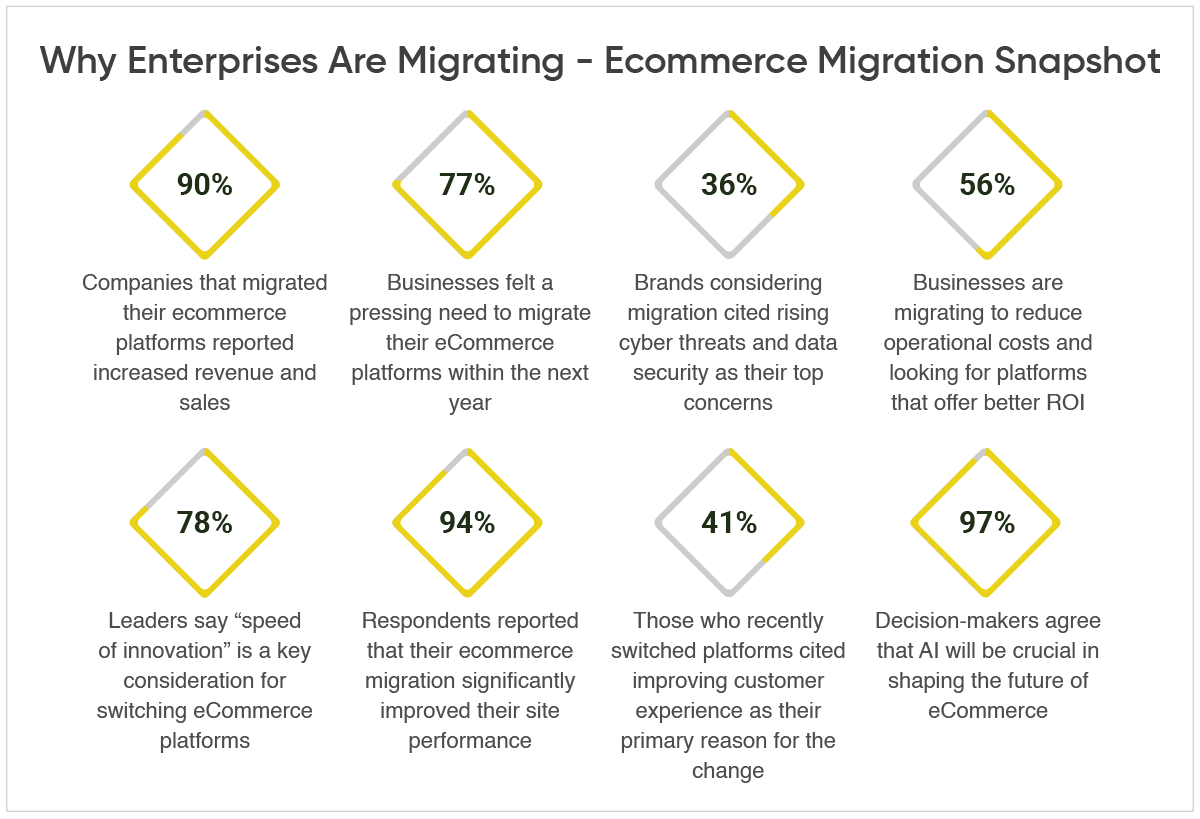
- 90% of companies that migrated their ecommerce platforms reported increased revenue and sales.
- 77% of businesses felt a pressing need to migrate their eCommerce platforms within the next year
- 36% of brands considering migration cited rising cyber threats and data security as their top concerns
- 56% of businesses are migrating to reduce operational costs and looking for platforms that offer better ROI
- 78% of leaders say “speed of innovation” is a key consideration for switching eCommerce platforms
- 94% of respondents reported that their ecommerce migration significantly improved their site performance
- 41% of those who recently switched platforms cited improving customer experience as their primary reason for the change
- 97% of decision-makers agree that AI will be crucial in shaping the future of eCommerce
Source: Statista, General Industry Reports Fall 2025
As the data shows; with brands achieving higher revenue, stronger CX, better performance, and safer infrastructure, ecommerce migration has become a strategic necessity. For enterprises navigating rising expectations and rapid technological shifts, moving to a modern platform is now key to staying competitive.
8 Modern Enterprise Challenges Driving Brands to Migrate to StoreHippo
In today’s fast-paced digital landscape, enterprise brands face enormous pressure to deliver seamless customer experiences while managing complex operations. With rising customer expectations and rapid technological advancements, traditional ecommerce platforms often struggle to keep up. This has led many brands to seek advanced, scalable solutions and plan ecommerce platform migration to tackle these modern challenges head-on.
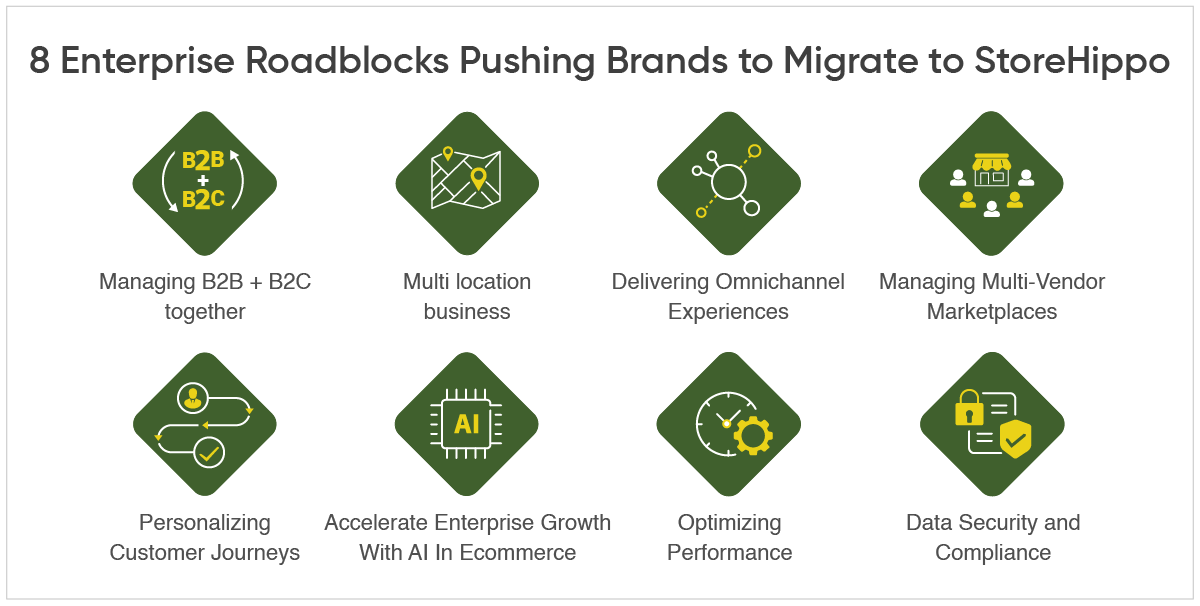
Let’s dive into the key challenges that are reshaping enterprise ecommerce:
1. Managing Complex B2B and D2C Models Simultaneously
The Challenge:
Enterprises today often operate in both B2B and D2C business models, each requiring unique customer experiences, and operational workflows. Managing complex hybrid business models on a traditional ecommerce platform can lead to inefficiencies in business operations. B2B transactions typically involve bulk orders, negotiated pricing, and custom workflows, while D2C focuses on personalized experiences, faster delivery, and seamless navigation. Without a flexible platform that offers tailored customer experiences, enterprises struggle to maintain consistency across both business models, driving the need for ecommerce platform migration to better solutions that can handle hybrid models without causing disruptions.
How StoreHippo Mitigates It:
StoreHippo helps you build a range of marketplaces in no time. You can build horizontal, vertical, B2B, B2C, D2C, B2B2C, hybrid or custom marketplaces with StoreHippo’s advanced ecommerce solutions. StoreHippo comes with inbuilt support for diverse business models unlike other marketplace builders that offer apps, plug-ins or complex extension-based solutions. When you migrate to StoreHippo, you can easily pivot to new business models or combine two or more models to create a hybrid business model for your brand. With the plug-and-play solutions from StoreHippo, you do not require any additional apps or extensions to build hybrid solutions for your unique business needs. Building innovative custom marketplaces is also easy with the headless architecture of the fully hosted and managed enterprise ecommerce platform StoreHippo.
2. Scaling Business Across Multiple Locations
The Challenge:
Expanding across multiple locations is a major milestone for enterprise brands, but it comes with logistical and operational complexities. Managing region-specific storefronts, local currencies, taxes, and shipping rules can be challenging for traditional ecommerce platforms, and here’s where ecommerce replatforming comes into picture. As you scale your business globally, you must deliver hyperlocal customer experiences while maintaining centralised control over inventory and operations. Without a platform that supports location-based adaptability, helps in offering localized content, managing diverse tax structures, and handling region-specific delivery options, your business growth slows down substantially.
How StoreHippo Mitigates It:
StoreHippo’s multi-store solutions help you build and manage multiple location-based storefronts from a central admin dashboard. With StoreHippo, you can quickly roll out multiple stores for different locations, create unique URLs for each location, create different inventory, offer unique deals etc, making it easier for customers to navigate and shop from their respective locations. You can easily manage your sub-store network from a central admin. You can also create different mobile apps for each of the sub-stores right from your admin panel, without additional coding or cost. Ecommerce migration to StoreHippo also means that you can create unique store designs for all your sub-stores.
3. DeliveringOmnichannel Customer Experiences
The Challenge:
Modern consumers expect a consistent shopping journey across multiple touchpoints, whether online, mobile, or in-store. However, many legacy ecommerce platforms lack the agility to integrate mobile and other channels seamlessly. With mobile apps becoming the core of ecommerce, brands need platforms that help maintain omnichannel consistency for customer retention and satisfaction. Brands, therefore must embrace ecommerce platform migration to a flexible solution capable of delivering cohesive omnichannel experiences across all customer touchpoints.
How StoreHippo Mitigates It:
StoreHippo ecommerce solution is built on mobile first principle that comes with a built-in mobile apps builder. You can create multiple Android and iOS mobile apps right from your admin dashboard at zero additional costs with no need for coding. The marketplaces powered by StoreHippo are PWA stores that look, feel, and work like mobile apps even on entry-level devices with poor internet connectivity. StoreHippo also provides built-in apps for delivery boys, vendors and admins to help them manage the business on the go. As you migrate to StoreHippo, you can also create multiple touchpoints seamlessly using the same backend logic and APIs. From creating consistent user experiences to boosting conversions, StoreHippo helps brands mitigate the challenge of delivering omnichannel customer experiences.
4. Managing Multi-Vendor Marketplaces
The Challenge:
Operating a multi-vendor marketplace involves managing multiple sellers, tracking commissions, ensuring smooth logistics, etc. Traditional ecommerce platforms often lack the flexibility to accommodate the complexities of multi-vendor marketplaces, resulting in inefficiencies and errors. As your marketplace grows, manual processes become unsustainable, affecting vendor onboarding, order fulfillment, and payment reconciliation. Ecommerce replatforming to a robust platform with advanced multi vendor solutions helps you maintain transparency, monitor vendor performance, and automate operational workflows.
How StoreHippo Mitigates It:
StoreHippo offers a comprehensive multi-vendor marketplace solution that offers end-to-end vendor onboarding and management features. With the easy-to-use intuitive vendor dashboard, your vendors can seamlessly register on the platform and start selling in just a few easy steps. While the admins have complete control over vendor activities, StoreHippo creates unique vendor dashboards to help them run and manage their business independently. Your vendors can upload products, track orders, and manage their inventory independently. Ecommerce platform migration to StoreHippo also helps you seamlessly manage the vendors, overview their business, approve or reject their products, etc, right from your admin dashboard. StoreHippo also offers an adaptive payment feature that helps you divide a single payment made by a customer into multiple sellers as well as admin.
5. Personalising Customer Journeys
The Challenge:
Modern consumers expect personalised experiences tailored to their preferences and behaviour. Traditional ecommerce platforms often lack advanced personalisation capabilities, limiting brands from delivering relevant product recommendations and targeted marketing. Without a data-driven approach to customer journeys, businesses miss opportunities to improve engagement and drive conversions. However, with ecommerce migration to modern ecommerce platforms with robust technology, offering a bpersonalised buyer journey becomes easy. With the growing demand for customised experiences, it is indeed important for businesses to explore various platforms that support intelligent customer personalisation.
How StoreHippo Mitigates It:
Built on MACH architecture, StoreHippo gives you better creative control and agility to implement multi level personalisations. With StoreHippo’s built-in features like drag-and-drop design tools, pricing overrides, discount engine, multilingual, multi-currency, etc. you can implement multi-level personalisations on your enterprise marketplace. The price override feature helps you offer personalised product prices based on customer segments and locations. When you migrate to StoreHippo, you can create personalised discounts and offers for your buyers with the built-in discount engine. You can send out personalized notifications to your buyers in real time with the PUSH notification feature and recover abandoned carts seamlessly with StoreHippo enterprise ecommerce platform.
6. Accelerate Enterprise Growth With AI In Ecommerce
The Challenge:
As enterprise ecommerce grows more complex, manual processes slow down innovation, increase operational overhead, and limit the ability to deliver personalised buyer experiences at scale. Traditional platforms rely on plugin-heavy AI add-ons that create fragmented workflows, inconsistent data, and performance issues. Without native AI in ecommerce powering every layer, from image enhancement and catalogue creation to search and personalisation, enterprises struggle to maintain catalogue hygiene, improve discovery, and offer real-time recommendations. These limitations directly impact conversion rates, operational efficiency, and the customer experience, making ecommerce migration essential for brands seeking AI-enabled speed, accuracy, and intelligent automation.
How StoreHippo Mitigates It
StoreHippo comes with built-in AI capabilities designed to simplify and enhance every stage of the ecommerce workflow without external plugins. Its AI-powered cataloguing reads product images, generates SEO-ready descriptions, adds product title HSN etc, and reduces manual cataloguing time for large or multi-vendor catalogues. StoreHippo’s AI semantic search improves product discovery by understanding buyer intent even in different languages and semantic variations. With AI-powered recommendations, enterprises can deliver personalised product suggestions and improve AOV across B2B, B2C, and hybrid marketplaces. StoreHippo also enables AI-assisted multilingual and voice-based buying experiences, making it easier for brands to serve new markets. StoreHippo also has dedicated AI bots for conversational AI in retail, AI for MSMEs that guides small and medium enterprises every step of their journey and AI for agri commerce, helping agri brands, FPOs etc take agriculture to mainstream digital commerce. Brands and marketplaces can also create their custom agentic AI bots to help their vendors on their marketplace or B2B set up.
7. Optimising Performance at Scale
The Challenge:
As enterprise businesses scale, the demands on their ecommerce platforms grow exponentially. Handling high traffic volumes, large product catalogs, and complex transactions can overwhelm traditional systems, leading to slow page loads, downtime, and poor user experiences. Ecommerce replatforming helps mitigate this performance bottleneck which is even more critical during peak seasons, where even minor slowdowns can result in lost sales and dissatisfied customers. To meet these demands, businesses need to migrate to a solution that offers scalable infrastructure, ensuring consistent performance regardless of traffic spikes or business expansion.
How StoreHippo Mitigates It:
StoreHippo’s cloud-based platform empowers you to scale efficiently, ensuring that you can meet the future demand without disruption. You can also seamlessly handle traffic spikes and high-volume orders with the inherent scalability of StoreHippo scalable headless solution. When you migrate to StoreHippo, you can plan the growth of your enterprise brand without worrying whether the marketplace platform will be able to accommodate their growth or not. The elastic scalability of the cloud-native infrastructure along with the auto-provisioning of servers, ensures that enterprise brands need not worry about peak load tolerance or growing exponentially.
8. Ensuring Data Security and Compliance
The Challenge:
Traditional ecommerce platforms often fall short in offering advanced security measures, exposing businesses to data breaches and legal risks. Such data risks can lead to severe loss of customer trust. As data privacy regulations continue to evolve, enterprises must ensure their ecommerce infrastructure meets global compliance standards. This urgent need for enhanced security and regulatory adherence is driving enterprises toward ecommerce platform migration to more secure and compliant solutions.
How StoreHippo Mitigates It:
StoreHippo ecommerce solutions come with robust, enterprise-grade security features like data encryption and compliance updates. StoreHippo prioritizes these features to help you protect sensitive data, build customer trust, and stay compliant as regulations change. With free SSL, a PCI-DSScompliant platform, authentication, authorisation and one-way encryption, StoreHippo further enhances your business and data security. Overall, migrating to a secure platform with robust security features protects your brand’s reputation and gives you peace of mind. You can seamlessly stay compliant with global regulations and ensure robust security to protect customer data and transactions.
Conclusion
As enterprise brands evolve, so do their challenges. Rigid, outdated platforms can no longer keep up with the complexities of modern ecommerce. Right from managing hybrid business models to delivering hyper-personalised customer experiences, ecommerce migration is no longer just an option. A robust ecommerce platform is a necessity for businesses aiming to scale, optimize operations, and stay ahead of the competition.
With ecommerce platform migration to StoreHippo, you can gain access to powerful, future-ready ecommerce solutions designed to simplify operations, drive growth, and deliver seamless experiences. Whether you’re looking to expand globally, enhance security, or personalize your customer journey, StoreHippo offers the agility and innovation needed to thrive in today’s digital-first world.
Ready to embrace the future of ecommerce and migrate to StoreHippo? Explore 300+ enterprise-grade features now, with a custom demo for your brand.
FAQs
1. How much time does it take to migrate to StoreHippo from my current platform?
Most ecommerce migration projects to StoreHippo take 4-8 weeks, depending on catalog size, workflows, and integrations. StoreHippo’s team helps plan the migration in a way that processes happen in parallel which enables brands to switch without disrupting ongoing operations.
2. Will my SEO, URLs, and customer data remain safe during ecommerce replatforming to StoreHippo?
Yes, StoreHippo follows a structured replatforming process with URL mapping, redirects, and data integrity checks to protect your SEO. All catalog, customer, and order data is migrated securely.
3. Can StoreHippo handle large product catalogs and multi-vendor setups after platform migration?
Yes, after you migrate to StoreHippo, the platform can manage large catalogs, multiple vendors, pricing rules, and complex workflows easily. It’s built to support enterprise-scale operations seamlessly across diverse business models.
4. Do I need additional plugins or paid extensions after migrating to StoreHippo?
No, StoreHippo is a no-plugin platform with 300+ native features, so most enterprise needs work out of the box. This reduces long-term costs compared to plugin-heavy platforms.
5. How does StoreHippo support complex B2B, D2C, and hybrid business models?
StoreHippo natively supports multiple business models, so brands can run B2B, D2C, B2B2C, or hybrid setups from a single backend. You can also pivot or add new models anytime once you migrate to StoreHippo.