


Enterprise ecommerce is growing fast, but managing it is getting harder.
More channels, more customers, more vendors, more data. What once looked like growth now often feels like operational chaos. Teams are stuck managing endless catalogue updates, pricing changes, order flows, and customer queries across disconnected systems. The result? Slower decisions, inconsistent experiences, and growth that’s harder to sustain than it should be.
This is exactly where agentic AI for ecommerce is changing the game, but adopting it without clarity can create as many challenges as it solves.
The real advantage doesn’t come from simply using AI, but from using it strategically. Enterprises need to move beyond the hype and understand where agentic AI actually drives impact, whether in ecommerce automation, decision-making, or end-to-end operational efficiency.
Instead of rushing adoption, the focus should be on asking the right questions: where can AI reduce complexity, how can it improve execution, and what outcomes truly matter?
Table of Contents
- How Agentic AI is Revolutionising Ecommerce
- 10 Critical Questions Enterprises Should Ask to Future-Proof Ecommerce Operations with Agentic AI
- 1. What are the top five ecommerce operational areas where agentic AI is driving transformation for enterprise businesses?
- 2. How can agentic AI for ecommerce reduce operational complexity across multi-channel businesses?
- 3. What operational challenges indicate the need for agentic AI-powered ecommerce automation?
- 4. How does agentic AI drive rapid, scalable growth for enterprise ecommerce businesses?
- 5. Can agentic AI solutions help unify fragmented ecommerce operations at scale?
- 6. How does agentic AI for ecommerce enhance customer experience while optimising backend operations?
- 7. What capabilities should enterprises look for in agentic AI solutions to future-proof ecommerce operations?
- 8. How does ecommerce automation powered by agentic AI impact cost efficiency and scalability?
- 9. What is the impact of agentic AI on vendor, supplier, and marketplace ecosystem management?
- 10. How can enterprises implement agentic AI in ecommerce operations without disrupting existing systems?
- Conclusion
How Agentic AI is Revolutionising Ecommerce
Agentic AI isn’t just improving ecommerce, it’s fundamentally changing how it operates. From real-time conversations that convert to intelligent systems that predict and act, AI is turning every interaction into a growth opportunity. The result is faster decisions, sharper personalisation, and measurable impact across the entire ecommerce journey.
Here's what the data reveals :
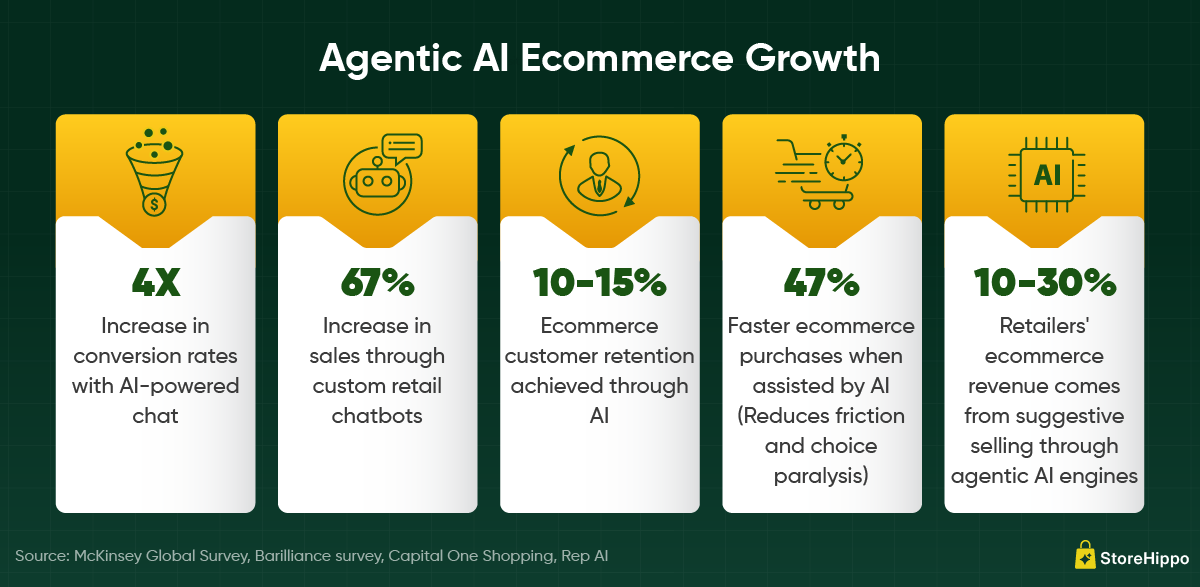
- 4X increase in conversion rates with AI-powered chat
- 67% increase in sales through custom retail chatbots
- 10% to 15% e-commerce customer retention achieved through AI
- 47% faster ecommerce purchases when assisted by AI ( reduces friction and choice paralysis)
- 10%-30% of retailers' ecommerce revenue comes from suggestive selling through agentic AI engines
Source: McKinsey Global Survey, Barilliance survey, Capital One Shopping, Rep AI
The picture is clear: Agentic AI has moved beyond experimentation to delivering real, measurable outcomes. Enterprises using agentic AI in their ecommerce operations are already seeing faster decision-making, higher conversions, improved customer experiences, and more efficient, scalable operations.
But before choosing agentic AI for ecommerce, enterprises should ask the right questions to select the most effective solution for their business needs.
10 Critical Questions Enterprises Should Ask to Future-Proof Ecommerce Operations with Agentic AI
Here are the 10 strategic FAQs to help enterprises evaluate the right agentic AI solution for scalable ecommerce operations.
1. What are the top five ecommerce operational areas where agentic AI is driving transformation for enterprise businesses?
Enterprise ecommerce operations span multiple high-impact functions where execution speed, accuracy, and scalability directly influence outcomes. To future-proof operations, enterprises should evaluate where agentic AI can drive the most measurable impact.
Key areas include:
- Catalogue Automation: Enterprises should look for AI capabilities that enable scalable product content creation, tagging, and structuring to reduce manual effort and improve consistency
- Intelligent Discovery: AI-driven search and recommendations should align product visibility with user intent to improve conversions
- Dynamic Pricing and Promotions: Pricing and offers should be continuously optimised based on demand signals and buyer behaviour
- Order Management: Enterprises should enable automated routing, fulfilment, and tracking to improve efficiency and turnaround time
- Customer Engagement:Conversational AI should support real-time, assisted buying journeys across touchpoints
In essence, agentic AI should transform core ecommerce functions into coordinated, intelligence-driven workflows rather than isolated processes.
With platforms like StoreHippo, these capabilities are delivered through a unified AI-native commerce engine that connects catalogue, discovery, orders, and customer interactions.
2. How can agentic AI for ecommerce reduce operational complexity across multi-channel businesses?
Multi-channel ecommerce introduces complexity across systems, workflows, and customer touchpoints. To manage this effectively, enterprises should evaluate how agentic AI enables unified and coordinated execution.
Key areas include:
- Cross-Channel Synchronisation: Enterprises should ensure AI can align catalogue, inventory, and order flows across web, mobile apps, marketplaces, and conversational interfaces
- Workflow Automation: Repetitive operational tasks should be automated to reduce manual effort and errors
- Consistent Execution: Pricing, promotions, and customer experiences should remain aligned across all channels
- Real-Time Adaptability: Systems should respond dynamically to changes in demand, behaviour, and operational inputs
In essence, agentic AI should reduce complexity by enabling unified, automated operations across all channels from a single operational layer.
With platforms like StoreHippo, this is supported through an AI-powered operational layer combined with an omnichannel-ready architecture.
3. What operational challenges indicate the need for agentic AI-powered ecommerce automation?
As enterprise ecommerce operations scale, inefficiencies begin to surface across systems, workflows, and execution layers. These challenges often signal the need for ecommerce automation and intelligent decision-making.
With agentic AI for ecommerce, enterprises can address these operational bottlenecks effectively:
Key areas include:
- Manual Dependencies: High reliance on manual processes for catalogue updates, pricing, and order management slows execution
- Fragmented Workflows: Disconnected systems create delays, inconsistencies, and operational gaps
- Slow Decision-Making: Lack of real-time insights limits the ability to respond quickly to market changes
- Inconsistent Customer Experiences: Variations across channels impact engagement and conversions
In essence, these challenges highlight the limits of manual and rule-based systems, making agentic AI essential for scalable and efficient ecommerce operations.
StoreHippo addresses these gaps with AI-driven automation, real-time decision engines, and a unified intelligence layer, enabling faster execution and reducing operational dependencies across ecommerce workflows.
4. How does agentic AI drive rapid, scalable growth for enterprise ecommerce businesses?
Enterprise growth depends on the ability to scale operations efficiently while continuously optimising execution. Enterprises should evaluate how agentic AI supports both speed and scalability.
Key areas include:
- Faster Go-To-Market: AI should enable quicker catalogue creation and onboarding processes
- Continuous Optimisation: Product discovery, recommendations, and buyer journeys should improve dynamically in real time
- Operational Scalability: Systems should handle increasing volumes without proportional increases in resources
- Intelligent Automation: Routine workflows across orders, inventory, fulfilment, and support are automated to reduce manual dependencies
In essence, agentic AI should enable growth by combining automation, real-time optimisation, and scalable execution.
StoreHippo combines AI-powered automation, intelligent recommendations, and agentic AI assistants with a scalable cloud-native architecture, enabling enterprises to achieve rapid, sustainable growth.
5. Can agentic AI solutions help unify fragmented ecommerce operations at scale?
Enterprise ecommerce operations are often distributed across multiple systems, leading to fragmentation and inefficiencies. Enterprises should assess whether agentic AI can unify these operations into a coordinated system.
Key areas include:
- Cross-System Coordination: AI should connect workflows across catalogue, inventory, orders, and fulfilment for real-time synchronisation
- Autonomous Order Routing: Orders should be assigned based on availability, proximity, or business logic without manual intervention
- Unified Customer Journeys: Experiences should remain consistent across web, mobile, marketplaces, and conversational channels
- Centralised Visibility: Enterprises should have a consolidated view of operations and performance
In essence, agentic AI should enable systems to function as a connected, intelligent ecosystem rather than isolated tools.
With platforms like StoreHippo, this is enabled through a unified AI-native commerce engine and shared intelligence layer connecting catalogues, discovery, orders, and customer interactions. Combined with its Multistore architecture and built-in integrations, it enables enterprises to manage complex, multi-channel operations from a single platform with complete control and scalability.
6. How does agentic AI for ecommerce enhance customer experience while optimising backend operations?
Enterprise ecommerce performance depends on aligning customer experience with backend execution. Enterprises should evaluate how agentic AI connects these layers effectively.
Key areas include:
- Personalised Interactions: AI should deliver intent-driven recommendations and tailored experiences in real time
- Conversational Buying Journeys: AI assistants should guide users through discovery, decision-making, and purchase
- Backend Alignment: Inventory, pricing, and fulfilment should dynamically adjust to demand
- Reduced Friction: Faster search, checkout, and processing should improve overall experience
In essence, agentic AI should ensure that customer-facing experiences are consistently supported by efficient backend operations.
With platforms like StoreHippo, this alignment is achieved through integrated AI-powered discovery, recommendations, and conversational assistants with backend automation.
7. What capabilities should enterprises look for in agentic AI solutions to future-proof ecommerce operations?
To future-proof ecommerce operations, enterprises should look for agentic AI solutions that are deeply embedded into the platform, not layered through disconnected tools.
Key areas include:
- End-To-End AI Automation (not point solutions): From AI-powered cataloguing to order processing and customer interactions, the system should automate complete workflows, not just isolated tasks.
- Autonomous Decision-Making Across Operations: Capabilities like intelligent product discovery, dynamic recommendations, and smart order handling should work in real time without manual intervention.
- Custom Conversational And Agentic AI Assistants: Enterprises should be able to build custom AI shopping assistants that guide users, handle queries, and even complete transactions within chat or voice interfaces.
- Unified Backend With AI Integration: Enterprises should look for a unified system that connects catalogue, inventory, orders, vendors, and channels, so AI can act across the entire ecommerce operations stack, not in silos.
- Composable, API-First AI Architecture: Enterprises should choose a composable, API first platform that offers flexibility to scale, customise, and evolve with new business models, geographies, and channels without rebuilding systems.
- Self-Learning Intelligence At Scale: Enterprises should choose AI capabilities that can continuously improves search, catalogue accuracy, personalisation, and operational efficiency with every interaction.
In essence, the right agentic AI solution should not just automate ecommerce operations, it should act as an intelligent, unified control layer that learns, adapts, and scales with your business.
With platforms like StoreHippo, agentic AI becomes a native operational layer that drives speed, scale, and intelligence across the entire ecommerce ecosystem
8. How does ecommerce automation powered by agentic AI impact cost efficiency and scalability?
Scaling ecommerce operations traditionally requires increases in resources and effort. Enterprises should evaluate how agentic AI improves both cost efficiency and scalability.
Key areas include:
- Reduced Manual Effort: Ecommerce automation should minimise dependency on large operational teams
- Efficient Resource Utilisation: AI should optimise the use of inventory, logistics, and system capacity
- Lower Operational Overhead: Reduced reliance on multiple tools and manual workflows
- Scalable Execution: Systems should handle higher demand without proportional cost increases
In essence, agentic AI should enable efficient scaling by aligning automation with resource optimisation.
StoreHippo reduces costs through AI-driven automation and built-in enterprise capabilities, while its cloud-native, scalable infrastructure ensures efficient growth without increasing operational complexity.
9. What is the impact of agentic AI on vendor, supplier, and marketplace ecosystem management?
Managing vendor and supplier ecosystems introduces complexity across onboarding, catalogue management, inventory, and fulfilment. Enterprises should evaluate how agentic AI streamlines these operations.
Key areas include:
- Automated Onboarding: AI should simplify vendor onboarding and catalogue creation processes
- AI powered Image Enhancement: AI should automatically improve and standardise product images across vendor catalogues for better quality and consistency.
- Custom Support AI Bots : AI assistants should help sellers with routine queries, onboarding steps, and operational guidance in real time.
- Workflow Automation: Orders, pricing, and fulfilment should be coordinated across vendors with AI core.
In essence, agentic AI should enable structured and efficient coordination across the entire marketplace ecosystem.
StoreHippo combines multi vendor marketplace capabilities with AI-powered automation, enabling seamless vendor management, automated cataloguing, and efficient coordination across large-scale supplier networks.
10. How can enterprises implement agentic AI in ecommerce operations without disrupting existing systems?
Enterprises can implement agentic AI in ecommerce operations without disruption by adopting a platform where AI is already embedded into the core architecture, rather than added as a separate layer.
With StoreHippo's AI-powered ecommerce platform, agentic AI is built into its core to work within existing workflows and systems, enabling seamless adoption without disrupting ongoing operations and downtime:
- API-First, Headless Architecture For Seamless Integration: StoreHippo’s composable, API-driven backend enables enterprises to plug AI capabilities into existing ERP, CRM, logistics, and payment gateways without rebuilding their stack.
- Gradual Rollout Across Use Cases: Businesses can start with high-impact areas like AI-powered cataloguing, search, recommendations or customer support, and expand to order management, pricing, and automation workflows over time.
- No Plugin Dependency Or System Fragmentation: Built-in AI capabilities eliminate the need for multiple third-party tools, ensuring stability and reducing integration risks during implementation.
- Low-Code Configuration For Faster Adoption: Teams can configure AI-driven workflows, rules, and automation without heavy development cycles, minimising disruption to ongoing ecommerce operations.
- Unified Backend With Parallel Execution: Existing operations continue uninterrupted while AI-driven processes are introduced and optimised in parallel, ensuring business continuity.
In essence, StoreHippo enables enterprises to layer in agentic AI as a natural extension of their ecommerce operations, without disruption, without replatforming delays, and without compromising scale or stability.
Conclusion
As ecommerce ecosystem expands across channels, geographies, and business models, operational complexity continues to increase. Manual workflows and disconnected systems are no longer sufficient to support the speed, scale, and consistency enterprises require.
Agentic AI is now emerging as the operational layer that enables ecommerce businesses to simplify execution, improve decision-making, and scale efficiently. Enterprises that adopt agentic AI for ecommerce can reduce operational dependencies, deliver more consistent customer experiences, and respond faster to changing market demands.
To achieve this, the focus should not just be on adopting AI, but on choosing an enterprise ecommerce platform where AI is deeply embedded into the core architecture and can run across the entire ecommerce ecosystem.
With StoreHippo, agentic AI functions as a unified intelligence layer across catalogue, discovery, orders, and customer journeys. Combined with a scalable, API-first architecture and built-in enterprise capabilities, it enables businesses to future-proof their ecommerce operations while maintaining flexibility and control.
Looking to build intelligent, automated, and scalable ecommerce operations?
Book your customised demo with StoreHippo today.