


Not long ago, selling FMCG products online meant managing a basic ecommerce store with limited products and delivery options. Today, businesses are building FMCG multi vendor marketplaces that bring together multiple sellers, large product catalogues, and faster fulfilment on a single platform. This helps them expand their reach while managing complex operations more efficiently.
The opportunity is growing fast. Consumers are increasingly buying groceries, personal care products, and household essentials online, while quick commerce is raising expectations for faster deliveries and better convenience. This has created new opportunities for businesses to launch scalable FMCG marketplaces.
Leading platforms like Blinkit, JioMart, BigBasket, Instamart, and Zepto show how successful FMCG marketplaces combine technology, efficient operations, and customer-focused experiences. Their growth highlights the key capabilities businesses need to manage sellers, inventory, fulfilment, and high-volume orders as they scale.
Table of Contents
Why FMCG Ecommerce in India Is Growing Faster Than Ever
Consumer buying habits have changed significantly over the last few years. Ordering groceries, personal care products, packaged foods, and household essentials online has become part of everyday life. Quick commerce, hyperlocal deliveries, and mobile-first shopping have further accelerated the growth of FMCG ecommerce across metros as well as Tier II and Tier III cities.
As more consumers choose the convenience of online shopping, businesses have a huge opportunity to build their own FMCG multi vendor marketplace. Before you launch, here are a few industry trends shaping the future of FMCG ecommerce in India.
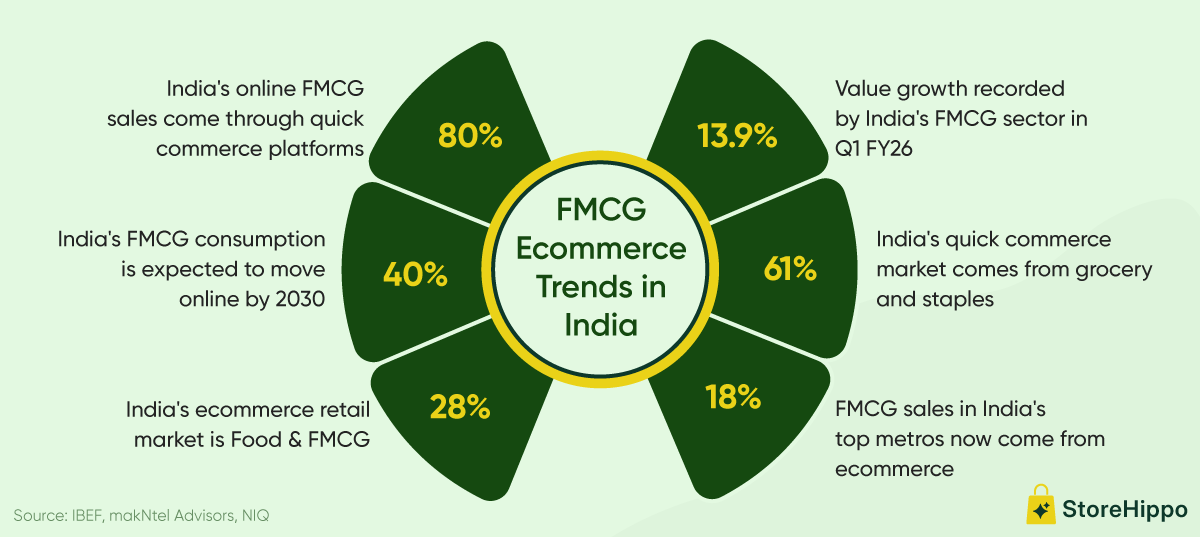
- 13.9% value growth recorded by India's FMCG sector in Q1 FY26 (source:IBEF)
- 61% of India's quick commerce market comes from grocery and staples (source: makNtel Advisors)
- 18% of FMCG sales in India's top metros now come from ecommerce (source: NIQ)
- 28% of India's ecommerce retail market is Food and FMCG (source: IBEF)
- 40% of India's FMCG consumption is expected to move online by 2030 (source: Economic Times)
- 80% of India's online FMCG sales now come through quick commerce platforms (source: NIQ)
These trends highlight a clear shift in consumer buying behaviour, making this the right time for FMCG businesses to build a scalable online marketplace.
Let's look at the ecommerce platforms leading this growth and what makes them successful.
The Top 5 FMCG Multi Vendor Marketplaces in India
Explore the top 5 FMCG multi vendor marketplaces in India and the strategies they use to lead the country's fast-growing online grocery and FMCG industry. 
1. Blinkit
Originally launched as Grofers in 2013, Blinkit has transformed from an online grocery platform into one of India's leading quick commerce marketplaces. Customers use Blinkit to order groceries, fresh produce, personal care products, household essentials, electronics, and other daily-use items with delivery in just a few minutes. Its strong network of dark stores and technology-driven operations have made it one of the most successful FMCG multi vendor marketplaces in India.
Blinkit Growth Stats
- ₹2,301 crore revenue from operations in FY25
- 1,301 dark stores across India
- 4.7 lakh+ average daily orders
- 90 million+ monthly active users
- Available in 80+ cities
Source: Eternal (Zomato) Annual Report, Economic Times
Blinkit's focus on rapid deliveries, smart inventory management, and expanding product categories has helped it redefine online grocery shopping and set new benchmarks for quick commerce in India.
2. JioMart
Launched by Reliance Retail, JioMart has emerged as one of India's fastest-growing online grocery and FMCG marketplaces. The platform offers groceries, fresh fruits and vegetables, packaged foods, personal care products, home essentials, electronics, and fashion through a seamless digital shopping experience. By combining its online marketplace with Reliance's vast retail network, JioMart has built a strong omnichannel presence across the country.
JioMart Growth Stats
- 4,000+ Reliance Retail stores supporting omnichannel fulfilment
- 19,000+ PIN codes served across India
- Millions of products across grocery and lifestyle categories
- Available in 1,000+ cities and towns
- Backed by India's largest retail network
Source: Reliance Industries Annual Report, Reliance Retail
JioMart continues to strengthen its position by connecting digital commerce with physical stores, giving customers greater convenience while helping sellers reach a wider audience.
3. Big Basket
BigBasket launched in 2011 and has become one of India's largest online grocery and FMCG marketplaces. It offers everything from fresh fruits and vegetables to packaged foods, dairy products, personal care items, household essentials, and gourmet products. With a wide product range, reliable delivery network, and multiple fulfilment models, BigBasket continues to help customers shop for groceries conveniently across India.
BigBasket Growth Stats
- 50 million+ registered customers
- 40,000+ products across 1,000+ brands
- Presence in 300+ cities and towns
- Thousands of daily deliveries across India
- Backed by Tata Digital
Source: Tata Digital, BigBasket
BigBasket has built customer trust by offering a wide product selection, dependable deliveries, and consistent shopping experiences across cities of different sizes.
4. Instamart
Instamart is Swiggy's quick commerce marketplace that enables customers to order groceries and everyday essentials with doorstep delivery in minutes. From fresh produce and packaged foods to personal care products, home essentials, and electronics, Instamart continues to expand its catalogue while serving customers across major Indian cities through a rapidly growing dark store network.
Instamart Growth Stats
- Available in 120+ cities
- 1,000+ dark stores across India
- Millions of monthly orders
- Thousands of products across multiple categories
- One of India's fastest-growing quick commerce platforms
Source: Swiggy Annual Report, Economic Times
Instamart combines Swiggy's logistics expertise with fast fulfilment and a growing product assortment, making it one of the leading FMCG marketplaces in the country.
5. Zepto
Founded in 2021, Zepto has rapidly become one of India's leading quick commerce marketplaces. It offers FMCG products, including groceries, fresh produce, personal care products, household essentials, dairy products, and everyday convenience items through its extensive network of dark stores. By using technology-driven operations and a quick delivery model, Zepto has built a loyal customer base in a short span of time.
Zepto Growth Stats
- Presence in 80+ cities
- 900+ dark stores across India
- Thousands of products across FMCG categories
- Millions of active customers
- Among India's fastest-growing quick commerce companies
Source: Zepto, Economic Times, Inc42
Zepto stands out by using smart technology, managing inventory efficiently, and delivering products quickly to make everyday shopping easier and more convenient for customers.
These successful marketplaces show how the right combination of technology, operations, and customer-focused strategies can drive FMCG ecommerce growth. If you want to build and scale your own FMCG multi vendor marketplace, let's explore the key capabilities you need to succeed.
How Can You Build a Successful FMCG Multi Vendor Marketplace in India?
Building a successful FMCG multi vendor marketplace in India requires an ecommerce platform that can manage multiple sellers, products, inventory, orders, deliveries, and customer experiences from one place. Choosing an enterprise ecommerce platform with built-in automation, AI capabilities, and enterprise-grade scalability helps you launch faster, streamline operations, and grow without technical limitations.
If you want to build an FMCG marketplace like BigBasket, Blinkit, JioMart, or Swiggy Instamart, you need more than a basic ecommerce website. Your platform should simplify vendor onboarding, automate inventory and order management, integrate with multiple payment gateways and logistics partners, and deliver fast, reliable shopping experiences. Your marketplace should support quick commerce, omnichannel selling, AI-powered automation, and high order volumes.
StoreHippo brings all these capabilities together in a single AI-powered enterprise ecommerce platform. With built-in multi-vendor management, 300+ enterprise features, 120+ integrations, omnichannel commerce, and a MACH architecture, it helps businesses launch, manage, and scale future-ready FMCG marketplaces with ease.
Why Choose StoreHippo to Build Your FMCG Marketplace App?
StoreHippo helps businesses build and scale high-performance FMCG marketplaces without relying on multiple third-party tools or custom development. From onboarding vendors and managing large product catalogues to automating inventory, logistics, and order fulfilment, it enables businesses to manage their FMCG products business from a unified platform.
Whether you're launching a grocery marketplace, a hyperlocal FMCG multivendor marketplace, a wholesale marketplace, or an omnichannel commerce ecosystem, StoreHippo provides the flexibility, automation, and enterprise scalability required to support rapid business growth.
Everything You Need to Build and Scale an FMCG Marketplace:
StoreHippo offers enterprise-grade capabilities in a single AI-powered ecommerce platform, including:
- Complete Multi Vendor Management to onboard suppliers, distributors, retailers, and brands while managing products, commissions, settlements, orders, and inventory from one central dashboard.
- AI-Powered Commerce with intelligent product discovery, semantic search, personalised recommendations, AI-powered image editing and catalogue creation, and the capability to build custom AI agents to simplify operations and improve customer experiences.
- Inventory and Order Automation to manage thousands of fast-moving SKUs across multiple stores and vendors with real-time inventory visibility and automated order processing.
- Omnichannel Commerce to sell through websites, mobile apps, WhatsApp, and other channels while delivering a consistent shopping experience across every touchpoint.
- Hyperlocal and Multi-Location Fulfilment with integrated logistics partners, location-based order routing, live tracking, scheduled deliveries, and faster fulfilment to meet growing customer expectations.
- Multi Store Management to launch region-specific, language-specific, or brand-specific storefronts while managing the entire business from a single admin panel.
- Built-In Mobile App Builder to launch Android apps, iOS apps, and Progressive Web Apps (PWAs) without additional development, helping businesses reach India's mobile-first consumers.
- Integrated Payment solutions with Multiple payment gateways, automated settlements, shipping partners, and smart fulfilment workflows that simplify day-to-day marketplace operations.
- Integrated Payment Solutions with multiple payment gateways, automated settlements, secure transactions, and flexible payment workflows that simplify payments for customers and streamline marketplace operations.
- Enterprise-Ready Architecture powered by MACH principles, headless commerce capabilities, and 300+ APIs that enable seamless integrations, customisations, and long-term scalability.
With built-in enterprise features, StoreHippo eliminates plugin dependency and reduces development effort, helping businesses launch FMCG marketplaces faster and scale confidently.
Conclusion
The FMCG ecommerce landscape is evolving rapidly, creating new opportunities for businesses to build scalable marketplaces and reach a wider customer base. As consumer expectations continue to rise, long-term success will depend on how efficiently you manage sellers, fulfil orders, and deliver consistent shopping experiences at scale. Choosing the right ecommerce platform from the start helps reduce operational complexity and prepares your business for future growth.
Ready to discover how you can launch and scale a high-performing FMCG multi vendor marketplace?
Book a personalised demo with StoreHippo now.
FAQs
1. Why should enterprises consider building a hyperlocal marketplace for fast-moving consumer goods?
Enterprises should consider building a hyperlocal marketplace for fast-moving consumer goods because it enables faster deliveries, expands local seller networks, and meets growing consumer demand for convenience. It also helps businesses increase order volumes, improve customer retention, optimise last-mile fulfilment, and create new revenue opportunities while scaling across multiple locations.
Building a hyperlocal marketplace for FMCG products comes with the following benefits:
- Less capital required
- Warehouse not required
- Lower logistics costs as delivery happens to nearby locations
- Quick and smooth delivery process
- More vendors equal more profits
2. How can enterprises start a hyperlocal FMCG products multi vendor marketplace like Big Basket?
Enterprises can start a hyperlocal FMCG products multi vendor marketplace like BigBasket by choosing a scalable multi-vendor ecommerce platform, onboarding local sellers, integrating hyperlocal logistics, enabling real-time inventory management, and offering multiple payment options. AI-powered product discovery, mobile apps, and automated order fulfilment further help deliver a seamless shopping experience and scale the marketplace faster. The StoreHippo ecommerce solutions offer powerful features like end-to-end vendor management, a built-in discount engine, adaptive payments, etc to help brands run and manage their business seamlessly.
3. What features should an FMCG multi vendor marketplace have?
An FMCG multi vendor marketplace should have features like vendor management, real-time inventory tracking, automated order processing, multiple payment options, logistics integrations, mobile commerce capabilities, and AI-powered personalisation. These features help businesses manage large product catalogues, streamline operations, improve fulfilment speed, and deliver better customer experiences as the marketplace grows.
4. How can AI help grow an FMCG multi vendor marketplace?
AI can help FMCG multi vendor marketplaces improve product discovery, personalise shopping experiences, automate catalogue management, optimise inventory, and streamline customer support. AI-powered recommendations, intelligent search, demand insights, and automation help businesses increase conversions, reduce manual effort, and manage large-scale marketplace operations more efficiently.
5. How can enterprises offer personalisations on their FMCG multi vendor marketplace?
Enterprises can offer personalisation on their FMCG multi vendor marketplace by using customer data, AI-powered recommendations, and personalised marketing to show relevant products, offers, and shopping experiences. AI can analyse browsing behaviour, purchase history, location, and preferences to suggest products, create targeted promotions, and improve customer engagement.
Pallavee Kumar brings over 20 years of hands-on ecommerce experience, having helped B2B, B2C, and enterprise brands scale through strong operations and clear storytelling.
She blends strategic thinking with practical execution to help complex commerce ecosystems grow with clarity, speed, and real business impact.