


Hyperlocal ecommerce is changing the way businesses connect with customers. It is no longer simply about delivering an order faster. It is about showing customers what is available near them, connecting them with the right sellers, and ensuring every order reaches them through the most suitable fulfilment option.
As local shopping and mobile commerce continue to gain momentum, enterprises need more than a website. A connected ecommerce store and hyperlocal app can help businesses manage multiple locations, sellers, inventory, delivery zones and customer interactions from a single ecosystem.
But scaling local commerce comes with its own set of challenges. Managing location-based inventory, seller operations, logistics, payments and customer experiences across different channels can quickly become complicated. This is where the right hyperlocal marketplace software can make a real difference by bringing these moving parts together while keeping operations manageable.
In this guide, we’ll explore how enterprises can build a scalable hyperlocal ecommerce store and app, the capabilities they should look for, and how the right technology can help turn local demand into sustainable business growth.
Before going into details, let us first check the hyperlocal ecommerce market growth, trends and opportunities for business growth.
Table of Contents
- Hyperlocal Ecommerce: The Enterprise Opportunity Behind the Shift
- What Is a Hyperlocal Ecommerce Store?
- Steps to Build a Hyperlocal Ecommerce Store and App
- 1. Define Your Hyperlocal Business Model
- 2. Choose Your Target Market and Locations
- 3. Choose a Hyperlocal Marketplace Platform
- 4. Onboard Local Sellers and Manage Their Catalogues
- 5. Set Up Location-Based Inventory and Serviceability
- 6. Build the Hyperlocal Ecommerce Store
- 7. Develop the Hyperlocal Marketplace App
- 8. Integrate Payments and Hyperlocal Logistics
- 9. Add AI-Powered Commerce Capabilities
- 10. Enable Omnichannel Selling
- 11. Add Marketing and Customer Engagement Tools
- 12. Test, Launch and Scale
- How StoreHippo Helps You Build and Scale a Hyperlocal Ecommerce Store and App
- 1. Built-in Hyperlocal Marketplace Capabilities
- 2. Multi-Location Store Management
- 3. Multi-Vendor Management
- 4. AI-Powered Hyperlocal Shopping Experiences
- 5. Unified Omnichannel Commerce
- 6. Location-Based Inventory and Serviceability
- 7. Integrated Hyperlocal Logistics
- 8. Flexible Payments and Seamless Checkout
- 9. Built-in Marketing and Customer Engagement
- 10. Seamless Integrations for Connected Operations
- Conclusion
- FAQs
Hyperlocal Ecommerce: The Enterprise Opportunity Behind the Shift
Hyperlocal ecommerce is expanding rapidly as shoppers are conditioned to faster delivery and more convenient access to products available in their area. Also mobile is now the primary shopping channel, making the hyperlocal store and app combination even more important for enterprises.
Here are some trends that reflect the market sentiments:
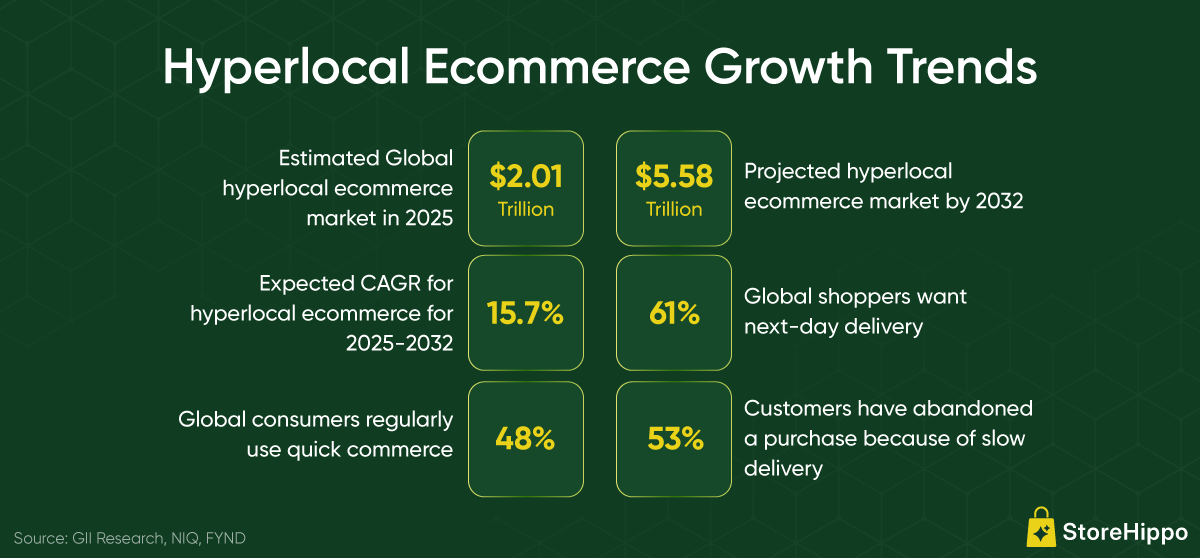
- $2.01T was the estimated Global hyperlocal ecommerce market in 2025
- $5.58T is the projected hyperlocal ecommerce market by 2032
- 15.7% is the expected CAGR for hyperlocal ecommerce for 2025-2032
- 61% of global shoppers want next-day delivery
- 48% of Global consumers regularly use quick commerce
- 53% of customers have abandoned a purchase because of slow delivery
Source: GII Research, NIQ, FYND
What it shows: Customers increasingly expect ecommerce to be not just convenient, but local, fast and responsive to their immediate needs. For enterprises, this creates an opportunity to connect customers with nearby stores, products and fulfilment options through a more localised shopping experience.
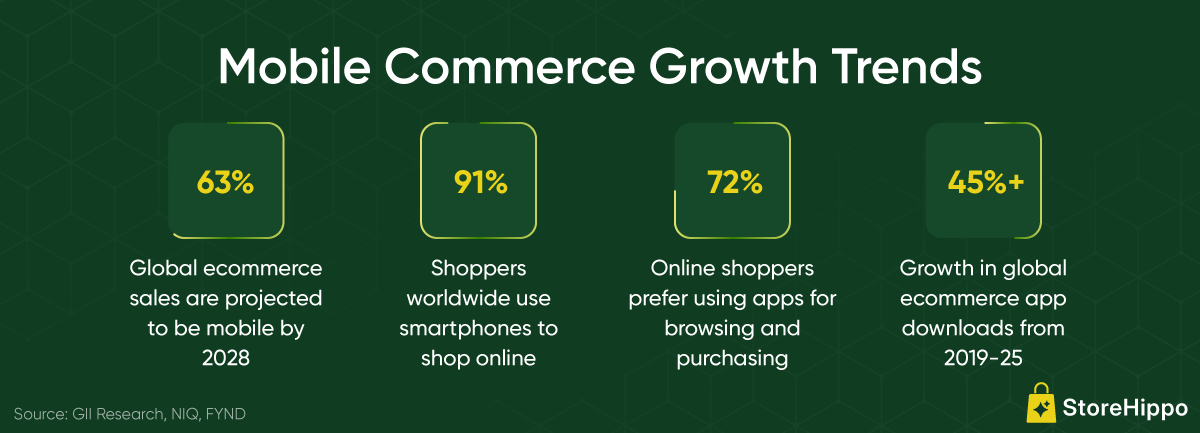
- 63% of global ecommerce sales are projected to be mobile by 2028
- 91% of Shoppers worldwide use smartphones to shop online
- 72% of online shoppers prefer using apps for browsing and purchasing
- 45%+ growth in global ecommerce app downloads from 2019 to 2025
Source: Oberlo, Deutsche Post, DHL, Sensor Tower
What it shows: As mobile shopping grows, apps can help enterprises make hyperlocal commerce more accessible, convenient and scalable by connecting shoppers with nearby products, sellers and fulfilment options.
What Is a Hyperlocal Ecommerce Store?
A hyperlocal ecommerce store is an online store that connects customers with products or services available within a specific local area. Instead of serving customers across a large geographic region, it focuses on nearby neighbourhoods, cities, pin codes or delivery zones. A hyperlocal store helps customers discover products in their local area, check availability, place orders online and receive deliveries from nearby sellers or stores.
For enterprises, this model can bring online convenience to local shopping while helping them work with multiple stores, dealers, distributors or local sellers. With the right hyperlocal ecommerce setup, an enterprise can manage products, inventory, orders and customers across different locations while giving shoppers a more relevant experience based on where they are.
For enterprises looking to expand their local reach, having a geo-targeted ecommerce store and hyperlocal app together makes it easier to engage, convert and retain local customers. Having multi-channel business presence also gives businesses better control over local sales and fulfilment.
Why Should Enterprises Planning Geo-Targeted Online Stores also Have a Hyperlocal App
Enterprises planning geo-targeted online stores should consider having a hyperlocal app because it gives customers a faster way to discover nearby products, check availability, place orders and track deliveries. It also gives enterprises a direct channel to engage customers, promote local offers and encourage repeat purchases.
A hyperlocal app can help enterprises strengthen their local presence while connecting customers with multiple sellers, stores and products in their area.
Here are some key benefits:
- Make local shopping more convenient: Customers can browse nearby products, check availability, place orders and track deliveries directly from their smartphones.
- Improve location-based discovery: Use customer location, pin codes or delivery zones to show relevant products and sellers available in their area.
- Drive repeat purchases: Push notifications, saved preferences, easy reordering and personalised offers can encourage customers to return to the app.
- Promote local offers: Enterprises can run location-specific discounts, coupons and promotions based on customer preferences and local demand.
- Connect multiple sellers and stores: A hyperlocal app can bring products from different stores, dealers or sellers together, giving customers more choice from a single platform.
- Support faster fulfilment: By connecting orders with nearby inventory and delivery partners, enterprises can improve order processing and offer more convenient delivery options.
- Build a stronger omnichannel presence: Connect the app with the ecommerce website, WhatsApp, physical stores, partner portals and other channels to give customers a consistent shopping experience.
Steps to Build a Hyperlocal Ecommerce Store and App
Building a successful hyperlocal ecommerce business requires more than just setting up an online store and app.
Follow these proven steps to bring local sellers, customers, inventory and deliveries together and create a seamless shopping experience:
1. Define Your Hyperlocal Business Model
The first step in building a hyperlocal ecommerce business is identifying your target customers, product categories, service area, seller types, fulfilment model and revenue streams. When you are sure about your business model, it will make it easier to decide how your store and app should work as you grow.
2. Choose Your Target Market and Locations
Now that you are clear on what your hyperlocal ecommerce business will offer and who it will serve, it's time to choose your target markets and service locations. Decide whether you want to start with a neighbourhood, city, multiple cities or specific pin codes. Identify the local sellers you want to bring on board and understand the demand, competition and delivery expectations in each location before expanding further.
3. Choose a Hyperlocal Marketplace Platform
Now comes the third and one of the most important steps- choosing the right hyperlocal marketplace software. As the technology you choose to build your hyperlocal app or store can make a big difference, you should carefully evaluate the features of the platform you choose. Choose the hyperlocal ecommerce platform that supports multiple sellers, location-based selling, inventory management, payments, logistics, mobile commerce and third-party integrations. The right enterprise ecommerce platform should help you manage your store and app without creating unnecessary technology challenges.
4. Onboard Local Sellers and Manage Their Catalogues
Create seller onboarding workflows and enable sellers to add products, manage pricing, update inventory and process orders from their dashboards. Give sellers easy-to-use dashboards where they can add products, manage prices, update inventory, process orders and track fulfilment. Standardised catalogue and seller management also help you maintain a consistent shopping experience across the platform.
5. Set Up Location-Based Inventory and Serviceability
After seller onboarding for your hyperlocal ecommerce store, connect products and inventory to specific stores, sellers, pin codes, or delivery zones. This allows customers to see products that are actually available in their location. It also helps sellers manage orders based on their delivery areas and avoid accepting orders they cannot fulfil.
6. Build the Hyperlocal Ecommerce Store
When sellers are onboarded, and inventory and products are mapped to specific locations, build a responsive ecommerce storefront that makes local discovery quick and convenient. Add features to your hyperlocal ecommerce marketplace that make it easy for customers to select their location, find nearby products, search and filter listings, view seller information, add products to their cart, complete checkout and track orders. Keep the experience simple, especially for customers shopping on mobile devices.
7. Develop the Hyperlocal Marketplace App
Once your hyperlocal ecommerce store is ready, the next step is to build a hyperlocal app that makes shopping more convenient for customers on mobile devices. Build Android and iOS apps with features such as location detection, personalised recommendations, push notifications, mobile payments, order tracking and easy reordering. Make sure the app offers a smooth shopping experience and keeps product availability and order information updated in real time.
8. Integrate Payments and Hyperlocal Logistics
A smooth payment and delivery experience is essential for any hyperlocal ecommerce business. Integrate secure payment gateways and multiple delivery partners to manage order fulfilment, delivery assignment, serviceability, real-time tracking and returns. This gives customers more reliable checkout and delivery options while helping you manage orders efficiently across different locations.
9. Add AI-Powered Commerce Capabilities
Make your hyperlocal ecommerce store more personalised and easier to use by adding AI-powered search, personalised recommendations, automated catalogue management, AI shopping assistance and intelligent product discovery. These capabilities help customers find relevant products faster while reducing manual catalogue management and improving the overall shopping experience.
10. Enable Omnichannel Selling
Expand your hyperlocal ecommerce reach by connecting your web store and hyperlocal app with WhatsApp, partner portals, AI channels and other customer touchpoints. This makes it easier for customers to discover products, interact with sellers and place orders through the channels they already use, while helping you manage these channels from a single platform.
11. Add Marketing and Customer Engagement Tools
Now is the time to promote your hyperlocal ecommerce store and hyperlocal app and encourage customers to shop again. Use coupons, discounts, QR codes, personalised offers, loyalty programmes, abandoned-cart campaigns and location-based promotions to reach the right customers with relevant offers and drive repeat purchases.
12. Test, Launch and Scale
Before launching your hyperlocal ecommerce store and app, test the complete customer and seller journey, including inventory, payments, order processing, delivery and app performance. Start with a focused location, track key metrics and customer feedback, fix any gaps you identify, and then expand into new locations, sellers and product categories.
How StoreHippo Helps You Build and Scale a Hyperlocal Ecommerce Store and App
StoreHippo helps enterprises build powerful hyperlocal ecommerce stores and apps that connect local sellers with customers in their targeted locations. From managing multiple sellers and location-based inventory to enabling AI commerce, launching mobile apps and supporting faster deliveries, StoreHippo makes it easier for enterprises to manage local operations, offer personalised shopping experiences and expand into new markets.
Here’s how StoreHippo helps enterprises build and grow their hyperlocal business:
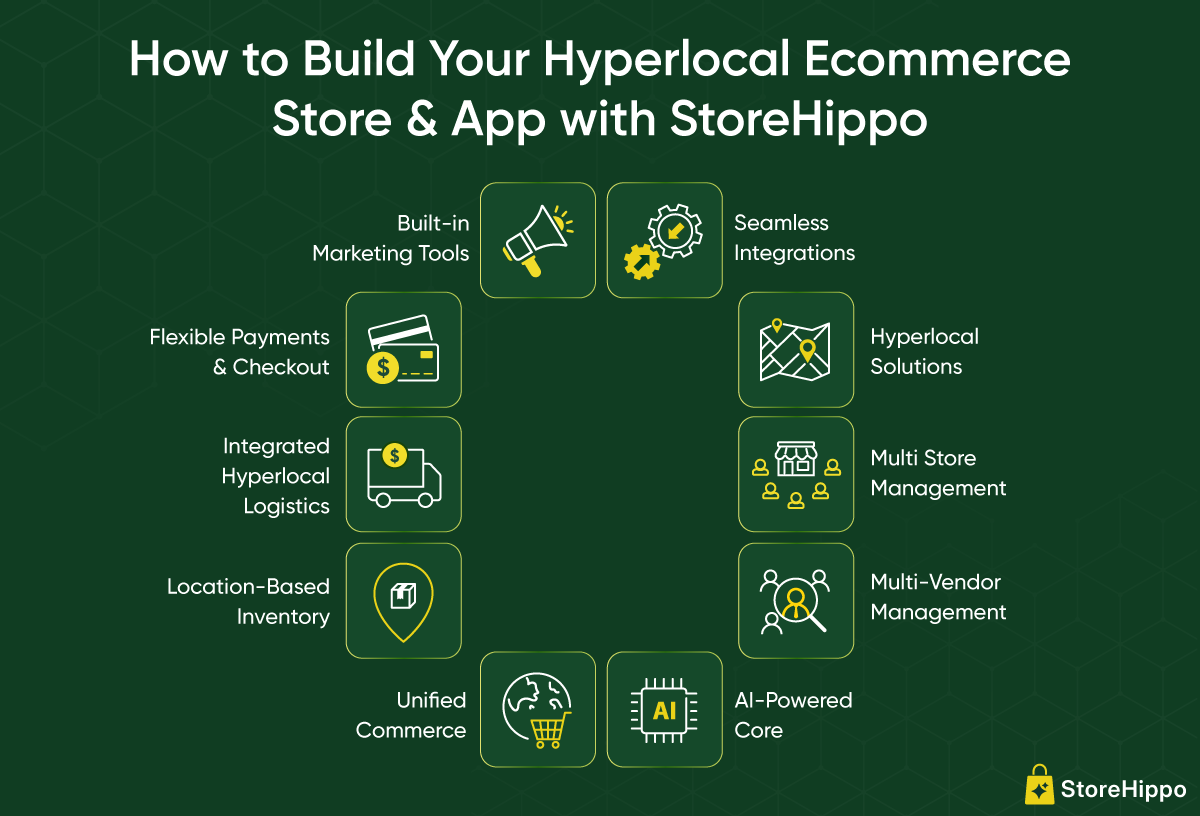
1. Built-in Hyperlocal Marketplace Capabilities
StoreHippo offers built-in hyperlocal ecommerce solutions that make it easier for enterprises to build and manage a hyperlocal marketplace with multiple sellers, stores, dealers or distributors. Enterprises can create location-based storefronts, assign sellers to specific areas and manage products, orders and customers from a centralised platform.
Its built-in geolocation capabilities help enterprises show customers products and sellers based on their location, making local product discovery and fulfilment easier. Built on MACH and headless architecture, StoreHippo also gives enterprises the flexibility to support different business models, including B2B, B2C, D2C, B2B2C, marketplace and hybrid models, as their business grows.
2. Multi-Location Store Management
Expanding the hyperlocal marketplace from one region to multiple cities does not have to mean managing completely separate ecommerce systems. StoreHippo’s multi-store capabilities enable enterprises to create multiple location-based sub-stores while managing them from a unified admin dashboard
Enterprises can set different themes, product catalogues, sellers, prices, offers, payment options and shipping rules for each location. This gives each market the flexibility to cater to local customer needs while keeping the overall ecommerce operations under centralised control.
3. Multi-Vendor Management
A strong network of local sellers is essential for enterprises looking to build and scale a successful hyperlocal ecommerce business. StoreHippo helps enterprises onboard and manage multiple vendors through dedicated seller dashboards. Sellers can add products, manage inventory, update pricing and process orders, while enterprises can maintain central control over marketplace operations. This makes it easier to bring more local businesses onto the platform as the network grows.
4. AI-Powered Hyperlocal Shopping Experiences
AI can make local ecommerce experiences much more relevant by helping customers find the right products faster. StoreHippo enables enterprises to build an AI-powered hyperlocal marketplace with AI-powered search and personalised recommendations. These capabilities help customers discover relevant products based on their intent, preferences and shopping behaviour instead of making them browse through endless product listings.
By leveraging StoreHippo’s agentic commerce capabilities, enterprises can build custom AI shopping assistants to help customers discover products, get relevant recommendations and make faster purchase decisions. They can also deploy custom AI agents to handle buyer queries and provide support before and after purchases.
5. Unified Omnichannel Commerce
StoreHippo’s AI-powered hyperlocal marketplace platform enables enterprises to expand their hyperlocal business across multiple sales channels, including web stores, PWA stores, mobile apps, WhatsApp Business and emerging AI-powered channels. Its built-in mobile app builder makes it easy to launch branded mobile apps directly from the admin dashboard, while enterprises can also connect their WhatsApp Business account and sell through emerging AI-powered channels.
Enterprises can manage all these channels through a unified omnichannel setup, giving them centralised control over catalogues, inventory, orders, customers and other ecommerce operations while maintaining a consistent shopping experience across every touchpoint.
6. Location-Based Inventory and Serviceability
Showing customers products that are not available or cannot be delivered to their location can lead to a poor shopping experience. StoreHippo helps enterprises connect products and inventory to specific sellers, stores, locations and delivery zones.
Enterprises can set serviceable areas and manage inventory based on location, making it easier for customers to find products that are available for delivery in their area. This also helps enterprises manage orders more efficiently and avoid fulfilment issues.
7. Integrated Hyperlocal Logistics
Fast and reliable fulfilment is one of the key factors in scaling a hyperlocal business. StoreHippo lets enterprises connect with 30+ built-in nationwide and hyperlocal logistics partners or integrate their preferred delivery providers to fulfil orders across different locations.
Enterprises can use location-based and rule-based shipping to assign orders to the right delivery partner based on factors such as location, serviceability, cost and delivery timelines. Automated order routing can further help direct orders to the appropriate seller, store or fulfilment location, making last-mile delivery faster and easier to manage.
8. Flexible Payments and Seamless Checkout
A simple and convenient checkout can make it easier for customers to complete their purchases. StoreHippo supports multiple payment options through its pre-integrated payment gateways, giving customers the flexibility to pay using their preferred method.
Enterprises can offer options such as cards, net banking, UPI and digital wallets across their hyperlocal ecommerce store and app, making the checkout process easier for customers across different locations.
9. Built-in Marketing and Customer Engagement
Hyperlocal businesses need more than just a digital storefront to keep customers coming back. StoreHippo hyperlocal marketplace software provides built-in marketing tools that enterprises can use to create location-based promotions, discounts, coupons, personalised offers and QR-code campaigns.
Enterprises can also use customer data and purchase behaviour to create personalised recommendations and targeted communications, helping local customers discover relevant products and offers.
10. Seamless Integrations for Connected Operations
Running a hyperlocal ecommerce business involves managing products, sellers, orders, payments, deliveries and customer data across different systems. Enterprises can connect their ecommerce platform with ERP, CRM, accounting systems, payment gateways, logistics providers and other business applications.
StoreHippo’s headless architecture and APIs make it easier to integrate these systems with the ecommerce platform. This helps enterprises bring their existing tools together, streamline day-to-day operations and manage their hyperlocal business more efficiently.
Conclusion
Building a successful hyperlocal ecommerce business is about bringing local discovery, mobile shopping and faster fulfilment together in one connected experience. From choosing the right business model and onboarding local sellers to managing location-based inventory, logistics, AI-powered experiences and multiple sales channels, every part needs to work together as the business scales.
The right hyperlocal marketplace software can make this easier by giving enterprises the flexibility to manage multiple locations, sellers, products and customer touchpoints from a unified platform. With the right technology in place, enterprises can start with a focused market and expand their hyperlocal presence without adding unnecessary operational overhead.
Want to build an AI-powered hyperlocal marketplace that is ready to scale?
Book a personalised demo with StoreHippo now.
FAQs
1. What should enterprises evaluate before investing in a hyperlocal ecommerce platform?
Enterprises should evaluate scalability, integration capabilities, security, customisation, total cost of ownership and long-term flexibility before investing in a hyperlocal ecommerce platform. They should also assess whether the platform can support their expansion plans, connect with existing business systems and adapt to changing customer and market requirements.
2. How can enterprises tailor hyperlocal ecommerce experiences for different locations at scale?
Enterprises can tailor hyperlocal ecommerce experiences by using customer location, browsing behaviour, purchase history and local demand to personalise products, offers, recommendations and content. Location-based segmentation and automated marketing can help deliver relevant experiences across multiple markets without requiring separate campaigns for every location.
3. What technology challenges can enterprises face when scaling hyperlocal ecommerce across multiple cities?
Enterprises can face challenges with multi-location inventory, seller management, integrations, data synchronisation, order routing, logistics and platform scalability when expanding hyperlocal ecommerce across multiple cities. A flexible technology setup can help manage these complexities without requiring separate systems for each location.
4. How can AI help enterprises make better decisions in hyperlocal ecommerce?
AI can help enterprises analyse customer behaviour, local demand, product performance and market trends to make faster, data-driven decisions. It can also identify patterns that help enterprises improve product assortment, pricing, promotions, inventory planning and customer experiences across different locations.
5. How can enterprises future-proof their hyperlocal ecommerce strategy?
Enterprises can future-proof their hyperlocal ecommerce strategy by choosing flexible technology that can adapt to new locations, sales channels, business models, customer expectations and emerging technologies. They should also prioritise scalable integrations, AI capabilities, mobile commerce and data-driven decision-making from the start.
6. What should enterprises look for in hyperlocal marketplace software as they scale?
Enterprises should look for scalability, multi-location management, seller management, flexible integrations, AI capabilities, omnichannel support and strong security in hyperlocal marketplace software. The platform should also make it easy to add new sellers, locations, products and customer touchpoints without creating unnecessary technology challenges.
Binny Joseph is a seasoned ecommerce and enterprise growth leader, serving as Senior Vice President of Sales & Alliances with deep experience helping global brands adopt modern commerce solutions.
He writes about hyperlocal ecommerce, and the technology strategies businesses need to build scalable, location-based commerce ecosystems that deliver faster fulfilment and better customer experiences.