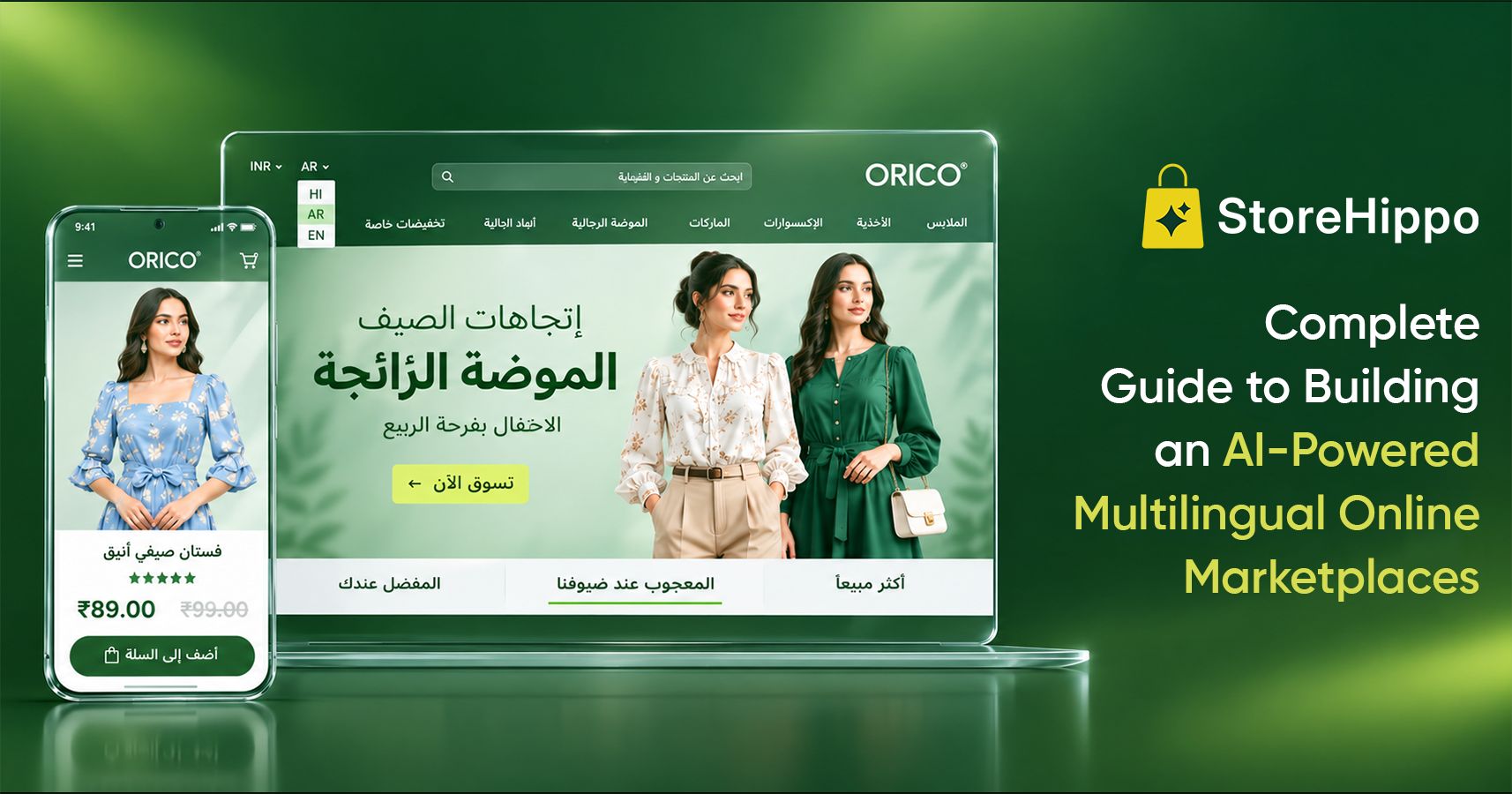



Nearly 50% of websites use English as their content language, yet 76% of online shoppers prefer buying products in their native language. For enterprises building an online marketplace for global buyers, that's a gap worth paying attention to.
Think about it. A buyer in Japan discovers an Indian fashion brand. A shopper in France wants Korean skincare products. A customer in Dubai is exploring European furniture. The demand crosses borders, but will these buyers complete a purchase if they can't understand product details, compare prices in familiar currencies or use their preferred payment methods?
That's why building a multilingual marketplace is about much more than translating your website. Enterprises need to deliver localised shopping experiences across countries while managing sellers, catalogues, orders, payments and fulfilment from a central platform.
With multilingual ecommerce capabilities and AI simplifying translations, product discovery and personalised shopping, businesses now have more ways to reach international customers without multiplying operational overhead.
So, how do you build a scalable AI-powered marketplace and marketplace app that feels local to buyers everywhere? Let's explore the essential features, technology and steps involved.
Table of Contents
- How Multilingual Ecommerce Is Transforming Cross-Border Shopping
- What is a Multilingual Online Marketplace
- Benefits of Building a Multilingual Ecommerce Marketplace for your enterprise business
- How to Build a Multilingual Online Marketplace for Global Growth
- 1. Identify Your Target Markets and Languages
- 2. Choose a Multilingual Ecommerce Platform
- 3. Translate your Multilingual Online Marketplace And App
- 4. Localise Product Catalogues
- 5. Customise the Shopping Experience
- 6. Manage TAX and Regulatory Compliance
- 7. Configure Shipping and Delivery
- 8. Optimise Your Marketplace for Multilingual SEO
- 9. Localise Customer Support
- 10. Test, Launch, and Scale
- Conclusion
- FAQs
How Multilingual Ecommerce Is Transforming Cross-Border Shopping
As more businesses sell across borders, speaking customers’ languages becomes increasingly important. These statistics show how multilingual websites and localised content can help businesses reach more customers, build trust, and drive sales.
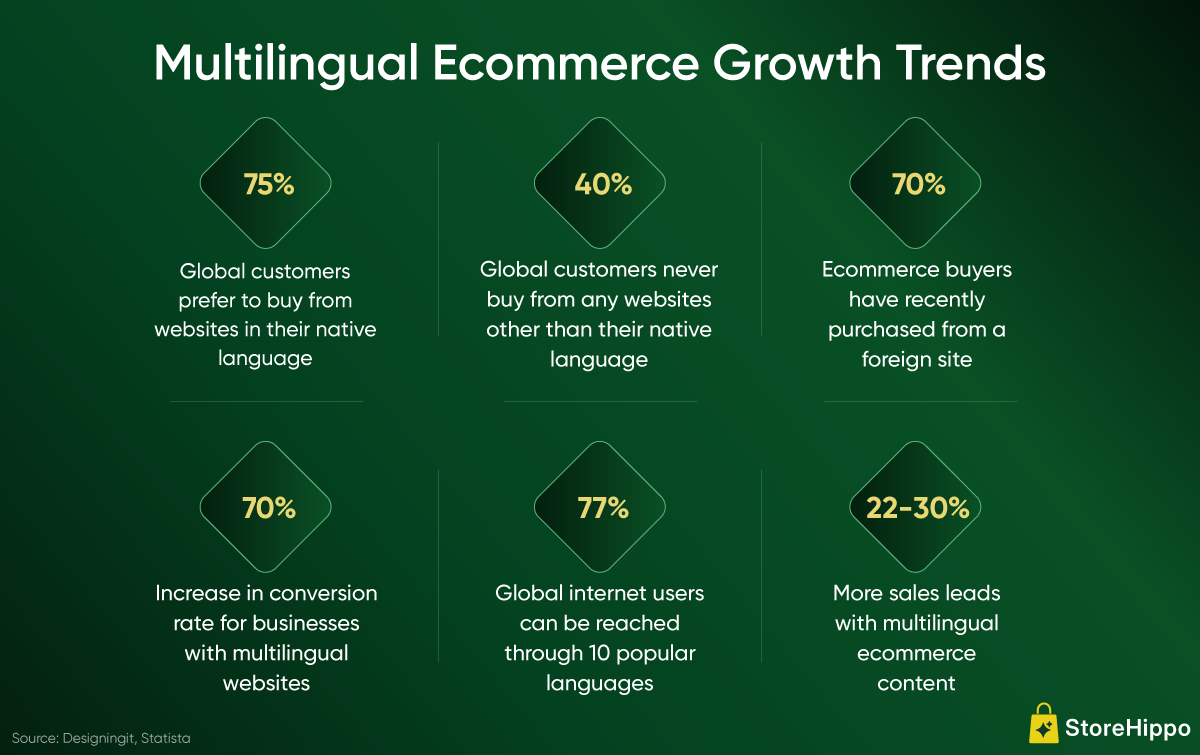
- 75% of global customers prefer to buy from websites in their native language
- 40% of global customers never buy from any websites other than their native language
- 70% of ecommerce buyers have recently purchased from a foreign site
- 70% increase in conversion rate for businesses with multilingual websites
- 77% of global internet users can be reached through 10 popular languages.
- 22–30% more sales leads with multilingual ecommerce content.
Source: Designingit, Statista
These trends show that language can make a real difference in how customers find, trust, and buy from international brands. For businesses looking to expand globally, a multilingual ecommerce website makes shopping easier for customers across different markets and helps businesses connect with a wider audience.
What is a Multilingual Online Marketplace
A multilingual online marketplace is a multi vendor website that enables customers to browse products, explore categories, and shop in their preferred languages. It brings multiple sellers and buyers together while making the shopping experience easier for people from different countries and regions.
Unlike a single-language marketplace, a multilingual marketplace displays key shopping information, such as product descriptions, category names, navigation menus, and checkout instructions, in multiple languages. This helps customers understand product details, compare options, and make informed purchasing decisions without language barriers.
For businesses, a multilingual marketplace creates opportunities to reach international audiences, connect with regional customers, and expand into new markets. Features such as localised content, multiple currencies, and region-specific payment options can further improve the shopping experience and help businesses build trust with diverse customer groups.
Benefits of Building a Multilingual Ecommerce Marketplace for your enterprise business
Building a multilingual ecommerce marketplace helps enterprise businesses connect with diverse audiences and expand beyond language and geographical barriers. From improving customer experience to driving international sales, here are the key benefits of offering a multilingual shopping experience:
1. Reach Global Markets: Expand into new countries and connect with customers across different regions.
2. Improve Customer Experience: Let shoppers browse products and navigate your marketplace in their preferred language.
3. Build Customer Trust: Make product information easier to understand and help buyers make confident purchasing decisions.
4. Increase Conversions: Reduce language barriers that may prevent customers from completing their purchases.
5. Boost Customer Engagement: Connect with buyers through localised product descriptions, content, and shopping experiences.
6. Strengthen Brand Loyalty: Make customers feel valued by offering a familiar and accessible shopping experience.
7. Expand Market Reach: Target diverse language-speaking audiences without building separate marketplaces for each region.
8. Gain a Competitive Advantage: Stand out from competitors that offer limited language options.
9. Support Cross-Border Sales: Make it easier for international customers to discover products and shop from different sellers.
10. Scale Business Operations: Manage multiple language experiences through a centralised marketplace platform as your enterprise expands.
With a multilingual online marketplace, you can grow your business and open your brand to global opportunities. All you need is a multilingual ecommerce platform to help you either build a multilingual marketplace or convert your marketplace into multiple languages seamlessly.
How to Build a Multilingual Online Marketplace for Global Growth
Building a multilingual online marketplace is about more than translating your website content. You need to understand your customers, make shopping easy in their preferred languages, and create an experience that feels familiar across markets.
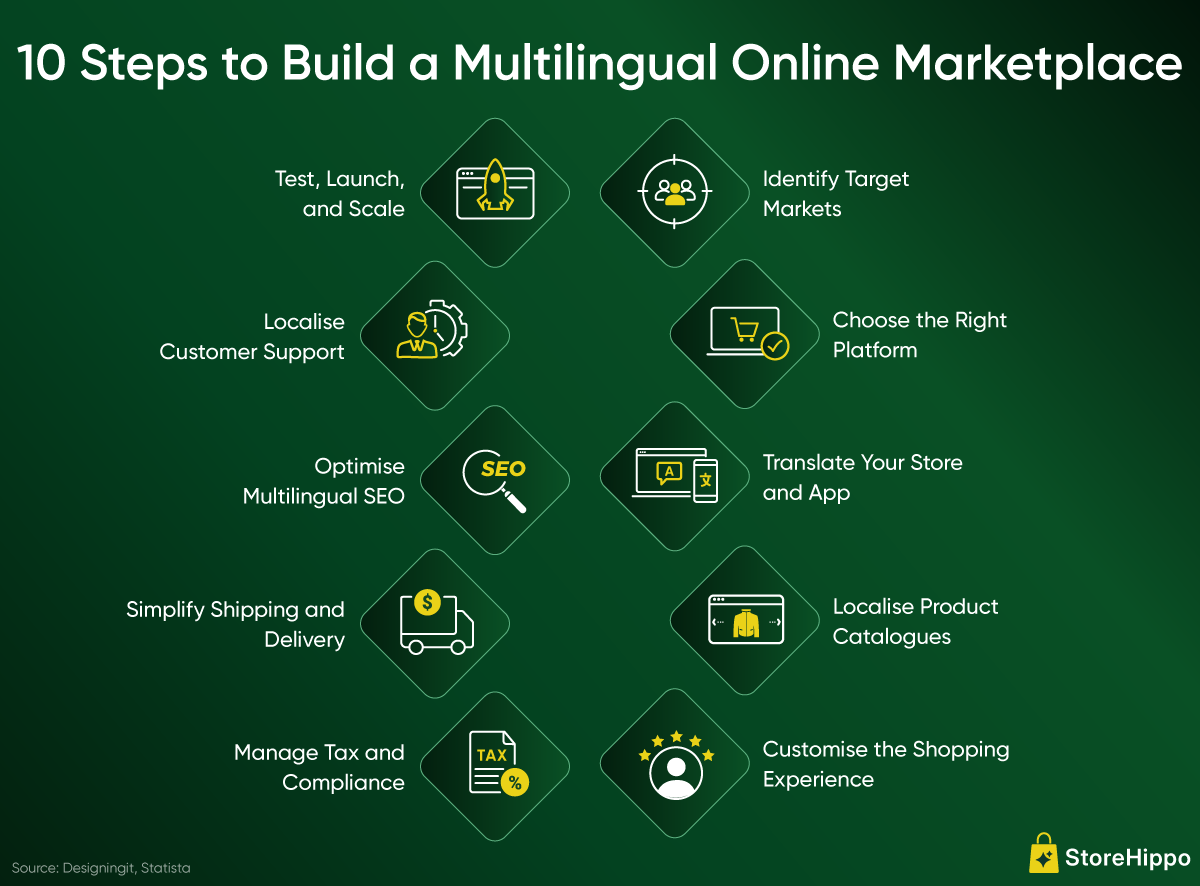
Here are 10 practical steps to help you get started and expand your business into new regions:
1. Identify Your Target Markets and Languages
Start by deciding where you want to expand your business. Research local demand, customer preferences, buying habits, and the languages your target customers speak. You don't have to launch in every market at once. Start with regions that offer the strongest growth opportunities and add more languages as your business expands.
How StoreHippo helps: StoreHippo's e-commerce platform enables enterprises to build multilingual storefronts for domestic and international audiences. With support for 100+ languages, including regional and right-to-left languages, businesses can create localised shopping experiences for different customer groups without building separate storefronts for every language.
2. Choose a Multilingual Ecommerce Platform
Your platform should make it easy to manage different languages, product catalogues, sellers, and customer interactions from one place. Choose a multilingual ecommerce platform that offers built-in translation capabilities, flexible storefront customisation, centralised admin, and support for mobile apps. If you plan to expand across regions, consider additional requirements such as local payments, currency support, and search engine optimisation.
Go with a scalable online marketplace platform that makes it easy to add more sellers, expand your product range, and reach customers through new sales channels as your business grows.
How StoreHippo helps: StoreHippo comes with built-in multilingual features, so you don't need to rely on external translation plugins. It also lets businesses manage multiple sellers, mobile apps, and different sales channels from one platform, making it easier to run and grow their marketplace as the business expands.
3. Translate your Multilingual Online Marketplace And App
Customers should be able to browse products, understand policies, and place orders without struggling with language barriers. Translate important elements such as menus, category names, product descriptions, checkout instructions, FAQs, and order notifications. Review the translated content carefully to make sure they sound natural and is easy to understand.
Don't limit language support to your website. Your marketplace app (and other channels) should offer the same smooth and consistent experience, so customers don't have to switch languages or struggle to understand essential information when shopping on their phones.
How StoreHippo helps: StoreHippo offers automatic translation and manual translation controls, enabling businesses to translate their storefront content and make selective changes where needed. It also supports multilingual themes and comes with a built-in, no-code mobile app builder that lets businesses create Android and iOS apps, making it easier to offer customers a consistent shopping experience across their website and mobile apps.
4. Localise Product Catalogues
Simply translating product information may not be enough to connect with customers in different markets. Tailor product titles, descriptions, specifications, size charts, and measurement units to suit local preferences. For instance, a fashion store should use sizing information that local shoppers understand, while an electronics store should present product specifications in a clear and familiar format.
Make sure product details stay accurate and consistent across all language versions, especially when multiple sellers add products to your catalogue. This helps customers understand what they're buying and make confident purchase decisions.
How StoreHippo helps: StoreHippo’s AI-powered marketplace platform makes catalogue creation easier with built-in AI-powered cataloguing tools that generate product titles, descriptions, dimensions, and other listing details from uploaded product images. Businesses can then review and edit the content and use StoreHippo’s multilingual features to translate product information into different languages. This makes it easier to manage catalogues and reach customers across global markets.
5. Customise the Shopping Experience
A shopping experience that works in one market may not work the same way in another. Make it easy for customers to switch languages, ensure your online marketplace website displays properly on mobile screens, and offer payment options they're familiar with. Multi-currency e-commerce capabilities can make it easier for international shoppers to understand prices in their preferred currency and shop with confidence.
Display applicable taxes, shipping charges, and other fees clearly before customers place an order. When customers know exactly how much they need to pay, they're more likely to complete their purchases without hesitation.
How StoreHippo helps: StoreHippo’s built-in multilingual and multi-currency features help businesses create localised shopping experiences for customers across markets. Businesses can display prices in customers’ preferred currencies, enable automatic currency conversion, and manage multi-currency pricing and invoicing without relying on external plugins. StoreHippo also offers 60+ integrated domestic and international payment gateways, enabling businesses to provide payment options suited to different markets. With customisable storefronts and support for multiple languages, currencies, and payment methods, businesses can make shopping more convenient for international customers.
6. Manage TAX and Regulatory Compliance
Every market has its own rules for taxation, invoicing, consumer protection, and data privacy. Before launching your multilingual ecommerce marketplace, identify the requirements that apply to your products and business model in each region. Make sure taxes are calculated correctly, include all required information on invoices, and clearly explain every charge to customers at checkout.
For a global multi-vendor marketplace, it's also important to establish clear processes for managing seller information, payments, and applicable tax responsibilities.
How StoreHippo helps: StoreHippo offers a built-in tax engine that supports multi-level tax calculations, country and location-based tax rules, and GST-compliant invoicing. Its global commerce solutions also support multi-currency invoicing and country-specific payment methods, helping businesses manage transactions across markets. Businesses can configure tax rules and payment options according to the requirements of each market.
7. Configure Shipping and Delivery
Customers need clear information about where you deliver, how long shipping will take, and how much it will cost. Before entering a new market, clearly define your delivery areas, shipping charges, expected delivery times, and return policies. If you're running a multi-vendor marketplace, set clear fulfilment processes so sellers can handle and ship orders smoothly and consistently.
For international sales, you'll also need to consider customs regulations, cross-border shipping, and any additional documents required to deliver orders to customers in different countries.
How StoreHippo helps: StoreHippo offers integrated logistics solutions with 30+ logistics providers to help businesses manage shipping and order fulfilment from one platform. Its shipping integrations and cross-border fulfilment capabilities help enterprises manage deliveries across different markets. Businesses can configure shipping methods and charges based on their requirements and available logistics integrations.
8. Optimise Your Marketplace for Multilingual SEO
Customers in different regions may use different search terms to find the same product. Research relevant keywords in each target language instead of simply translating your existing search terms. Localise page titles, meta descriptions, product content, and URLs where appropriate. Configure language-specific URLs correctly to help search engines identify the relevant page for each audience.
A well-optimised online marketplace can improve product discoverability and help customers find the right products through organic search.
How StoreHippo helps: StoreHippo offers SEO-ready storefronts with editable page titles, meta descriptions, product URLs, and other SEO settings. These capabilities help businesses optimise their storefront content for different markets.
9. Localise Customer Support
Customers shopping on your multilingual ecommerce marketplace may have questions about payments, delivery updates, products, returns, or refunds. Make sure they can find the help they need in their preferred language. Translate FAQs, help articles, order notifications, and return policies into the languages you support. You should also offer customer support through channels your customers find convenient, so they can get help whenever they need it.
For a global online marketplace with multiple sellers, clear communication matters even more. Customers should know where to turn when they have questions about a product, need an order update, or want help with a purchase from any seller.
How StoreHippo helps: StoreHippo is an AI-powered marketplace platform that offers AI tools, including multilingual shopping assistants and custom-built AI agents, to help businesses handle buyer queries and streamline customer support. Businesses can build custom AI assistants for tasks such as answering product questions, providing order updates, and resolving payment or delivery queries. Its multilingual capabilities also help businesses create more accessible shopping experiences for customers across different markets.
10. Test, Launch, and Scale
Before launching your multilingual ecommerce marketplace, test the complete shopping journey in every supported language. Check language switching, product pages, search results, checkout, payments, shipping information, and order notifications on both desktop and mobile devices. Ask people familiar with each language to review the experience and identify confusing translations.
Once your online marketplace is live, monitor customer feedback, search behaviour, conversion rates, and abandoned carts. Use these insights to improve translations, refine product information, and identify opportunities to expand into new markets.
How StoreHippo helps: StoreHippo brings together multilingual commerce features and AI-powered tools such as semantic search, personalised product recommendations, and conversational shopping assistance. These features help customers find products that match their needs and browse large catalogues more easily. If you're planning to build an AI-powered marketplace, make sure to check the language support available for each AI feature and configure it to suit your target markets.
Conclusion
Building a multilingual online marketplace is a practical step towards reaching global buyers and creating shopping experiences that feel familiar to customers across different regions. From localising product catalogues and managing multiple currencies to streamlining shipping and customer support, every detail matters when expanding into new markets. The right ecommerce platform can help you manage these requirements without adding unnecessary challenges as your business grows.
StoreHippo brings together built-in multilingual capabilities, multi-currency support, AI-powered cataloguing, integrated logistics, and customisable storefronts to help enterprises build and scale their global marketplace. With the right tools in place, you can connect with diverse audiences and make cross-border shopping more accessible.
Ready to build a multilingual online marketplace for global buyers?
Book your StoreHippo demo now.
FAQs
1. How can businesses measure the success of a multilingual online marketplace?
Businesses can measure the success of a multilingual online marketplace by tracking conversion rates, average order value, customer acquisition costs, repeat purchases, and cart abandonment across different markets. Monitor customer engagement, organic traffic, and revenue by language to identify growth opportunities. These insights help businesses understand which markets perform well and where improvements are needed.
2. Should businesses launch all language versions of an online marketplace at once?
No, businesses do not need to launch all language versions of an online marketplace at once. Start with markets that offer the strongest growth potential and prioritise the languages your target customers prefer. A phased rollout helps businesses test demand, gather customer feedback, address operational challenges, and expand gradually based on market performance and available resources.
3. How can businesses maintain consistent product information in a multilingual ecommerce marketplace?
Businesses can maintain consistent product information in a multilingual ecommerce marketplace by using a centralised catalogue with standardised product attributes, naming conventions, and content guidelines. Establish clear review processes to verify translations and keep product details accurate across languages. Regularly update all language versions whenever product specifications, pricing, or availability change to ensure customers receive consistent and reliable information.
4. What should enterprises evaluate before choosing a multilingual marketplace app for international customers?
Enterprises should evaluate language support, mobile performance, payment compatibility, product search, and checkout functionality before choosing a multilingual marketplace app. Check whether the app supports regional preferences, integrates with existing business systems, and scales as the business grows. Strong analytics, reliable performance, and consistent experiences across languages can help businesses serve international customers more effectively.
5. How can businesses manage multi-currency pricing in a multilingual online marketplace?
Businesses can manage multi-currency pricing by setting clear rules for exchange-rate updates, regional price adjustments, and rounding. A multilingual online marketplace should display prices in customers’ preferred currencies and clearly communicate applicable taxes, shipping charges, and fees. Regularly reviewing currency fluctuations and regional pricing strategies helps businesses maintain transparency, protect profit margins, and deliver a consistent shopping experience.
6. How can a multilingual marketplace maintain a consistent brand voice across regions?
A multilingual marketplace can maintain a consistent brand voice by creating clear brand guidelines for tone, terminology, and messaging across regions. Use these guidelines when adapting product descriptions, marketing campaigns, and customer communications. Have native-language reviewers check translations to ensure they sound natural, reflect local cultural nuances, and preserve the brand’s identity across different markets.
7. How can an AI-powered marketplace improve product discovery for international buyers?
An AI-powered marketplace can improve product discovery by using intelligent search, personalised recommendations, and conversational shopping assistants. These tools help international buyers find relevant products based on their preferences, search intent, and browsing behaviour. When configured for different languages and regional search terms, AI capabilities can make product discovery easier and create more relevant shopping experiences across markets.
8. When should an enterprise upgrade its multilingual ecommerce platform?
An enterprise should upgrade its multilingual ecommerce platform when it struggles to manage increasing traffic, expanding product catalogues, or new international markets. Limited language support, poor website performance, manual workflows, and integration challenges can also signal the need for an upgrade. A scalable ecommerce platform helps businesses streamline operations, deliver consistent shopping experiences, and support long-term global expansion.
Binny Joseph is a seasoned ecommerce and enterprise growth leader, serving as Senior Vice President of Sales & Alliances with deep experience helping global brands adopt modern commerce solutions.
He writes about global ecommerce, multilingual ecommerce platforms, and helping businesses choose the right enterprise ecommerce platform for international growth.