


Creating a B2B online marketplace that connects with today’s buyers isn’t just nice to have it’s essential for staying competitive.
In a competitive world, a successful marketplace needs more than just a great selection of products it needs to connect with modern buyers in meaningful ways.
But how do you build a marketplace that stands out and engages your audience effectively?
Modern B2B buyers look for more than just products; they want a seamless, personalized experience that makes their purchasing journey easy and efficient.
That’s where a powerful B2B ecommerce platform comes in.
With the right features and strategies, you can create a marketplace that doesn’t just attract buyers but keeps them coming back.
Curious about what it takes to engage today’s buyers and turn your B2B marketplace into a thriving B2B hub?
Table of Contents
- B2B Ecommerce: Trends To Engage Modern Buyers
- How AI Can Be Leveraged To Reach And Engage B2B Buyers
- How to Build a B2B Marketplace That Reaches and Engages Modern Buyers
- 1. Understand Your Target Audience
- 2. Focus on a User-Friendly Interface
- 3. Optimize for Mobile and B2B Sales Apps
- 4. Utilize Advanced Search and Filtering Options
- 5. Offer Detailed Product Information
- 6. Personalize the Buyer Experience
- 7. Leverage Data Analytics to Improve Continuously
- 8. Offer Self-Service And Automation
- 9. Ensure Robust Security and Compliance
- 10. Provide Efficient Customer Support
- Conclusion
- FAQs
B2B Ecommerce: Trends To Engage Modern Buyers
Before we look into ways to engage buyers, let us understand how the B2B ecommerce market is behaving: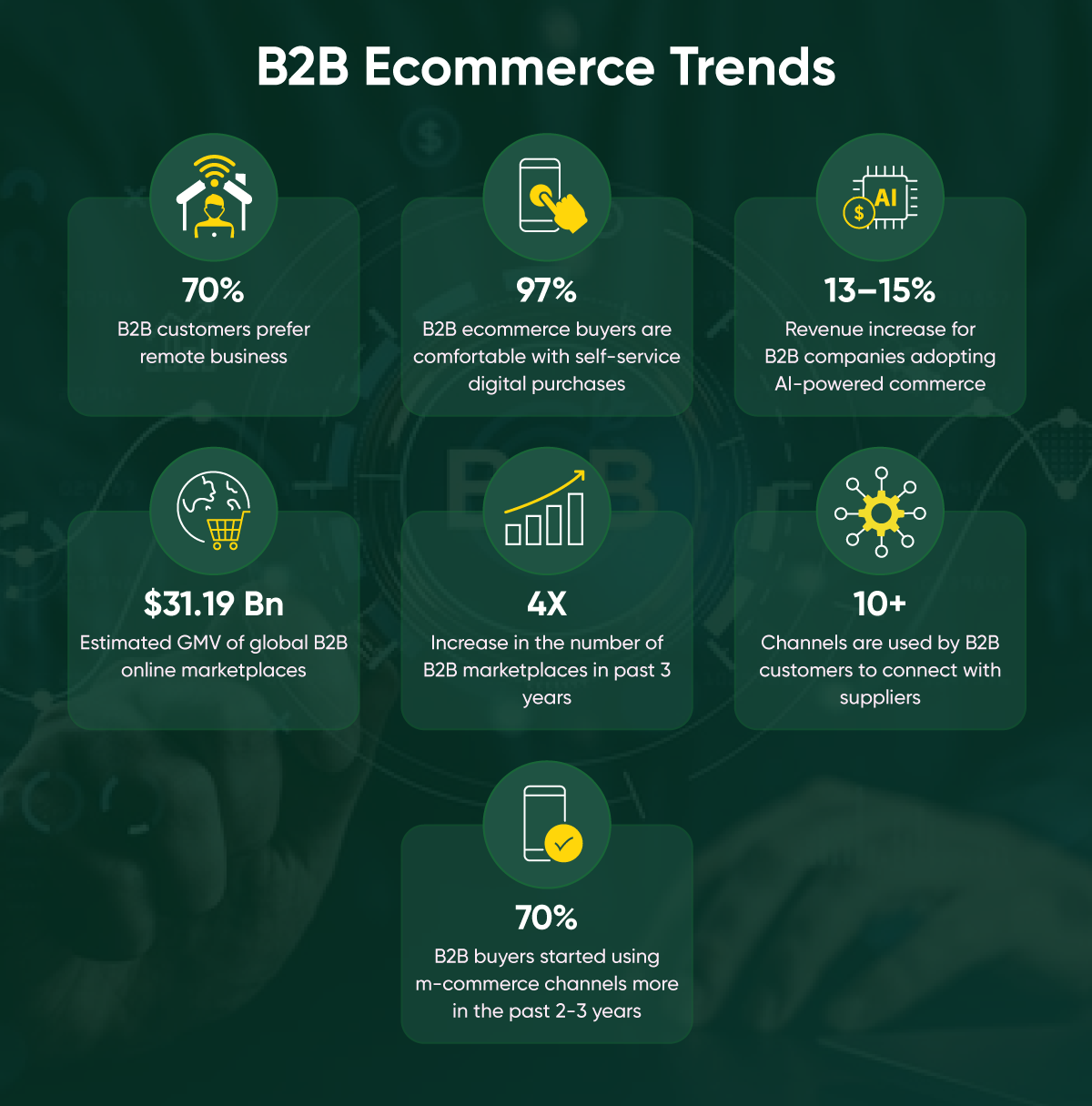
- 70% of B2B customers prefer remote business
- 97% of B2B ecommerce buyers are comfortable with self-serviced digital purchases
- $31.19 billion is the estimated GMV of global B2B online marketplaces
- 4X increase in the number of B2B marketplaces in past 3 years
- 10+ channels are used by B2B customers to connect with suppliers
- 70% of B2B buyers started using m-commerce channels more in the past 2-3 years
Source: Statista, McKinsey & Company, DHL Express
The tremendous growth in the B2B commerce sector signifies the importance of keeping the modern buyers engaged. With the immense pool of buyers gravitating towards online means of buying, you need to create a B2B online marketplace that truly resonates with the modern buyer.
How AI Can Be Leveraged To Reach And Engage B2B Buyers
As B2B marketplaces scale, AI is emerging as a key differentiator. Enterprises that adopt AI are not just improving speed and efficiency, they are using intelligence to drive measurable impact across revenue, conversions, and operations.
Here’s what the data shows:
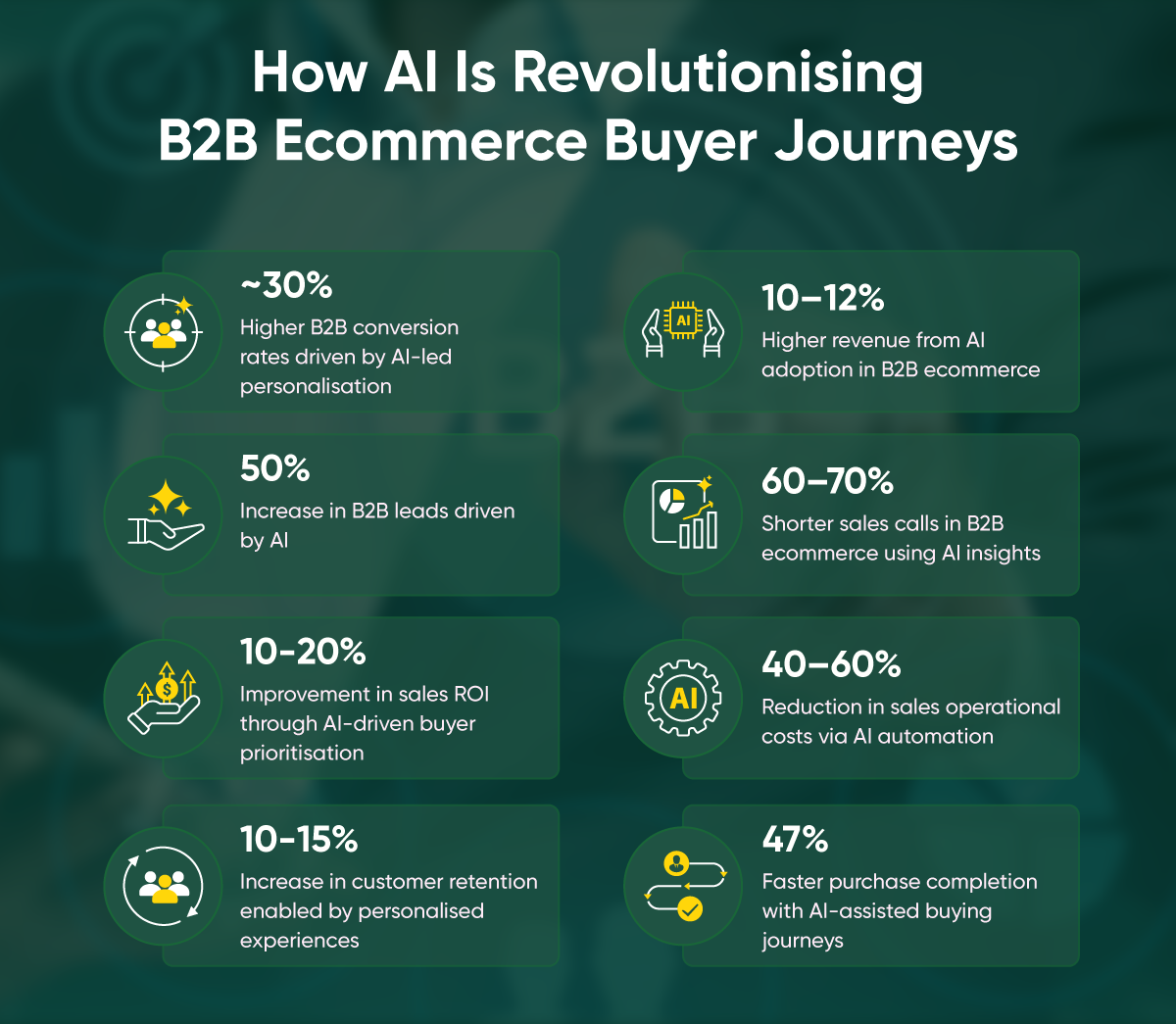
- ~30% higher B2B conversion rates driven by AI-led personalisation
- 10–12% higher revenue from AI adoption in B2B ecommerce
- 50% increase in B2B leads driven by AI
- 60–70% shorter sales calls in B2B ecommerce using AI insights
- 10–20% improvement in sales ROI through AI-driven buyer prioritisation
- 40–60% reduction in sales operational costs via AI automation
- 10–15% increase in customer retention enabled by personalised experiences
- 47% faster purchase completion with AI-assisted buying journeys
Source: McKinsey, Gartner, Persana AI, SparxIT, Patent PCm, HelloRep
These numbers clearly highlight that AI is no longer optional, it has become the driving force for efficiency, personalisation, and growth in modern B2B commerce. With expanding catalogues, increasingly complex buyer journeys, and rising demands for speed and relevance, manual and rule-based systems quickly fall short. AI-driven tools enable B2B marketplaces to manage this growing complexity while maintaining consistent discovery, faster decision-making, and greater operational control at scale.
This is where a B2B ecommerce platform with AI built into its core is essential for driving smarter decisions, improving efficiency, and delivering personalised experiences at scale.
AI lays the foundation for smarter, faster, and more personalised B2B commerce. But turning intelligence into measurable buyer engagement requires the right marketplace strategies. Here are ten proven ways to build a B2B marketplace that resonates with modern buyers.
How to Build a B2B Marketplace That Reaches and Engages Modern Buyers
Building a B2B marketplace that reaches and engages modern buyers is essential for businesses aiming to stay competitive in today’s digital-first landscape. All you need is a robust B2B ecommerce platform that aligns with the unique demands of B2B business models.
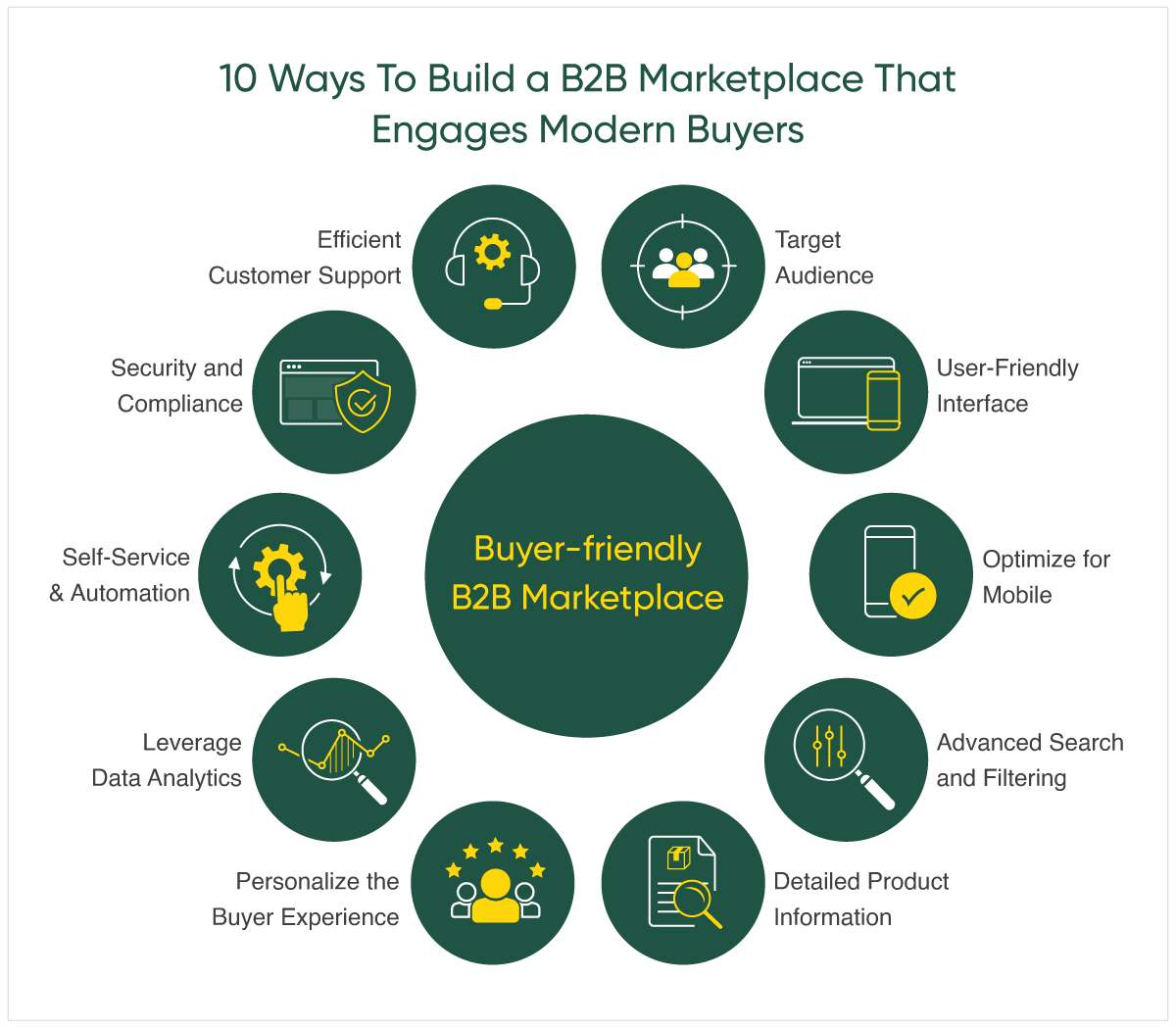
Here are 10 strategies to help you create a marketplace that not only attracts but also retains modern buyers:
1. Understand Your Target Audience
Identifying and understanding your audience is the foundation of any successful B2B online marketplace. Modern B2B buyers are more informed and research-driven than ever before. They prioritize efficiency and expect seamless digital experiences similar to B2C platforms. When you conduct market research and build detailed buyer personas, you can tailor your B2B online marketplace to meet your buyers’ specific needs. Your B2B online marketplace can succeed better by catering to diverse B2B buyers through deep insights into buyer behavior, making it a perfect example of an audience-focused marketplace.
StoreHippo’s multi-store ecommerce solutions help you create multiple location-based, product-based, audience-based B2B stores catering to specific target audiences. You can create stores based on different audience groups and set different product catalogs. You can also promote best-selling products by enabling the price override feature or design each store differently as per the location demands.
2. Focus on a User-Friendly Interface
B2B buying is no longer traditional, the buyers expect a fancy marketplace that offers a streamlined, intuitive interface mirroring their experience with B2C platforms. A user-friendly design ensures easy navigation through the marketplace and keeps your buyers engaged. You can keep your buyers engaged with easy and quick navigation, organized categories, and a mobile-responsive design on your marketplace. Investing in a B2B sales app can also help you enhance user experience by offering convenient, on-the-go access for buyers.
The inherently scalable infrastructure from StoreHippo ecommerce solutions helps you offer high-performance speed on your B2B marketplace even during high traffic volumes or when your products, sellers, stores, etc. grow exponentially. StoreHippo comes with advanced features like easy navigation from one page to another, and seamless checkout options to create a user-friendly interface on your marketplace. StoreHippo's scalable B2B ecommerce platform also helps you create conversion-oriented designs for your marketplace with its 100+ device-optimized design themes library. The easy drag-and-drop tool helps even novice users to play around with the designs without having to indulge in coding.
3. Optimize for Mobile and B2B Sales Apps
A mobile-optimized B2B marketplace and sales app can significantly enhance the buying experience and engage better with modern B2B buyers. The digital-age B2B buyers expect convenience and accessibility on the go and expect their brands to enable buying on their mobile devices. When you make it easy for customers to browse products, communicate with suppliers, and complete transactions from anywhere, you engage, attract, and convert better. Ensure that your B2B online marketplace is fully mobile-responsive and consider developing a dedicated app to cater to buyers.
StoreHippo ecommerce solutions are built on mobile-first technology. The built-in mobile app builder from StoreHippo helps you create multiple mobile apps right from your admin dashboard, without any coding and at zero additional costs. You can leverage m-commerce to your benefit and create multiple B2B sales apps for Android and iOS. You can also convert your wholesale B2B marketplace website into PWA stores that look, feel, and work like mobile apps even on entry-level devices. With StoreHippo, you can build a B2B marketplace that offers multiple mobile solutions for different users like admin, distributors, delivery boys, etc to help them handle their business on the go.
4. Utilize Advanced Search and Filtering Options
To keep buyers engaged, your B2B online marketplace must include advanced search features, such as easy navigation, predictive search, filtering by multiple criteria, etc. These features help buyers find the exact products they need without any hassle. You can also use an AI-powered search system, that helps streamline product discovery. When your B2B marketplace provides advanced search capabilities, your buyers can locate products by specific criteria such as certifications, materials, and location, enhancing the overall buyer journey.
StoreHippo ecommerce solution offers easy navigation and fast loading page speed to help you offer a seamless shopping experience on your B2B sales app and marketplace. Your buyers can easily move back and forth the marketplace. StoreHippo also comes with a faceted search feature to help you promote discoverability and enhance the user experience on your marketplace website. You can also narrow down the searches to make the marketplace intuitive and fast for quicker conversions. StoreHippo’s AI-powered semantic search and recommendations further help you engage and sell better on your B2B marketplace.
5. Offer Detailed Product Information
B2B buyers require in-depth information before making purchasing decisions. Unlike B2C buyers, B2B buyers often make bulk purchases and invest in long-term supplies. They therefore need comprehensive information to ensure the products meet their specific requirements. When you offer a detailed product description along with the technical specifications, and clear images, you instill confidence and help buyers make informed decisions. You can also consider adding customer reviews and ratings for added credibility. A B2B online marketplace that provides comprehensive product information and high-quality images, makes it easy for buyers to evaluate options thoroughly before purchasing.
You can build comprehensive product pages with StoreHippo’s advancedproduct management system. When youbuild a B2B marketplace, you can create an advanced look and feel for your product pages by adding multiple product images and videos to engage better with your customers. StoreHipp’s AI-powered cataloguing tool automates catalogue creation, tagging, and content optimisation at scale. Built-in AI image enhancement tool, Magic Edit, transforms raw product images into professional, market-ready visuals, significantly improving catalogue quality, making it easier to showcase various product options and help your customers understand the product and its variations better. When you can add detailed product descriptions on your marketplace with StoreHippo, you can translate them into multiple languages with StoreHippo’s auto-translation tools. It helps your customers engage with your products in their native language.
6. Personalize the Buyer Experience
Personalization is crucial in engaging modern buyers. Offering a personalized B2B journey helps you engage better with modern buyers. You can tailor product recommendations, create special offers, and develop content based on a buyer’s behavior, preferences, and past purchases. B2B businesses that adopt personalization to enhance their buyer experience experience increased engagement, and higher conversion rates on their marketplace as well as B2B sales app.
StoreHippo helps you offer personalized solutions to your customers. You can use the price override functionality to offer personalized product prices on your B2B store directly from your admin dashboard. The powerfulbuilt-in discount engine helps you offer personalized multi-level discounts and coupons. You can also send out personalized notifications to your customers in real time and engage with them in their native language with StoreHippo’s support for multiple languages. StoreHippo also helps youcreate multilingual themes and personalize your promotional pages for customers from various locations. You can also recover abandoned carts by sending out personalized notifications to your customers.StoreHippo’s AI-powered B2B ecommerce platform is built to make marketplaces smarter, faster, and more personalised at every touchpoint. AI-powered search and recommendations guide buyers based on intent and behaviour, helping them discover the right products faster and convert with confidence. With StoreHippo, brands can build custom agentic AI assistants to support buyers, sellers, and internal teams across everyday operations and buyer journeys.
7. Leverage Data Analytics to Improve Continuously
Data analytics is key to understanding buyer behavior and identifying areas for improvement. By analyzing B2B buying metrics such as user engagement, search patterns, and purchase frequency, you can optimize yourB2B online marketplace to better meet buyer needs. You can use data analytics to track customer interactions and improve product offerings. By leveraging analytics, you can enhance your marketplace, introduce new features based on buyer feedback, and make data-driven decisions that drive engagement and sales.
StoreHippo comes with a gamut of analytical solutions to help you analyze your customer segmentation and make data-centric marketing plans for overall business growth. Built on decoupled headless API, StoreHippo helps create multiple B2B personalized landing pages, and custom forms using the built-in form builder. You can capture rich customer data and use them for continuous business growth. With StoreHippo enterprise ecommerce solutions, you can seamlessly integrate with several data tools like Google Analytics, Zoho, etc. that provide rich customer data. Various AI capabilities operate on a unified intelligence layer, ensuring insights and automation remain connected for better understanding on buyer behaviour and strategic growth.
8. Offer Self-Service And Automation
Modern buyers prefer taking charge of their buying process. Well, since B2B shopping involves long and multiple negotiation cycles, 75% of the buyers prefer digital self-service and remote human contact to in-person communication. You can offer a self-service feature that significantly reduces the dependency on sales representatives. When you automate the order processes like shipping,order management, follow-up emails, etc on your B2B online marketplace, you reduce customer grievances and boost productivity.
StoreHippo comes with a host of B2B features that help you streamline and automate the sales process on your B2B sales app and marketplace. You can introduce self-service and automation with StoreHippo features likeRFQ, differential/multi pricing, customizable forms, tiered pricing, credit management, MOQ (Minimum Order Quantity), tax engine, etc. You can offer real-time delivery tracking, easy cancellations, and refunds of orders to help your B2B buyers stay informed about their orders.
9. Ensure Robust Security and Compliance
Modern B2B buyers prioritize security and expect their information to be protected on the platforms they use. Implementing strong security measures, such as encryption. When you build a B2B marketplace that emphasizes security and compliance, offers verified suppliers, and secure transaction options, you build trust with buyers. Ensuring a secure B2B marketplace can enhance your brand’s credibility and attract more buyers.
StoreHippo ecommerce solutions help build secure enterprise business-to-business marketplaces across industry verticals. The PCI-DSS-compliant platform comes with a host of security features like authentication, authorization, and audit logs to ensure robust security. The 60+ secure, PCI-compliant payment gateways from StoreHippo also help ensure secure payments on your B2B sales app and marketplace.
10. Provide Efficient Customer Support
Offering quick and reliable customer support is critical for engaging modern B2B buyers. Offering live chat options, chatbots, a comprehensive FAQ section, etc can help your buyers make quick buying decisions. Round-the-clock customer service has become a major deciding factor for the buyers. B2B ecommerce platform that offers real-time customer support through various support channels and can resolve buyer queries instantly and create a seamless purchasing experience. By investing in a robust customer support system, you can address concerns quickly, and increase buyer satisfaction and retention.
StoreHippo ecommerce solutions help you be available for your customers 24x7 and create exceptional customer support. StoreHippo B2B ecommerce platform helps you integrate a variety of customer support tools, live chat, and chatbots, so you can offer multi channel support to your customers. You can also customize your dashboard so that the buyers can raise a ticket to connect with you. You can send unified notifications like SMS, push, and emails to connect with buyers and offer them support wherever needed during or after the buying journey. StoreHippo also enables enterprises to build their custom AI support agents that automate the majority of the routine support queries enabling wholesale marketplaces to work with lean teams and keeping customers happy with quick query resolutions.
Conclusion
Modern B2B buyers are digitally confident, experience-driven, and expect speed, relevance, and personalisation at every step of their buying journey. To win and retain these buyers, enterprises must build a B2B marketplace that go beyond transactions and deliver consistent, intelligent experiences.
StoreHippo B2B ecommerce solution provides a powerful, enterprise-ready foundation to build and scale high-performing B2B marketplaces and B2B sales apps. With built-inAI for ecommerce, StoreHippo enables smarter catalogue management, intuitive buyer discovery, assisted buying journeys, and automated operations, helping brands engage buyers more effectively while scaling with control. Supported by 300+ enterprise-grade features and 120+ built-in integrations, StoreHippo enables B2B businesses to stay ahead as buyer expectations continue to evolve.
Ready to build a future-ready B2B marketplace that truly engages modern buyers? Book your free demo today.
FAQs
1. What should enterprises prioritise first when they build a B2B marketplace for modern buyers?
Enterprises should prioritise buyer experiences, not just product catalogues. Modern B2B buyers expect intuitive navigation, fast reordering, self-service capabilities, and consistency across channels. These expectations must be natively built into the platform rather than added later through custom development or plugins.
With StoreHippo B2B ecommerce solutions, buyer journeys, pricing logic, approvals, and self-service workflows are natively supported, enabling enterprises to design and launch engagement-first B2B marketplaces from day one.
2. How do enterprises keep their B2B online marketplace relevant as buyer behaviour evolves?
Relevance depends on platform flexibility. Buyer expectations, channels, and decision-making patterns evolve continuously, and marketplaces must adapt without repeated re-platforming. Enterprises need configurable workflows, modular features, and omnichannel readiness.
StoreHippo’s unified, API-first architecture allows enterprises to evolve buyer journeys, add new channels, and introduce advanced capabilities like AI-driven discovery without disrupting ongoing operations.
3. What role does AI play in helping enterprises engage modern B2B buyers at scale?
AI enables enterprises to build intelligent B2B marketplaces that adapt to buyer intent, scale engagement, and simplify complexity. As catalogues grow and buyer journeys become more digital-first, AI helps enterprises move beyond manual processes and rule-based experiences to deliver faster discovery, relevant recommendations, and consistent engagement across channels.
With StoreHippo’s AI-powered ecommerce solutions, B2B enterprises can leverage AI capabilities built directly into its core. From automated catalogue creation and AI-driven image optimisation to intent-based search, personalised recommendations, and AI-assisted buying journeys, StoreHippo allows enterprises to adopt AI seamlessly, helping them engage bulk buyers at scale while maintaining control, efficiency, and long-term flexibility.
4. Can a single B2B ecommerce platform support multiple buyer segments' journeys at scale?
Yes, but only if the platform is designed for enterprise complexity. Most B2B marketplaces serve multiple buyer types such as distributors, retailers, bulk buyers, and corporate accounts, each with different pricing, catalogues, and workflows.
StoreHippo enables enterprises to run multiple buyer-specific journeys through its multi-store feature, catalogues, and pricing models on one centralised platform, ensuring consistency, governance, and operational efficiency at scale.
5. How critical is mobile commerce when enterprises build a B2B marketplace today?
Mobile is no longer optional in B2B. 70% of B2b journeys and a significant amount of purchases happen on mobile devices. Enterprises that offer mobile-first buying experience see faster ordering cycles and higher buyer retention.
StoreHippo offers built-in mobile app builder, enabling enterprises to build dedicated B2B apps without additional development overhead.
6. How can enterprises reduce dependency on sales teams without impacting buyer relationships?
The answer lies in intelligent self-service. Modern buyers prefer digital-first interactions for routine and repeat purchases, while sales teams should focus on strategic accounts.
StoreHippo supports self-serve ordering, approvals, pricing visibility, and reordering workflows within the B2B marketplace, allowing enterprises to reduce sales friction while maintaining high-value buyer relationships.
7. What role does personalisation play in engaging modern B2B buyers?
Personalisation is a growth driver, not a cosmetic feature. Enterprises that personalise pricing, content, recommendations, and communication see higher conversion rates and stronger buyer loyalty.
StoreHippo’s B2B ecommerce platform enables behaviour-led personalisation across pricing, promotions, content, and notifications, without relying on disconnected third-party tools.
8. How do enterprises manage complexity as sellers, SKUs, and buyers grow?
Complexity must be handled at the platform level, not through manual processes or plugins. As marketplaces scale, performance, governance, and visibility become critical.
StoreHippo’s scalable architecture is designed to support growth across regions, sellers, and catalogues while maintaining speed, stability, and operational control.
9. How should enterprises measure buyer engagement beyond revenue metrics?
Modern B2B engagement goes beyond sales numbers. Key indicators include repeat purchase frequency, ordering speed, channel usage, discovery behaviour, and self-service adoption.
StoreHippo provides integrated analytics across web and B2B sales apps, helping enterprises optimise engagement strategies based on real buyer behaviour.
10. What makes StoreHippo suitable for enterprises planning long-term B2B growth?
StoreHippo is built for scale, flexibility, and control. Its AI-native architecture, mobile-first approach, and enterprise-grade feature set enable businesses to build B2B marketplaces that meet current buyer expectations while remaining adaptable to future shifts
By unifying catalogue management, discovery, operations, and buyer engagement, StoreHippo enables enterprises to turn marketplace complexity into a sustainable competitive advantage.