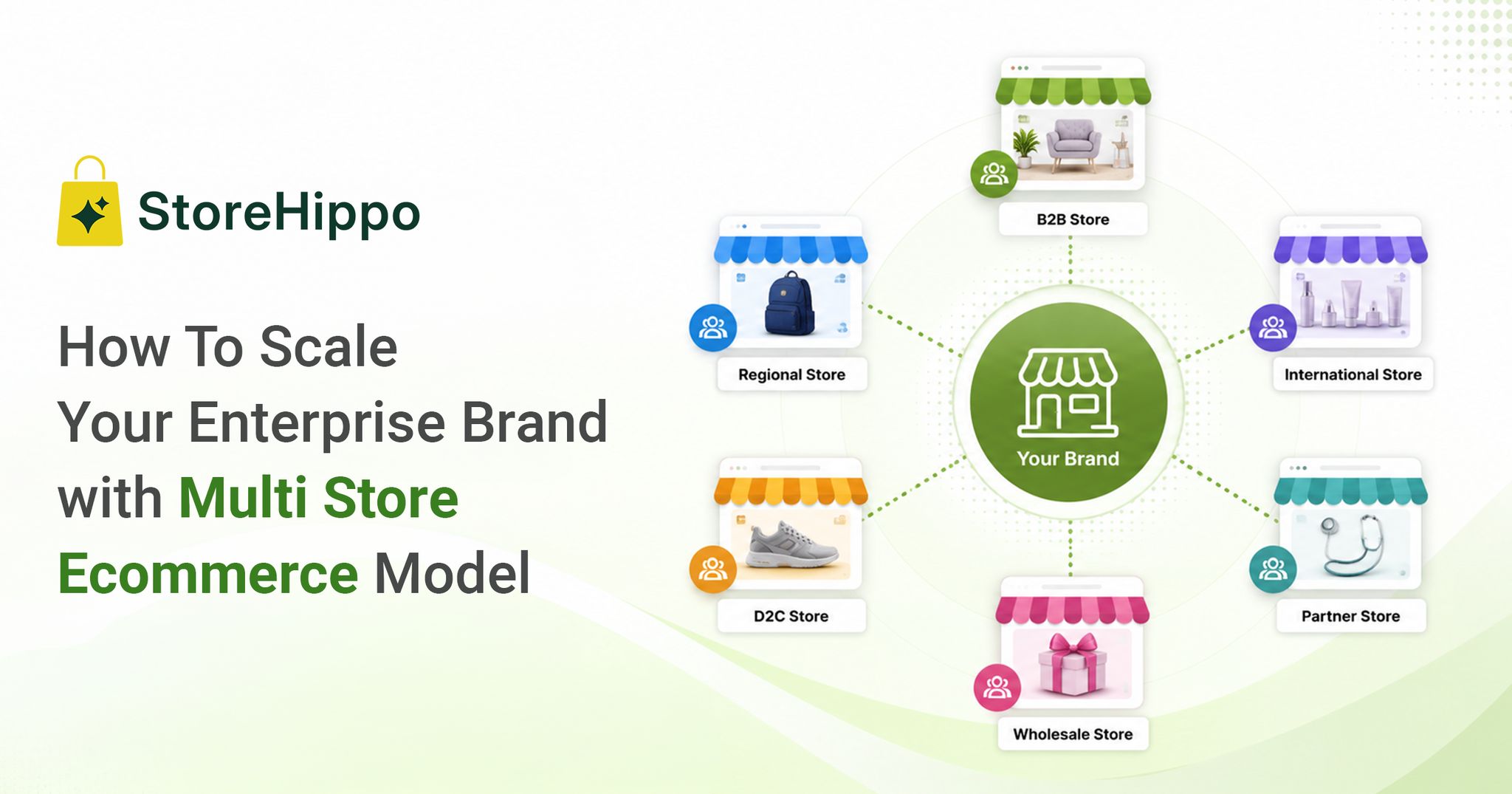



Most enterprise ecommerce brands start with a single online store and expect it to serve every customer, every region, and every business need. It works well at the start. But as the business grows, one storefront often struggles to deliver the right experience for every buyer.
Different customer segments have different expectations. They may need different catalogues, pricing, languages, promotions, or buying journeys. Trying to manage all of this through a single storefront can limit growth and make operations more complex.
That's why more enterprise and D2C ecommerce brands are adopting a multi store ecommerce model. By creating dedicated storefronts for different markets, customer segments, or business models while managing everything from one backend, businesses can deliver more personalised shopping experiences and scale without adding unnecessary complexity.
Every stage of enterprise growth brings new operational and customer experience challenges. The following seven strategies show how a multi store ecommerce platform helps solve them while preparing your business for long-term growth.
Table of Contents
- 1. When should an enterprise brand switch to a multi store ecommerce platform from a single store set-up?
- 2. How does store localisation help increase multi store ecommerce conversions more effectively than discounts?
- 3. How does differential pricing (pricing override) across sub-stores of a multi store ecommerce platform improve enterprise margins?
- 4. How can AI-driven personalisation across enterprise ecommerce brand’s sub-stores turn casual browsers into repeat buyers?
- 5. When should an enterprise ecommerce brand experiment with hybrid business models using a multi-store setup?
- 6. How can enterprises market multiple sub-stores of their multi store ecommerce platform while maintaining a consistent brand identity?
- 7. How can enterprise ecommerce brands expand into international markets without increasing operational complexity?
- How can enterprises scale a multi-store ecommerce business without rebuilding their tech stack every time?
- Conclusion
- FAQs
1. When should an enterprise brand switch to a multi store ecommerce platform from a single store set-up?
An enterprise brand should switch to a multi store ecommerce platform when a single storefront no longer meets the needs of different customer segments.
If your business serves separate catalogues, pricing, promotions, or buying experiences for different brands, regions, or customer groups, a multi-store setup gives you the flexibility to scale without increasing operational complexity.
The biggest driver behind this shift is personalisation. As enterprise brands serve more diverse customer groups, delivering relevant shopping experiences with a single storefront becomes increasingly difficult. The latest ecommerce trends highlight just how important personalisation has become.
The Personalisation Gap in Enterprise Commerce
- 71% of consumers expect personalised interactions, and 76% feel frustrated when they don't get them. A single storefront makes it difficult to deliver truly personalised experiences at scale.
- Brands that excel at personalisation generate 40% more revenue from those efforts. A multi-store setup makes it easier to tailor experiences for different customer segments.
- 80% of consumers are more likely to buy from brands that offer personalised experiences. Dedicated storefronts help turn that expectation into reality.
Source Mckinsey, Epsilon
Together, these trends show why enterprise brands are moving beyond a one-size-fits-all storefront and investing in personalised shopping experiences.
A single storefront works well in the early stages. But as your business grows across brands, regions, or customer segments, one store starts creating compromises. Different buyers end up navigating the same catalogue, search, promotions, and content, even though their needs are completely different. An electronics brand selling gaming laptops, office peripherals, and home audio products, for example, forces every customer through the same buying journey. The products may be right, but the experience rarely feels relevant.
Dedicated storefronts solve this challenge by giving every customer segment a shopping experience designed around its unique needs.
With dedicated storefronts, each customer segment gets its own catalogue, pricing, inventory, promotions, and buying journey, while everything continues to be managed from one central backend. A gamer sees a storefront built for gaming, while an enterprise IT buyer lands on a store designed around business procurement.
StoreHippo's multi store ecommerce platform enables enterprise brands to launch and manage multiple online stores from a single admin panel. Its built-in AI capabilities help automate catalogue creation, personalise product discovery, and deliver relevant shopping experiences across every storefront. Combined with store-specific catalogues, inventory and pricing, brands can offer personalised journeys without relying on custom development, third-party integrations, or operational complexity.
2. How does store localisation help increase multi store ecommerce conversions more effectively than discounts?
Store localisation increases conversions more effectively than discounts because it removes friction from the buying journey. When shoppers see their preferred language, currency, payment methods, pricing, and region-specific offers, they feel more confident purchasing. This creates better customer experiences, higher conversion rates, and stronger long-term loyalty than temporary discounts alone.
The data below shows why localisation has become one of the biggest drivers of ecommerce conversions worldwide.
Why Localisation Matters
- 76% of consumers prefer buying products with information in their own language
- 40% of shoppers never buy from websites in another language
- 80% of consumers are more likely to purchase from brands offering personalised experiences
- 51% higher checkout conversions with local payment methods
- 44% of online shoppers primarily use local payment methods over international alternatives
Source CSA Research, Epsilon, Paddle
Together, these trends show that shoppers are far more likely to complete a purchase when the buying experience feels local and seamless, making localisation a more sustainable growth strategy than discounts alone.
Discounts can boost short-term sales, but they rarely create lasting customer loyalty. Localisation improves every stage of the buying journey by making shopping feel familiar and relevant to every customer. When buyers can browse, pay, and complete purchases in ways they already trust, they are far more likely to convert and return.
Imagine a fashion D2C ecommerce brand expanding from the UK to the UAE. Shoppers in both countries expect to see prices in their own currency, use local payment methods, and browse in a language they understand. If every customer sees the same storefront, many may leave because the shopping experience doesn't feel familiar or convenient. Instead of relying on discounts to drive sales, the brand can increase conversions by giving every shopper an experience that matches local expectations
Managing this level of localisation with a single storefront quickly becomes difficult. That's where a multi-store ecommerce platform makes the difference by enabling brands to customise language, currency, pricing, taxes, shipping, promotions, and content for every market while managing everything from a single backend.
StoreHippo enterprise ecommerce platform helps brands deliver local shopping experiences without increasing operational complexity. Enterprise brands can launch region-specific storefronts with localised catalogues, currencies, taxes, shipping rules, and buyer journeys while managing everything from a single admin panel. StoreHippo also supports 100+ languages, including right-to-left languages such as Arabic and Hebrew. Its built-in AI capabilities personalise product discovery and shopping experiences in multiple languages, helping brands improve conversions across every region.
3. How does differential pricing (pricing override) across sub-stores of a multi store ecommerce platform improve enterprise margins?
Differential pricing (pricing override) across a multi store setup improves enterprise margins by allowing businesses to set prices based on local demand, purchasing power, competition, taxes, and operating costs. Instead of applying the same price everywhere, brands can maximize profitability in every market while remaining competitive, improving both revenue and long-term margin performance across multiple storefronts.
The latest ecommerce trends show why flexible pricing has become essential for protecting margins and staying competitive across multiple markets.
The Margin Advantage of Differential Pricing
- Global cross-border ecommerce is projected to reach $7.9 trillion by 2030, making market-specific pricing increasingly important for global growth.
- Around 60% of online shoppers have purchased from international retailers, but using the same price across every market can reduce competitiveness where price expectations and local market conditions differ.
- McKinsey estimates that personalised pricing strategies can increase revenue by 1–5% and improve margins by 2–7%, making flexible pricing a valuable driver for enterprise growth.
These trends show that a one-price-fits-all approach can limit both competitiveness and profitability as businesses expand into new markets. This is why enterprise brands increasingly tailor pricing to each market instead of following a one-price-fits-all approach.
Let's continue with the example of a fashion brand expanding from UK to the UAE. The same dress may need different prices in each market to reflect customer budgets, competition, taxes, and operating costs. This helps the brand stay competitive while protecting its margins.
The challenge isn't deciding different prices; it's managing them efficiently across multiple storefronts. That's where a multi-store ecommerce platform makes the difference.
StoreHippo multi store ecommerce platform enables brands to implement market-specific pricing without increasing operational complexity. Enterprise brands can assign different prices to the same SKU across multiple storefronts while managing a single product catalogue. Its built-in tax engine automatically applies region-specific tax rules, while flexible pricing tools help brands manage market-specific pricing from a single backend.
4. How can AI-driven personalisation across enterprise ecommerce brand’s sub-stores turn casual browsers into repeat buyers?
AI-powered personalisation helps convert casual browsers into repeat buyers by delivering relevant products, personalised recommendations, intelligent search results, and timely offers based on each shopper’s behaviour and intent. Across multiple storefronts, AI adapts the shopping experience to each audience, increasing engagement, improving customer satisfaction, and encouraging repeat purchases.
AI Ecommerce Personalisation Trends
- 71% of consumers expect personalised interactions
- 76% feel frustrated when brands don't personalise experiences
- 80% of consumers are more likely to buy from brands offering personalised experiences
- 91% of consumers are more likely to shop with brands that provide relevant recommendations and offers
Source: McKinsey, Epsilon, Accenture
These trends show that shoppers are more likely to return when every interaction feels relevant and personalised.
AI becomes even more effective in a multi-store setup because each sub-store serves a different customer segment. By learning what shoppers browse, search for, and purchase, AI can show more relevant products, search results, and offers that encourage customers to buy again.
Consider a skincare brand with separate storefronts for teenagers, premium beauty shoppers, and professional salons. A teenager searching for an acne face wash sees recommendations for a matching cleanser and sunscreen, while a salon owner sees professional product bundles instead.
This creates a better shopping experience, increases customer satisfaction, and encourages repeat purchases without requiring manual personalisation for every customer.
StoreHippo’s AI-powered enterprise ecommerce platform helps brands personalise every storefront without increasing operational effort. Its AI-powered semantic search understands buyer intent to surface more relevant products, while intelligent recommendations suggest items based on browsing and purchase behaviour. StoreHippo also enables enterprises to build custom agentic AI assistants that can engage customers during their shopping journey, recover abandoned carts, and deliver personalised offers based on real-time behaviour.
5. When should an enterprise ecommerce brand experiment with hybrid business models using a multi-store setup?
An enterprise brand should explore hybrid business models when it needs to serve multiple customer types without disrupting existing operations. A multi-store setup makes it easier to launch separate D2C, B2B, marketplace, dealer, or B2B2C storefronts while managing products, inventory, and operations through one unified backend.
Most businesses start with a single ecommerce model, such as B2C or D2C ecommerce model. As the business grows, new opportunities naturally emerge. Wholesale buyers may ask for bulk pricing, dealers may need dedicated ordering portals, or expansion into new markets may require a B2B2C model.
That's where a multi-store ecommerce platform makes the difference. Instead of rebuilding existing operations, brands can launch dedicated storefronts for each business model while managing everything from a single backend.
Imagine a consumer electronics brand that sells directly to customers but also supplies retailers and distributors. Instead of forcing everyone to use the same online store, it can launch a D2C storefront for consumers and a separate B2B portal with wholesale pricing and bulk ordering. Both stores share the same products, inventory, and backend, while delivering the right buying experience for each customer.
As new business opportunities emerge, brands need an enterprise ecommerce platform that lets them add new commerce models while keeping all operations connected and easy to manage.
StoreHippo achieves this through a modular, API-first architecture and makes it easy to add new business models without replacing existing systems or creating disconnected operations. StoreHippo multi store ecommerce platform helps enterprise brands launch and manage D2C, B2B, B2B2C, hyperlocal, quick commerce, marketplace, and other hybrid business models through dedicated sub-stores. Its unified backend keeps operations centralised, while its modular architecture lets businesses expand into new commerce models quickly without adding operational complexity.
6. How can enterprises market multiple sub-stores of their multi store ecommerce platform while maintaining a consistent brand identity?
Enterprises can market multiple sub-stores successfully by tailoring content, SEO, promotions, and campaigns for each audience while maintaining consistent branding, messaging, and customer experience. This approach improves search visibility, strengthens relevance for different buyer segments, and builds trust in the parent brand across every storefront.
Every customer segment searches differently, consumes different content, and responds to different campaigns. That's why each sub-store needs its own SEO strategy, landing pages, blogs, promotions, and product catalogue. This helps brands attract the right audience without competing against their own content in search results.
Imagine a consumer electronics brand running separate storefronts for gamers and business buyers. The gaming store publishes gaming setup guides, laptop comparisons, and esports offers, while the B2B store focuses on bulk pricing, procurement content, and enterprise solutions. Although each storefront speaks to a different audience, customers still recognise the same brand through consistent design, messaging, and service.
Publishing audience-specific content also helps buyers and AI-powered search engines discover the most relevant information more easily, improving search visibility and driving qualified traffic. At the same time, maintaining a consistent brand identity across every storefront builds familiarity, trust, and long-term customer loyalty.
Managing multiple marketing strategies can quickly become complex without the right platform. That's where a multi-store ecommerce platform makes the difference.
StoreHippo's multi-store ecommerce platform helps enterprise brands manage independent marketing strategies while maintaining a consistent brand identity. Brands can optimise SEO for every sub-store with unique URLs, meta titles, descriptions, sitemaps, and other search settings. They can also create customised storefronts, banners, and landing pages using drag-and-drop design tools. Blog engine, discount engine, other marketing tools. Built-in AI capabilities help personalise content, improve product discovery, and deliver more relevant shopping experiences, while the unified backend keeps customer data, branding, and operations centralised across every storefront.
7. How can enterprise ecommerce brands expand into international markets without increasing operational complexity?
Enterprise brands can expand into international markets without increasing operational complexity by managing all country-specific storefronts from a single backend logic. A multi-store ecommerce model enables local languages, currencies, taxes, shipping, and payment methods for every market while centralising products, inventory, orders, and administration, making global expansion faster, simpler, and more cost-effective.
After deciding to enter new markets, the biggest challenge is balancing localisation with operational efficiency. Running separate ecommerce systems for every country quickly increases costs, creates operational silos, and makes inventory, orders, and customer data harder to manage.
A multi-store ecommerce platform solves this by allowing businesses to launch country-specific storefronts while keeping operations connected through one backend. Each sub-store can offer local languages, currencies, payment methods, shipping options, tax settings, and region-specific buying experiences without duplicating core ecommerce operations.
For example, a skincare brand expanding into UK and the UAE can launch dedicated storefronts for both countries. Indian buyers see products priced in GBP (British Pound Sterling) with UPI payments, while UAE customers browse in Arabic with AED pricing, local taxes, and regional shipping options. Although both storefronts deliver a localised shopping experience, inventory, catalogues, and orders continue to be managed from one central backend.
This approach enables businesses to enter new markets faster, deliver localised buying experiences, and maintain complete visibility and control across every region.
StoreHippo's enterprise ecommerce platform supports 100+ languages, including RTL languages, enabling brands to create fully localised storefronts for global audiences. With support for 60+ payment gateways, multi-currency payment, built-in tax automation, and international shipping solutions, enterprise brands can manage international commerce from a single backend instead of operating multiple disconnected platforms.
How can enterprises scale a multi-store ecommerce business without rebuilding their tech stack every time?
Enterprises can scale multi store ecommerce without rebuilding their technology stack by choosing a platform designed to support future growth. A scalable platform lets businesses launch new storefronts, markets, and business models using the same backend, reducing operational complexity, lowering technology costs, and enabling faster expansion without replacing existing systems.
All of these growth strategies depend on one critical factor: choosing an ecommerce platform that can grow without requiring major technology changes. Instead of replacing systems every time the business expands, enterprises need a platform that scales alongside new stores, regions, and business models while keeping operations connected through a single backend.
StoreHippo helps enterprise brands do exactly that. Its built-in capabilities for multi store management, order and inventory management, discounts, taxes, multicurrency, multilingual commerce, AI, pre-integrated payment and shipping solutions, and multi-model support work together on a single platform, eliminating the need to depend on multiple plugins or separate tools. This keeps operations simpler as the business grows.
StoreHippo also helps brands reach modern mobile-first buyers. Businesses can launch fast-loading Progressive Web Apps (PWAs) and build Android and iOS apps for every sub-store using the built-in app builder, without zero coding and no technical hassle.
AI is built into its core from the start. It offers AI semantic search, personalised product recommendations, AI image enhancement tool, Magic Edit, automated catalogue creation, and custom AI assistants for buyers, sellers, and internal teams. Because these capabilities work together on the same platform, brands can deliver more personalised shopping experiences while reducing manual effort.
Conclusion
Multi-store ecommerce is no longer just about managing multiple storefronts. It's about giving every storefront the flexibility to serve a different audience while keeping operations simple, connected, and scalable.
Businesses that choose the right ecommerce platform today will find it easier to grow, adapt to changing customer needs, and explore new opportunities in the future.
The right multi store ecommerce platform helps you launch new business models, enter new markets, and deliver better shopping experiences without rebuilding your ecommerce operations every time your business expands.
StoreHippo AI-powered enterprise ecommerce platform helps enterprise brands launch, manage, and scale multiple storefronts from a single backend. With built-in AI, automation, and enterprise-ready commerce capabilities, businesses can personalise buying experiences, simplify operations, and grow with confidence.
Ready to build and scale multiple ecommerce businesses from a single platform? Book your personalised demo with StoreHippo now.
FAQs
1. How many online stores can I manage from a single multi store enterprise ecommerce platform?
The number depends on the platform. Enterprise-grade multi store solutions are designed to support multiple brands, countries, languages, business units, or franchise locations from a single admin panel, making it easier to scale as your business grows.
On a composable, headless platform like StoreHippo, there is no fixed cap on the number of sub-stores. Enterprise brands typically operate anywhere from 3 to 20+ sub-stores depending on the number of geographies, audience segments, or business models they're running. They can manage catalogue, inventory, orders, pricing, and analytics across all sub-stores from one unified admin without separate logins or platform instances.
2. Does a multi-store setup work better for D2C or B2B enterprise brands?
A multi-store setup works equally well for both B2B and D2C ecommerce business models. D2C businesses can create personalised storefronts for different customer segments or regions, while B2B brands can build dedicated portals for distributors, wholesalers, or dealers. The same platform can also support hybrid models like D2C, B2B, and B2B2C from a single backend.
3. How is multi store ecommerce different from a multi-vendor marketplace?
A multi store ecommerce model lets one brand manage multiple storefronts for different customer segments, regions, or business models while retaining full control over products, pricing, and operations. A multi-vendor marketplace allows multiple independent sellers to sell through the same platform. Enterprise brands can also combine both models to support their own stores and third-party sellers simultaneously.
4. How does a multi store ecommerce model improve customer experience?
It allows you to create storefronts tailored to different customer segments, regions, or brands without maintaining separate platforms. Customers see relevant products, pricing, language, promotions, and content, making the shopping experience more personalized and consistent.
5. What should I look for in a multi store ecommerce platform?
Choose a platform that offers centralized management, AI-powered personalisation, flexible storefront customisation, API integrations, enterprise-grade security, mobile-first experiences, and the ability to support future business models without requiring additional platforms or complex custom development.
Binny is a seasoned ecommerce and enterprise growth leader with deep experience helping global brands adopt modern commerce solutions. Binny is an ecommerce and enterprise growth expert with experience helping brands build and scale their online business.
He writes about ecommerce trends, digital transformation, and practical strategies that help businesses grow with the right technology and commerce solutions.