


B2B2C ecommerce is becoming a key growth model for enterprises looking to expand through distributors, dealers, franchisees, sellers, and service partners without losing control over the customer experience. By bringing these networks onto one connected B2B2C ecommerce platform, businesses can extend market reach, manage complex operations more efficiently, and open up new revenue channels.
Indian enterprises across industries are increasingly adopting B2B2C ecommerce solutions to connect partner-led sales with direct digital commerce. The result is a more scalable B2B2C marketplace model where brands can manage partners, products, orders, fulfilment, and customer journeys from a unified ecosystem.
Before we look at these successful businesses, let's see what's driving the rapid adoption of the B2B2C ecommerce model across industries.
Table of Contents
- Key Trends Shaping B2B2C Ecommerce in India
- 5 Successful B2B2C Ecommerce Businesses in India
- How Can You Build a Successful B2B2C Ecommerce Business?
- How StoreHippo Helps You Build a Successful B2B2C Ecommerce Platform?
- 1. Build and Manage a Scalable Partner Ecosystem
- 2. Use AI to Automate Commerce at Scale
- 3. Deliver Unified Commerce Across Every Sales Channel
- 4. Manage Your Entire B2B2C Business from One Place
- 5. Scale Multiple Brands, Regions, and Storefronts from One Platform
- 6. Simplify Payments Across Partners, Customers, and Regions
- 7. Launch Mobile Shopping Experiences Without Extra Development
- 8. Boost Customer Engagement with Built-In Marketing Tools
- 9. Scale Without Limits with Composable MACH Architecture
- 10. Streamline Shipping and Fulfilment Across Your Business
- Conclusion
- FAQs
Key Trends Shaping B2B2C Ecommerce in India
The rise of B2B2C ecommerce is changing the way businesses grow. Instead of managing more and more separate sales channels, modern businesses now bring manufacturers, distributors, dealers, retailers, and end consumers together on one connected digital platform. This makes it easier to work together, serve customers better, and grow faster.
The numbers below show how enterprises are making this shift and why this business model is becoming a preferred growth strategy across industries.
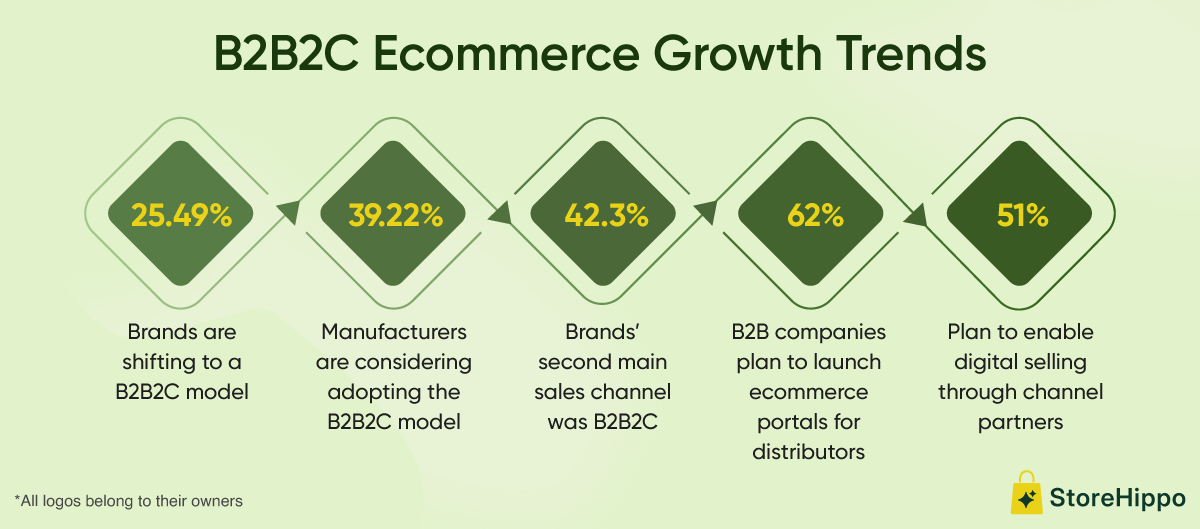
- 25.49% of brands are shifting to a B2B2C model
- 39.22% of manufacturers are considering adopting the B2B2C model
- 42.3% of brands’ second main sales channel was B2B2C
- 62% of B2B companies plan to launch ecommerce portals for distributors
- 51% plan to enable digital selling through channel partners
Source: Grand View Research, Copperberg, Adobe
These trends make one thing clear: businesses grow faster when all their channels, partners, and operations work together. Enterprises that can manage their partner network efficiently, automate routine tasks, and give buyers a seamless experience across every touchpoint will have a stronger advantage in the evolving ecommerce market.
Let's explore five Indian companies that have successfully built thriving B2B2C marketplace businesses by bringing together businesses, partners, and customers on a single platform.
5 Successful B2B2C Ecommerce Businesses in India
From mobility and food delivery to quick commerce and home services, these businesses have transformed their industries by building strong partner ecosystems and connecting every stakeholder through a unified digital platform. Here's a look at five leading B2B2C ecommerce businesses in India and the strategies driving their success.
1. Ola
Ola is one of India's largest ride-hailing platforms and a leading example of the B2B2C ecommerce business model. Founded in 2010 in Bengaluru, the company has changed the way people travel by bringing driver-partners and customers together on a single digital platform. Today, Ola offers cab, auto, bike, outstation ride, and courier services across more than 250 cities in India.
- 250+ cities across India
- Millions of customers served
- Over 1 million driver-partners
- One of India's leading ride-hailing platforms
Source: Ola, industry reports
Ola's success comes from building a strong partner network instead of investing in its own fleet of vehicles. It enables independent drivers to manage bookings, payments, and daily operations through one platform while helping the business expand quickly across new cities. This partner-led approach has allowed Ola to grow rapidly and build one of India's most successful B2B2C ecommerce businesses.
Enterprise takeaway: Ola shows how a connected partner ecosystem can help enterprises scale faster without making heavy investments in physical infrastructure.
2. Zomato
Zomato is one of India's most popular food delivery platforms and a leading example of a successful B2B2C ecommerce business. What started as a restaurant discovery platform in 2008 has grown into a large digital ecosystem that connects restaurants, delivery partners, and customers across hundreds of cities in India.
- 27 million+ monthly active customers
- 300,000+ restaurant partners
- 600,000+ delivery partners
- Part of Eternal, which enabled over $10 billion in transactions across its consumer platforms in FY26
Source: Eternal
Zomato's growth has been driven by its extensive restaurant and delivery partner network. Instead of managing restaurants or deliveries itself, the platform enables its partners to reach millions of customers while simplifying order management, payments, and fulfilment through a single platform. This partner-led model has helped Zomato expand rapidly while creating value for every stakeholder in its ecosystem.
Enterprise takeaway: Zomato shows how a unified B2B2C ecommerce platform can help enterprises scale by building a strong partner ecosystem instead of managing every operation themselves.
3. Blinkit
Blinkit has redefined quick commerce in India by making ultra-fast delivery of everyday essentials a reality. Founded in 2013 as Grofers and rebranded as Blinkit in 2021, the company has built a strong B2B2C ecommerce business by connecting local sellers, brands, dark stores, and delivery partners through a unified digital platform.
- 2,243+ dark stores across India
- Operates in 150+ cities
- ₹15,460 crore Gross Order Value (FY25)
- ₹2,400+ crore revenue from operations (FY25)
Source: Eternal Annual Report FY25
Blinkit's success comes from its hyperlocal fulfilment network. By enabling thousands of neighbourhood sellers and dark stores to fulfil orders through a single platform, it keeps inventory closer to customers and significantly reduces delivery timelines. This connected partner ecosystem has helped Blinkit scale rapidly while maintaining speed and operational efficiency across markets.
Enterprise takeaway: Blinkit shows how a well-connected B2B2C ecommerce platform can help enterprises build faster fulfilment networks by bringing sellers, inventory, and delivery partners onto one unified platform.
4. Urban Company
Founded in 2014 in Gurugram, Urban Company has become India's leading home services marketplace and a successful B2B2C ecommerce business. The platform has built a large network of skilled service professionals across categories such as beauty and wellness, home cleaning, appliance repair, plumbing, electrical services, pest control, painting, and more.
- 8.4 million annual transacting users (FY26)
- ₹4,290 crore Net Transaction Value (FY26)
- ₹1,556 crore revenue from operations (FY26)
- 10 million+ orders in Q4 FY26
Source: UC Investor Report
Urban Company's growth is built on a well-managed partner ecosystem. By bringing thousands of independent service professionals onto a single platform and supporting them with standardised onboarding, training, scheduling, payments, and quality processes, it has created a trusted marketplace that can scale consistently across cities and service categories.
Enterprise takeaway: Urban Company shows how a structured partner ecosystem and standardised operations can help enterprises build a scalable and trusted B2B2C marketplace.
5. Swiggy
Founded in 2014 in Bengaluru, Swiggy has grown from an online food delivery platform into one of India's largest B2B2C ecommerce businesses. Today, it operates in over 700 cities, connecting restaurants, merchants, delivery partners, and customers through a unified digital platform. Beyond food delivery, Swiggy has successfully expanded into quick commerce, dining-out, and pickup-and-drop services.
- 25.2 million monthly transacting users
- 700+ cities across India
- 45% year-on-year revenue growth in FY26
- ₹6,383 crore revenue in Q4 FY26
Source: Swiggy FY26 reports
Swiggy's growth has been driven by continuously expanding its partner ecosystem. By using the same technology and delivery network across multiple services, including Instamart and rapid delivery initiatives like Bolt, it has created new revenue opportunities while improving operational efficiency. This approach has helped Swiggy scale rapidly without building separate ecosystems for every new business.
Enterprise takeaway: Swiggy demonstrates how a flexible B2B2C ecommerce platform can support multiple business models and create new growth opportunities by building on a shared partner ecosystem.
The success of these B2B2C marketplace businesses shows that the right strategy and technology can help enterprises build scalable partner ecosystems and deliver exceptional customer experiences. If you're planning to build a B2B2C ecommerce platform like these industry leaders, the first step is choosing the right enterprise ecommerce platform.
How Can You Build a Successful B2B2C Ecommerce Business?
Building a successful B2B2C ecommerce business requires much more than launching an online storefront. As your partner ecosystem grows, managing distributors, dealers, vendors, inventory, orders, customers, and fulfilment across multiple channels becomes increasingly challenging. The right enterprise ecommerce platform should simplify these operations while giving every stakeholder a seamless experience.
If you're planning to build a platform like Ola, Zomato, Blinkit, Urban Company, or Swiggy, you need B2B2C ecommerce solutions that can support multiple business entities on a single platform without compromising performance or scalability. Your ecommerce platform should enable easy partner onboarding, automate product and order management, provide flexible pricing and commission management, integrate payments and logistics, and deliver unified experiences across every customer touchpoint.
As your business expands, it should also support multiple business models, AI-powered automation, unified omnichannel commerce, mobile-first experiences, and enterprise-scale operations. When you choose the future-ready platform from the start to build your B2B2C businesses, it becomes easy to streamline operations while accelerating growth.
How StoreHippo Helps You Build a Successful B2B2C Ecommerce Platform?
Building a successful B2B2C ecosystem requires technology that can connect every stakeholder while keeping operations simple. StoreHippo helps enterprises do exactly that.
Whether you're building a dealer network, a service marketplace, a franchise commerce platform, or a hybrid B2B2C ecosystem, StoreHippo B2B2C ecommerce solutions provide everything you need to launch faster and scale confidently.
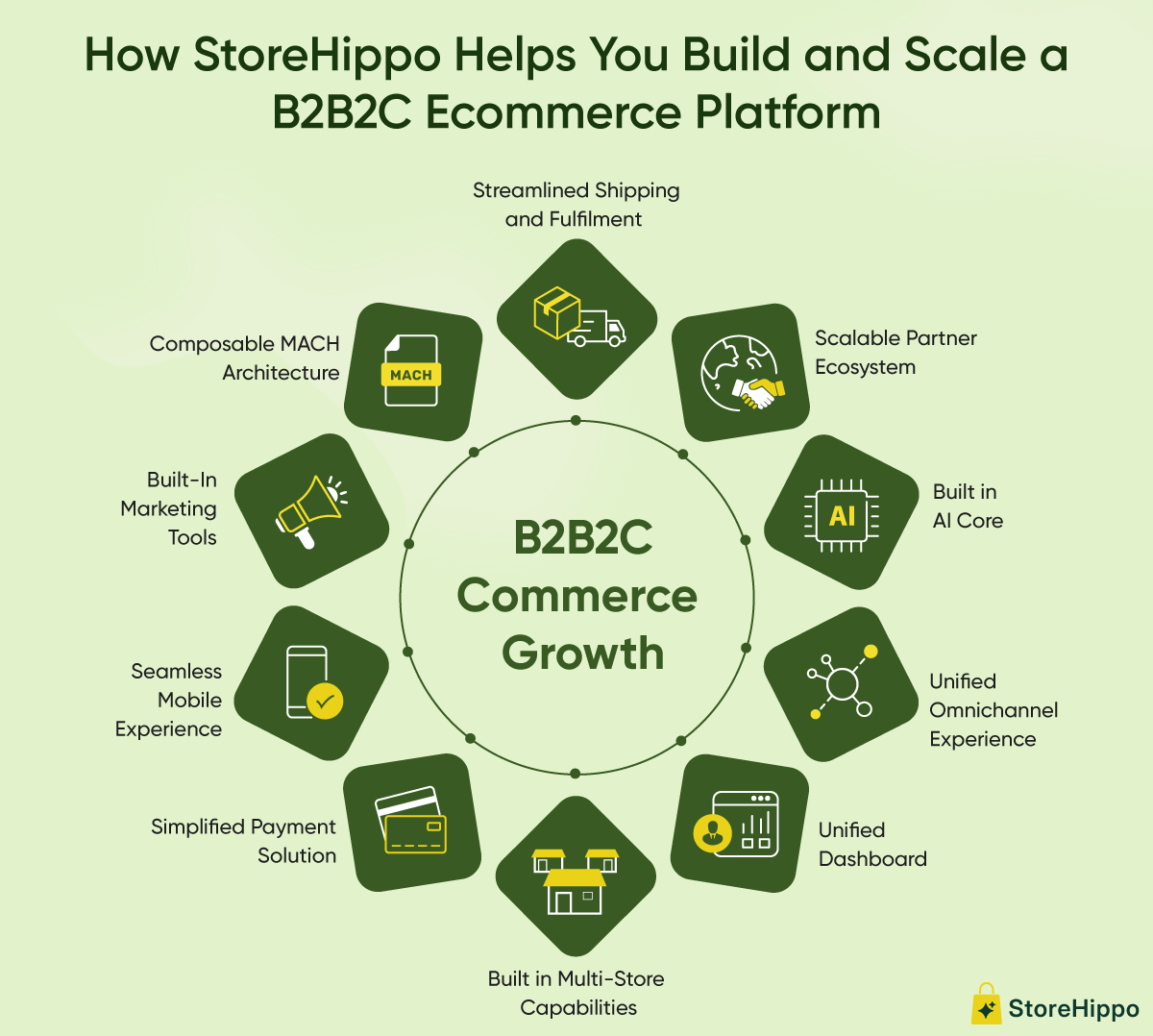
Here’s what StoreHippo offers:
1. Build and Manage a Scalable Partner Ecosystem
As your partner network grows, managing vendors, distributors, dealers, and sellers across multiple systems can become time-consuming. StoreHippo simplifies this by bringing partner onboarding, approvals, catalogue management, commission setup, discounts, settlements, and payments onto a single platform. This helps enterprises streamline partner operations while maintaining complete control as their ecosystem expands.
2. Use AI to Automate Commerce at Scale
AI is built into the core of StoreHippo's B2B2C ecommerce platform, helping enterprises automate catalogue creation, optimise product images with Magic Edit, deliver intelligent product discovery and recommendations, and deploy custom AI assistants. The result is faster operations, lower manual effort, and better buying experiences at scale.
3. Deliver Unified Commerce Across Every Sales Channel
Managing multiple sales channels separately often leads to disconnected inventory, orders, and customer experiences. StoreHippo enables enterprises to sell seamlessly across websites, mobile apps, WhatsApp, marketplaces, conversational commerce, and offline channels through a unified commerce platform. With every channel connected, businesses can deliver consistent experiences while simplifying day-to-day operations.
4. Manage Your Entire B2B2C Business from One Place
Running a growing B2B2C ecommerce business shouldn't require switching between multiple systems. StoreHippo brings products, inventory, orders, customers, vendors, fulfilment, and business operations together on a single dashboard, giving enterprises complete visibility and helping teams work more efficiently.
5. Scale Multiple Brands, Regions, and Storefronts from One Platform
Expanding into new brands, regions, languages, or partner networks shouldn't mean managing separate ecommerce platforms. StoreHippo's built-in multi-store capabilities allow enterprises to launch and manage multiple storefronts from a single backend while maintaining centralised control over products, inventory, orders, and business operations. This allows enterprises to expand into new markets without increasing operational complexity.
6. Simplify Payments Across Partners, Customers, and Regions
As transaction volumes increase, managing payments across multiple partners and markets becomes more challenging. StoreHippo B2B2C ecommerce solutions simplify payment with 60+ pre-integrated payment gateways, multi-currency support, and automated settlements, enabling enterprises to offer flexible payment options. This helps enterprises simplify payment operations while delivering a seamless checkout experience across every region and sales channel.
7. Launch Mobile Shopping Experiences Without Extra Development
With mobile driving a significant share of online purchases, delivering a seamless mobile experience is essential. StoreHippo's no-code mobile app builder enables enterprises to launch Android, iOS, and Progressive Web Apps (PWAs) without additional development, helping businesses reach customers across every device with fast, mobile-first experiences.
8. Boost Customer Engagement with Built-In Marketing Tools
Growing a B2B2C marketplace requires more than attracting customers, it requires keeping them engaged. StoreHippo offers built-in marketing tools including SEO features, personalised recommendations, loyalty programmes, QR codes, discount engines, abandoned cart recovery, push notifications, coupons, and targeted promotions to help enterprises improve conversions and encourage repeat purchases.
9. Scale Without Limits with Composable MACH Architecture
As business needs evolve, enterprises need technology that can adapt quickly. Built on a headless, API-first, cloud-native, and microservices-based MACH architecture with 350+ APIs, StoreHippo B2B2C ecommerce solutions give businesses the flexibility to integrate existing systems, customise workflows, and scale their partner-driven business without technology limitations.
10. Streamline Shipping and Fulfilment Across Your Business
Fast and reliable fulfilment is critical for delivering a great customer experience. StoreHippo integrates with 30+ logistics partners to automate shipping, enable smart order routing, provide live order tracking, optimise fulfilment, and support custom delivery boy management for in-house fleets. This helps enterprises streamline logistics while improving delivery efficiency across every sales channel.
With 300+ enterprise features, 350+ APIs, 120+ integrations, and built-in AI tools, StoreHippo eliminates plugin dependency and helps businesses launch and scale B2B2C ecommerce platforms with speed, flexibility, and confidence. Whether you're building a marketplace, dealer network, or service platform, StoreHippo provides the technology foundation to grow your business without operational bottlenecks.
Conclusion
The success of India's leading B2B2C ecommerce businesses shows that long-term growth is no longer driven by simply adding more sales channels. It comes from building connected ecosystems where partners, sellers, distributors, service providers, and customers work together through a single digital platform.
If you're planning to build a dealer network, distributor ecosystem, franchise platform, service marketplace, or B2B2C marketplace, choosing the right technology foundation is the first step. StoreHippo's AI-native enterprise ecommerce platform helps you launch and scale partner-driven commerce with unified operations, built-in automation, and the flexibility to support multiple business models as your business grows.
Ready to build a scalable B2B2C ecommerce platform?
Discover how StoreHippo’s B2B2C ecommerce solutions can help you launch faster, simplify partner operations, and build a future-ready commerce ecosystem.
Book your personalised demo today.
FAQs
1. What features should enterprises look for in a B2B2C ecommerce platform?
Enterprises should look for a B2B2C ecommerce platform that offers partner and multi-vendor management, support for multiple business models, unified commerce, AI-powered automation, headless MACH architecture, integrated payments and logistics, mobile commerce, multi-store capabilities, advanced marketing tools, and seamless integrations. These features help businesses streamline operations, scale partner ecosystems, and deliver consistent experiences across every sales channel.
2. How can businesses build a successful B2B2C ecommerce ecosystem?
Businesses can build a successful B2B2C ecommerce ecosystem by connecting distributors, dealers, sellers, service partners, and customers on a unified platform while automating partner onboarding, catalogue management, inventory, orders, payments, and fulfilment. Combining this with AI-powered automation, unified commerce, and seamless partner collaboration helps businesses scale efficiently and deliver consistent experiences across every sales channel.
3. How can enterprises build a scalable B2B2C ecommerce platform?
Enterprises can build a scalable B2B2C ecommerce platform by choosing a flexible platform that supports multiple business models, partner management, AI-powered automation, unified commerce, headless MACH architecture, and seamless integrations. A scalable platform should also centralise products, inventory, orders, payments, and fulfilment, enabling businesses to expand their partner ecosystem, enter new markets, and handle growing transaction volumes without increasing operational complexity.
4. How can AI improve the experience for businesses, partners, and customers in B2B2C ecommerce?
AI improves the experience for businesses, partners, and customers in B2B2C ecommerce by automating routine tasks, optimising catalogue management, enabling intelligent product discovery and recommendations, personalising buying journeys, and providing AI-powered assistants for faster support. This helps businesses improve operational efficiency, empowers partners to work more effectively, and delivers more relevant and seamless buying experiences for customers.
5. Why is unified commerce important for B2B2C businesses?
Unified commerce is important for B2B2C businesses because it brings products, inventory, orders, customers, partners, and business operations together on a single platform. This eliminates data silos, simplifies day-to-day operations, gives enterprises complete visibility across their business, and enables them to deliver consistent experiences across every sales channel.
6. How does omnichannel commerce benefit a B2B2C ecommerce business?
Omnichannel commerce benefits a B2B2C ecommerce business by connecting all sales channels, partners, and customer touchpoints through a single platform. This ensures consistent product information, inventory, pricing, and order management across websites, mobile apps, marketplaces, WhatsApp, and offline channels, helping businesses deliver seamless buying experiences while simplifying operations and improving efficiency.
7. Can a B2B2C ecommerce platform support multiple business models from a single platform?
Yes. A B2B2C ecommerce platform supports multiple business models by allowing enterprises to configure different storefronts, pricing, catalogues, workflows, user roles, commissions, and fulfilment processes from a single backend. Instead of managing separate platforms for B2B, B2C, D2C, marketplaces, dealer networks, or franchise operations, businesses can run them all on one unified platform while maintaining centralised control over products, inventory, orders, and business operations.
8. How does headless commerce improve a B2B2C ecommerce platform?
Headless commerce improves a B2B2C ecommerce platform by separating the frontend from the backend, allowing enterprises to build and customise different customer, partner, and seller experiences without changing the core commerce engine. This makes it easier to launch new storefronts, integrate third-party business systems, deliver consistent experiences across multiple sales channels, and scale the platform as business requirements evolve.
9. How can businesses simplify partner management in a B2B2C ecommerce model?
Businesses can simplify partner management in a B2B2C ecommerce model by using a unified platform that centralises partner onboarding, catalogue management, pricing, commissions, inventory, orders, payments, and settlements. Automating these processes and managing them from a single dashboard reduces manual effort, improves collaboration with partners, and helps businesses scale their partner ecosystem more efficiently.
10. Why should enterprises choose StoreHippo for B2B2C ecommerce?
Enterprises should choose StoreHippo for B2B2C ecommerce because it provides an AI-native, enterprise-grade platform designed to manage complex partner ecosystems at scale. With built-in support for multiple business models, partner and multi-vendor management, unified omnichannel commerce, composable MACH architecture, integrated payments and logistics, mobile commerce, and AI-powered automation, StoreHippo helps businesses launch, manage, and scale their B2B2C ecommerce operations from a single platform.
Binny Joseph is a seasoned ecommerce leader and Senior Vice President of Sales & Alliances with extensive experience helping enterprises build scalable digital commerce ecosystems. He shares practical insights on launching and growing B2B2C ecommerce platforms that connect businesses, partners, and customers on a unified commerce framework.