


The way B2B buyers research, compare, and place orders has changed dramatically over the last few years. Mobile apps have become a critical touchpoint throughout the buying journey, enabling procurement teams, distributors, retailers, and field sales teams to make faster purchasing decisions from anywhere.
As B2B ecommerce continues to evolve, enterprise buyers no longer view mobile apps as an additional convenience. They expect the same speed, personalisation, self-service, and seamless experiences they encounter in their everyday consumer interactions. Businesses that fail to meet these expectations risk losing buyers to competitors that offer more accessible and efficient digital experiences.
This shift has made B2B mobile apps a critical growth channel for wholesale brands, manufacturers, distributors, and online marketplaces. Beyond enabling transactions, modern B2B apps help businesses streamline operations, automate workflows, strengthen buyer relationships, and drive higher engagement across their partner network.
However, simply launching a mobile app is not enough. To deliver meaningful business value, your app needs the right set of features that simplify buying, improve productivity, and create seamless experiences for every stakeholder in the B2B ecosystem.
Table of Contents
- How Mobile Apps are Changing B2B Ecommerce Buying in 2026
- Why Enterprise Brands Should Build Their B2B Apps
- What Features Must a B2B Mobile App Have to Drive Enterprise sales
- How to Future-Proof Your B2B Mobile Apps for the AI Era
- Why StoreHippo is the Best B2B Ecommerce Platform for Mobile Apps
- Conclusion
- FAQs
How Mobile Apps are Changing B2B Ecommerce Buying in 2026
Mobile apps bring brands closer to buyers in a way no other channel can. As B2B purchasing becomes more digital and connected, mobile is emerging as the primary touchpoint for discovery, evaluation, and repeat buying.
The data below highlights how mobile-first omnichannel and conversational experiences are shaping modern B2B commerce.
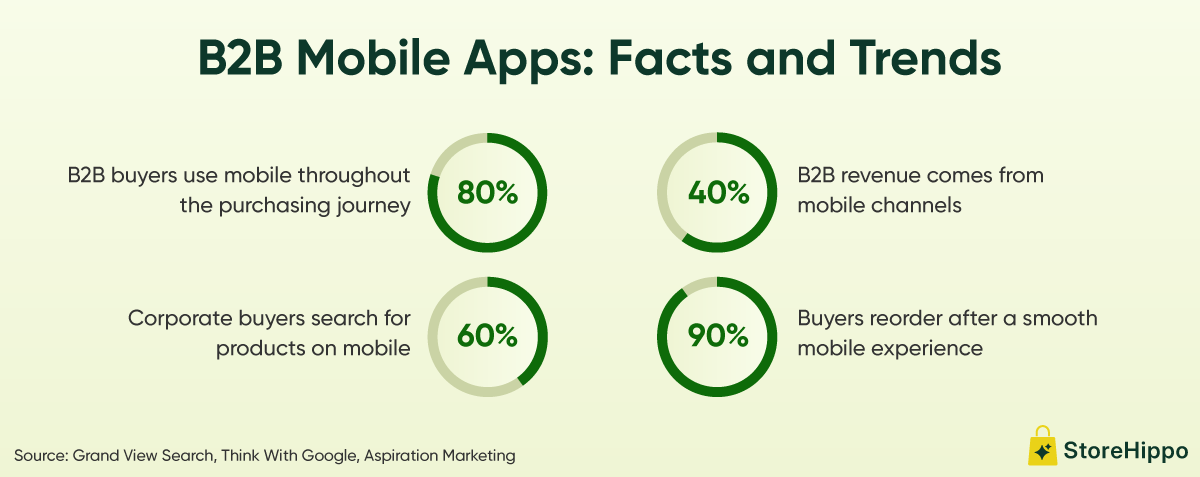
- 80% of B2B buyers rely on mobile devices throughout their entire purchasing journey
- 60% of corporate buyers specifically execute their product queries via mobile devices
- 40% of total revenue in leading B2B organisations comes from mobile channels
- 90% of B2B buyers are likely to reorder after a seamless mobile buying experience
Source: Grand View Search, Think With Google, Aspiration Marketing
Key takeaway: B2B buying is now mobile-first, with most buyers using apps across their entire journey. Brands that focus on mobile experiences are witnessing higher engagement and more repeat orders.
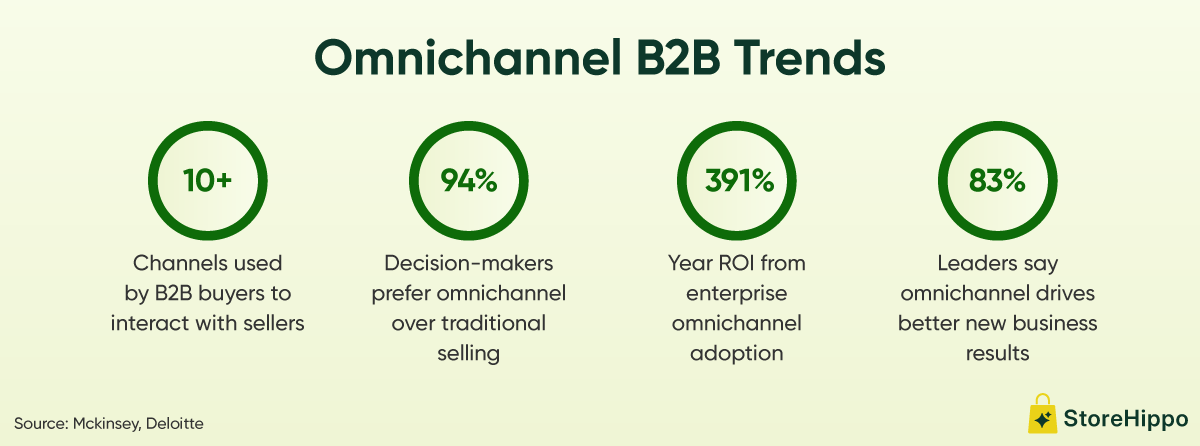
- 10+ channels B2B buyers use to interact with sellers throughout their journey
- 94% of B2B decision-makers say omnichannel models outperform pre-pandemic selling approaches
- 391% three-year ROI reported by enterprise B2B businesses adopting modern omnichannel platforms
- 83% of B2B leaders find omnichannel selling more effective for securing new business
Mckinsey, Deloitte
Key takeaway: Omnichannel strategies help enterprises grow faster by connecting every buyer touchpoint. It leads to better conversions and stronger business outcomes.
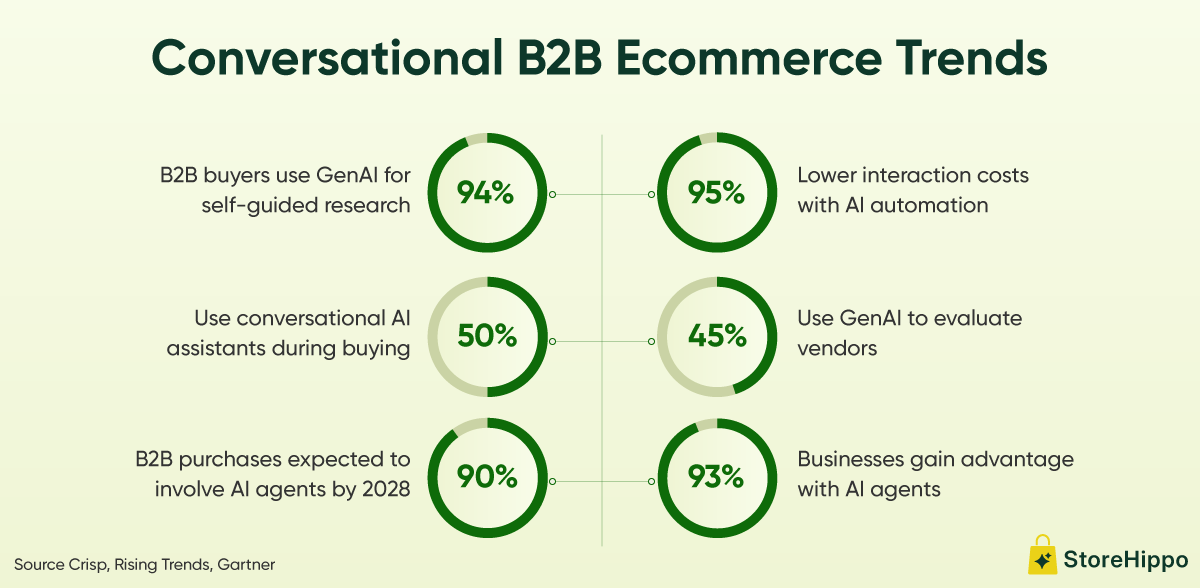
- 94% of B2B buyers adopted GenAI for self-guided research
- 50% of B2B buyers interact with contextual conversational assistants
- 90% of B2B purchases will be handled by AI agents by 2028
- 95% lower interaction costs by automating routine queries with conversational AI agents
- 45% of enterprise B2B buyers use generative AI channels to research and evaluate vendors
- 93% of ecommerce businesses gain a competitive advantage with AI agents
Source Crisp, Rising Trends, Gartner
Key takeaway: AI and conversational commerce transform B2B buying, with GenAI helping buyers research and make decisions faster. Businesses using AI lower costs, improve response times, and enable faster, smoother self-serve journeys.
The trends clearly show a strong shift toward mobile-first B2B buying. Mobile apps offer buyers flexibility, speed, and convenience, while giving businesses deeper visibility into buyer behaviour, better engagement through real-time interactions, and more personalised selling opportunities that directly support revenue growth.
Why Enterprise Brands Should Build Their B2B Apps
Building a marketplace app for their wholesale business helps brands introduce better engagement, efficiencies and conversions. Here are a few advantages of building a brand app for enterprise brands:
1. Enhanced Engagement
The biggest benefit of apps is that they literally open your shop on your clients’ phones. With apps, buyers tend to check your brand and its products/services more often and eventually tend to convert if you offer relevant deals.
2. Competitive Edge
With apps you not only leverage mobile commerce but also stand apart from your competitors. Your buyers perceive your brand as a modern brand that offers multi-channel engagement.
3. Fast and Efficient Orders
Mobile apps are fast and convenient for placing orders on the go. By enabling multi-level self-service, automated and personalised messaging marketplace apps can be used to make the wholesale sales process faster and more efficient.
4. Personalised Buyer Journeys
It is easier to build tailored and personalised buyer journeys by leveraging the inherent features of apps ( notifications, offers on the wishlist, real-time notifications, personalised promotions etc.) which enhance engagement.
5. Reduced Costs
If your B2B company has both marketplace B2B apps for customers and admin apps for your teams and vendors you can substantially save time and resources and reduce costs in the long.
6. Data-Driven Insights
Apps-data analysis give you in-depth insights which you can leverage strategically to improve inventory, order management, client engagement and eventually sales.
7. Effortless Communication
Apps make it possible to use multiple channels like WhatsApp, integrated chatbots, live chat etc., to connect with buyers effortlessly. By offering multi-channel interaction and support you can stay connected with your B2B buyers and make them loyal to your brand.
8. Ease of Payment
By 2022, only 28% of B2B brands are processing payments manually. More than 50% of B2B payments are done digitally now. B2B mobile apps offer seamless, secure and frictionless checkout thus enhancing user experience and sales eventually.
Having a multi-channel presence for your brand with offline and online stores and mobile apps goes a long way in establishing your business as a market leader. With customers showing a clear preference for mobile sales channels, it is imperative for wholesale brands to build their apps and leverage mobile commerce for growth.
What Features Must a B2B Mobile App Have to Drive Enterprise sales
Apps are intrinsic to your brand’s growth. However, just building B2B apps is no guarantee for success and better sales.
To make your apps work for your brand, you need to include the following features in your apps to maximise your ROI from your mobile sales channel.
Here are the features you need to incorporate in your B2B mobile apps: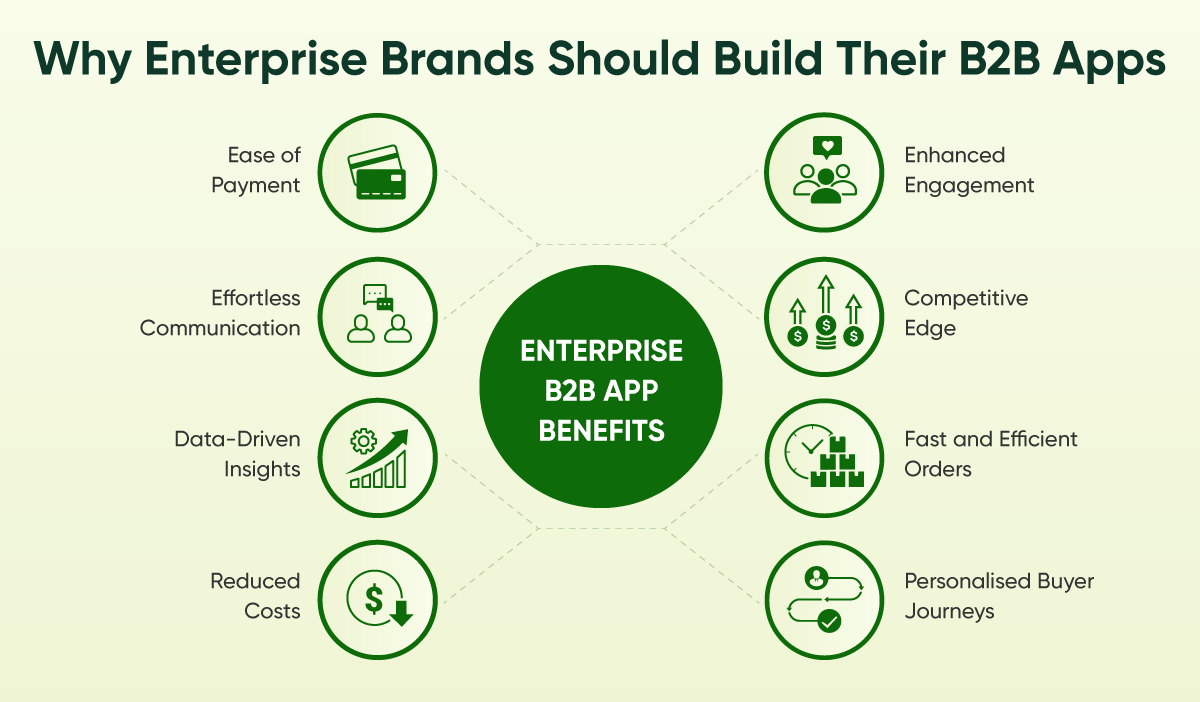
1. Beautiful Design and Seamless Navigation
The first thing that makes your apps sticky and conversion-oriented is your app design, easy navigation, seamless pinch and zoom and the ability to find desired products quickly. Add to this the ability to have multilingual content, and you have a winner in store.
A beautiful mobile app design not only attracts and retains your buyers but also creates a strong brand image. Responsive design optimised well also makes your app fast and enhances stickiness. Also, keep changing your themes depending on promos, offers or any other ongoing event activities, festivals, etc., you want to highlight.
Being consistent with your colour palette, branding, logo, product placement, establishing a visual hierarchy etc., goes a long way in making your brand stand out. High-quality images with 360-degree product views and videos also help your clients make an informed search using your B2B apps.
Offering seamless navigation so your clients can explore your site, move back and forth, and engage with more products and services through your app goes a long way in boosting your sales.
StoreHippo's B2B ecommerce platform comes with a rich theme designer for building amazing themes for B2B sites and apps. With the drag-and-drop feature and support for mix-and-match themes, you can build attractive and conversion-oriented themes in no time.
StoreHippo also offers multilingual support (including RTL languages) in themes, which adds a competitive edge to your branding and customer experience. With hierarchical, multi-level categories, advanced filters and faceted search, you can further simplify buying on your mobile apps.
2. AI-Driven Personalisation and Self-Service Features
The days when B2B ecommerce experiences were generic and one-size-fits-all are long gone. Today's business buyers expect the same level of convenience, relevance, and speed that they experience in their personal shopping journeys. However, B2B personalisation goes far beyond simply showing recommended products or sending targeted offers.
Enterprise buyers often operate within complex purchasing environments involving negotiated contracts, custom pricing, approval workflows, recurring orders, multiple stakeholders, and region-specific requirements. This is where AI-powered hyper-personalisation can make a significant difference.
Modern B2B mobile apps should be able to understand buyer behaviour, purchasing history, industry preferences, order patterns, and account-specific requirements to deliver highly relevant experiences at every touchpoint. From personalised catalogues and product recommendations to flexible pricing, customised promotions, content, language, and buying workflows, every interaction should feel tailored to the unique needs of each buyer account.
At the same time, buyers increasingly want the freedom to complete tasks independently without relying on sales representatives for every interaction. AI-powered self-service capabilities such as intelligent search, conversational buying assistants, automated reordering, RFQ management, order tracking, account management, and instant support help buyers find answers and complete transactions faster. This not only shortens sales cycles but also improves buyer satisfaction by giving customers greater control over their purchasing journey.
StoreHippo's AI-powered commerce platform enables enterprises to deliver these advanced experiences at scale. Its mobile-first architecture, MultiStore® capabilities, multilingual support, tiered and customer-specific pricing, discount engine, customised theme options, and location-based commerce features create the foundation for highly personalised buyer journeys. StoreHippo's AI-powered discovery, recommendations, conversational buying experiences, and intelligent automation further help enterprises deliver relevant, seamless, and efficient mobile commerce experiences that strengthen buyer relationships and drive long-term loyalty.
3. Multilingual Conversational Commerce
Most B2B buyers don't want to navigate complex portals or learn new software just to place an order. They prefer doing business the way they always have - through conversations. Whether it's checking product availability, requesting a quotation, reordering inventory, tracking deliveries, or resolving support queries, buyers increasingly expect these interactions to happen on familiar channels like WhatsApp.
A modern B2B mobile app should support conversational commerce across multiple languages, allowing dealers, distributors, retailers, and teams to engage in the language they are most comfortable with. This becomes even more important for businesses operating across diverse regions, markets, and partner networks.
With integrated WhatsApp commerce, buyers can browse catalogues, place orders, receive payment links, track shipments, request support, and get real-time updates without leaving the chat window. The result is faster order cycles, higher partner adoption, and a buying experience that feels natural rather than forced, helping businesses digitise operations while preserving the relationships and workflows their partners already prefer.
StoreHippo's AI-native B2B ecommerce platform enables enterprises to extend mobile commerce beyond traditional mobile apps through conversational buying experiences. Businesses can engage buyers across channels, automate routine interactions, support multilingual conversations, and create seamless ordering journeys that accelerate sales cycles and improve partner adoption. The result is a more intuitive buying experience that helps enterprises digitise their operations without disrupting existing business relationships.
4. Integrated Communication And Workflow Automation
Managing B2B transactions often involves multiple stakeholders, lengthy approval cycles, order clarifications, support requests, and constant coordination between buyers, sellers, distributors, and internal teams. When communication happens across disconnected channels, delays, missed updates, and operational inefficiencies become inevitable.
This is why modern B2B mobile apps need to go beyond order placement and become a central hub for communication and workflow management. Buyers should be able to raise queries, request quotations, track approvals, receive updates, communicate with account managers, and resolve issues without switching between multiple tools and channels.
Integrated communication capabilities help businesses keep all stakeholders informed throughout the buying journey, while workflow automation ensures that routine processes move forward without manual intervention. Automated notifications, approval workflows, order status updates, payment reminders, and support interactions help reduce response times and improve operational efficiency.
StoreHippo's AI-native ecommerce platform helps B2B enterprises streamline communication across buyers, distributors, dealers, vendors, and internal teams through a unified conversation dashboard. Its custom AI agents can handle order enquiries, RFQs, support requests, approval workflows, and routine operational tasks while maintaining context across channels. This helps businesses reduce manual coordination, accelerate decision-making, improve response times, and deliver a seamless buying experience across complex B2B networks.
5. Mobile-First Business Operations with Role-Based Experiences
In B2B commerce, business doesn't happen behind a desk anymore. Dealers place orders from stores, distributors manage inventory across regions, and field sales teams spend most of their time on the ground. Yet many businesses still rely on disconnected systems that require users to switch between calls, spreadsheets, emails, and desktop tools to get work done.
A modern B2B mobile app changes that by putting critical business operations directly in the hands of every stakeholder. Users can manage orders, inventory, payments, approvals, support requests, and business performance from a single mobile interface.
Just as importantly, every user should see an experience tailored to their role. A distributor can access regional inventory, dealer management tools, and bulk pricing, while a dealer sees only relevant products, negotiated rates, available credit limits, and reorder workflows. This role-based approach simplifies operations, reduces errors, and helps every partner work faster and more efficiently.
StoreHippo's mobile-first B2B ecommerce platform enables businesses to create tailored experiences for different user roles through features such as role-based access controls, tiered pricing, customer-specific catalogues, MultiStore® architecture, and workflow-driven operations. Combined with real-time business insights and reporting, enterprises can empower every stakeholder with the right tools and information to drive faster and more efficient business operations.
Now that you are familiar with the features needed to make your B2B app a success, it is time to find the best way of building your enterprise apps.
In the next section, we evaluate the best ways to create apps for your B2B company.
How to Future-Proof Your B2B Mobile Apps for the AI Era
Getting your B2B mobile apps ready for the AI era starts with choosing the right foundation. Enterprises can either build custom apps from scratch, which often requires significant time, investment, and ongoing maintenance, or go with a mobile-first commerce platform with a built-in app builder that enables faster deployment and scalability.
The real transformation begins when AI is embedded into the core of the platform rather than added as a separate layer. AI can automate routine workflows, personalise buyer experiences, improve product discovery, optimise operations, and support faster decision-making in real time. As a result, your mobile app becomes more intelligent, responsive, and capable of delivering better outcomes for both buyers and business teams.
At the same time, future-ready B2B mobile commerce is no longer about managing separate systems for mobile, web, and operations. The shift is towards a unified commerce ecosystem where everything works together seamlessly.
- Your catalogues, pricing, orders, and customer data stay in sync
- Mobile, web, and backend systems run on the same foundation
- You avoid disconnected tools and messy integrations
This setup also helps you move faster and scale easier:
- You launch features and apps much more quickly
- You’re ready across web, mobile app, PWA, and marketplace from day one
- You don’t need to rebuild systems as you grow
In short, AI-powered B2B mobile apps are not about adding more tools. They’re about having one connected system where commerce, mobile, and intelligence all work together smoothly.
Why StoreHippo is the Best B2B Ecommerce Platform for Mobile Apps
Mobile apps are essential for B2B companies planning to scale their business exponentially. With mobile sales channels becoming an integral part of everyone’s lives including B2B buyers, you need an enterprise platform that supports mobile commerce end-to-end.
StoreHippo not only offers customer-facing B2B mobile apps but also has apps for your admin teams and vendors. We also offer delivery boy apps so that your vendors can manage their fleet of delivery agents easily. StoreHippo has everything needed to run your business on the go.
We have evaluated the features required to boost your enterprise business through m-commerce, and StoreHippo offers all of these m-commerce features at one place. The plug-and-play solution from StoreHippo is powered by next-generation technology and an AI core.
StoreHippo’s AI core helps businesses automate catalogue management, improve product discovery, and deliver smarter, intent-based recommendations. Its AI-powered image optimisation (Magic Edit) helps maintain high-quality catalogues at scale, while enterprises can build custom AI assistants to support buyers, vendors, and internal teams with real-time support. Together, this creates a shared intelligence layer across your entire commerce ecosystem.
StoreHippo also supports a variety of business models like B2B, D2C, B2C, and B2B2C and comes with inbuilt solutions for multi-vendor marketplace, multi store, international ecommerce business and more.
Simply put, StoreHippo not only builds B2B mobile apps but provides you with a complete solution to build, run and grow your business across channels.
Conclusion
Mobile apps have evolved from optional digital touchpoints to essential growth engines for enterprise commerce. As B2B buyers increasingly prefer self-service, personalised, and mobile-first buying experiences, businesses need commerce solutions that can support these expectations at scale.
The most successful enterprise brands are building mobile experiences that combine intelligent automation, conversational engagement, personalisation, and data-driven decision-making. By investing in a future-ready B2B ecommerce platform, businesses can transform their B2B apps into powerful channels for growth, retention, and long-term competitive advantage.
Ready to win the m-commerce battle with B2B apps?
Explore StoreHippo B2B features and mobile app builder that has the potential to take your brand ahead of the competition.
Book your personalised demo now.
FAQs
1. What is a B2B mobile app, and how is it different from a B2C app?
A B2B mobile app is designed for business buyers, distributors, and sales teams to manage bulk purchasing, approvals, and reorders, while a B2C app focuses on individual consumer browsing and one-click purchases.
The key difference lies in complexity and workflows. B2B apps support negotiated pricing, role-based access, credit terms, and repeat ordering at scale, whereas B2C apps prioritise speed, discovery, and simplified checkout for individual transactions.
2. How do B2B mobile apps improve order cycle times for wholesale businesses?
B2B mobile apps reduce order cycle times by enabling buyers to browse catalogues, place bulk orders, and complete approvals directly from their mobile devices without relying on manual coordination or offline communication. This removes delays across sales, procurement, and fulfilment stages.
They also streamline reordering, automate workflows like pricing validation and approvals, and provide real-time inventory and order updates, helping wholesale businesses process transactions faster and move from enquiry to fulfilment with minimal friction.
3. Can B2B mobile apps support complex pricing like tiered and MOQ-based pricing?
Yes, B2B mobile apps can effectively support complex pricing models such as tiered pricing, MOQ-based pricing, contract pricing, and customer-specific rate cards by applying rules based on buyer type, order volume, and negotiated agreements. This ensures accurate pricing at every transaction stage.
It also helps enterprises to manage pricing consistency at scale by automating calculations, reducing manual errors, and ensuring each buyer sees the correct negotiated price in real time across products, categories, and regions.
4. What role does AI play in improving the performance of enterprise B2B mobile apps?
AI improves the performance of enterprise B2B mobile apps by automating repetitive tasks, optimising catalogue management, and delivering intelligent product recommendations that help buyers find what they need faster. This reduces friction and improves overall ordering efficiency.
It also enhances customer support through conversational assistants, enabling enterprises to streamline operations, reduce manual workload, and create a more responsive and data-driven mobile commerce experience.
5. Why are omnichannel capabilities essential for enterprise B2B mobile commerce?
Omnichannel capabilities are essential for enterprise B2B mobile commerce because they ensure buyers get a consistent experience across mobile apps, web portals, field sales, and offline touchpoints, while keeping data, pricing, and inventory fully synchronised in real time. This improves trust and reduces order errors.
It also enables enterprises to serve buyers wherever they are, speed up sales cycles, and unify operations across channels, leading to higher efficiency, better customer retention, and stronger long-term scalability.
6. How can enterprises ensure their B2B mobile apps remain scalable as buyer volumes, product catalogues, and order complexity grow?
Enterprises can ensure scalability in B2B mobile apps by choosing a platform built on API-first architecture that can handle growing buyer traffic, expanding catalogues, and increasingly complex order workflows without performance drop-off. This ensures smooth operations even during rapid business expansion.
They should also prioritise cloud-native infrastructure and automated catalogue and order management systems that reduce manual load, maintain speed, and support seamless scaling across regions, channels, and enterprise customers.
7. Why is it important for B2B apps to support both web and mobile experiences from a unified backend?
Supporting both web and mobile from a unified backend is important because it ensures consistent data, pricing, and workflows across all buyer touchpoints while eliminating duplication of effort and operational inconsistencies. This creates a seamless experience for users switching between devices.
It improves scalability and efficiency by centralising catalogue management, order processing, and integrations, allowing enterprises to launch updates faster, reduce maintenance overhead, and deliver a unified B2B commerce experience across channels.
8. How can enterprises reduce the total cost of ownership when launching B2B mobile apps?
Enterprises can reduce the total cost of ownership for B2B mobile apps by choosing a single, scalable enterprise ecommerce platform that eliminates the need for multiple custom-built systems, third-party plugins, and repetitive integrations. This lowers development, maintenance, and infrastructure expenses over time.
They should also prioritise cloud-native architecture, flexible APIs, and built-in commerce capabilities like catalogue, pricing, and order management, which reduce ongoing engineering effort and ensure faster updates with lower operational overhead.
9. How can enterprises use B2B mobile apps to improve distributor and dealer engagement?
B2B mobile apps improve distributor and dealer engagement by giving partners real-time access to catalogues, pricing, stock availability, and order status, making it easier for them to place and track orders without delays or dependency on sales teams. This strengthens collaboration and trust.
Mobile apps also support personalised pricing, targeted promotions, faster reordering, and self-service workflows, which increase engagement frequency, improve order accuracy, and help enterprises build stronger, more loyal distribution networks.
10. What security and compliance capabilities should enterprises prioritise in B2B apps?
Enterprises should prioritise security and compliance capabilities in B2B apps that protect sensitive business data, ensure secure transactions, and enforce controlled access across users, vendors, and internal teams. This is critical for maintaining trust and regulatory alignment at scale.
Key capabilities include role-based access control, end-to-end encryption, secure payment gateways, audit logs, multi-factor authentication, and compliant features that protect business data and ensure secure operations.
Pallavee Kumar brings over 20 years of hands-on ecommerce experience, having helped B2B enterprise brands scale through strong operations and clear storytelling. She combines deep industry expertise with practical insights to help businesses understand how to build and scale mobile-first ecommerce platforms that drive growth in the ecommerce landscape.